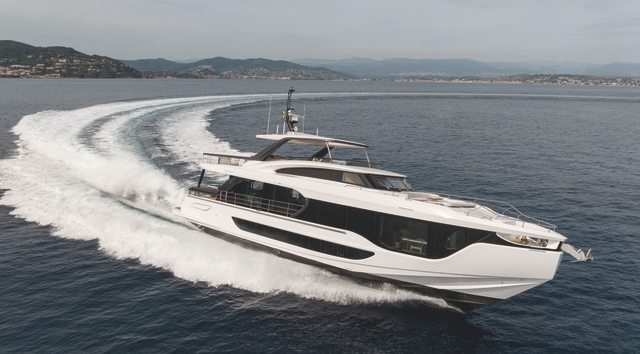
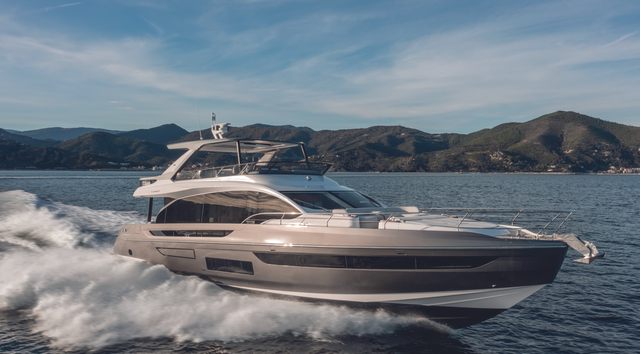
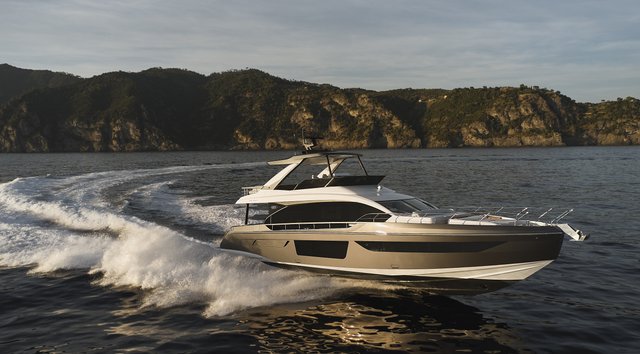
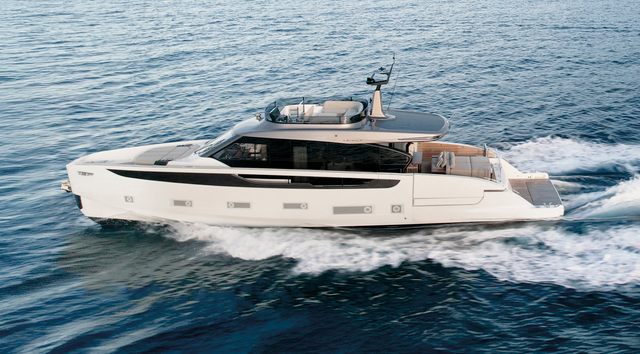
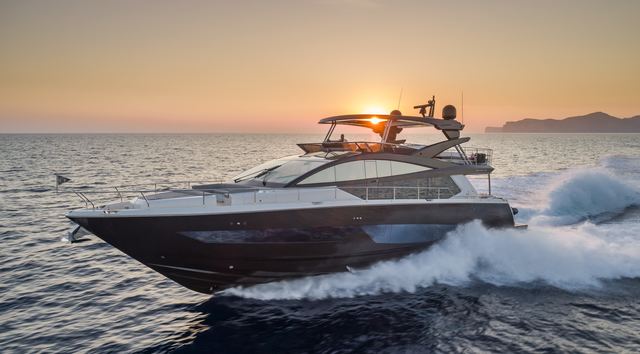
Azimut 80 (Mk2) Key Facts
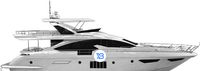
- LOA 25.2m
- Model Year 2018
- Cabins 4
- Crew 2
- Max Speed 30 knots
- Status Discontinued
- Generations 2
- Yacht Type Flybridge
- Use Type Cruising
- Vessel M/Y Deep Blue
Video Tour
On Deck
Aft, there is a lift platform for the tender, and that same area gives access to the crew cabin and the engine room. Shore power plugs in via a locker out here, and the stainless fittings in the platform take the chocks that hold the tender in place. Those chocks sit down in the engine space when not in use, so everything has its place.
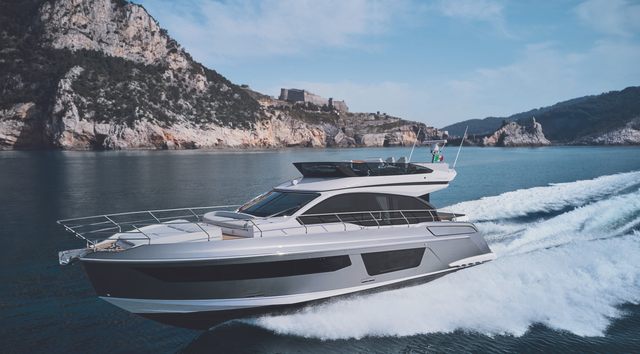
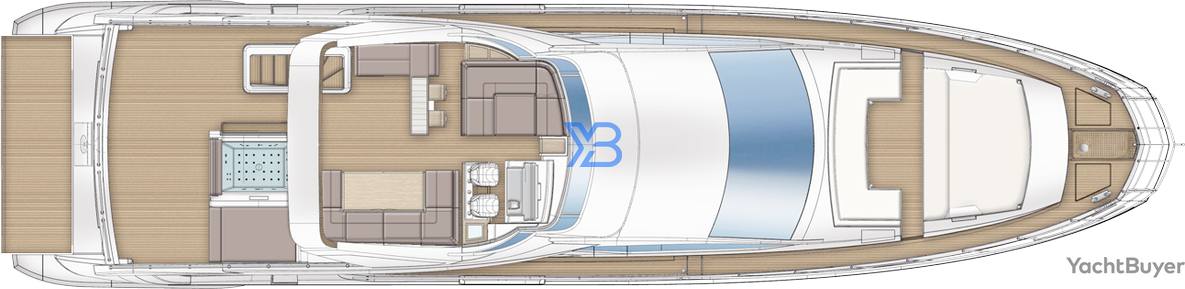
Head up to the flybridge and there is a hardtop, which on a day like this feels like a gift. A personal watercraft sits aft with a crane to launch it, and there is a grill right at the back, so cooking stays outside the main covered zone. An extending bimini rolls out to shade the aft section, and there is sunbathing space back there as well. Under the hardtop, you get a large dining area, space where you could add director chairs, a TV, and a substantial camera unit mounted up top. JL Audio speakers run through these exterior areas, and there is a bar unit with a fridge and an ice maker built in.
Side boarding doors sit on both sides of the main deck, and the side decks themselves have deep bulwarks with an overhang. The bulwarks are cut away at the right height, so from inside you look out across the water rather than into fiberglass, and yet the rail still does its job. Forward, there is a convivial bow area with seating and sunbathing, and a cabana style framework that lifts a sunshade over the space. Deck lockers are built in here, and you have an electric anchor winch, anchor controls, bollards, cleats, and a hatch over the forward cabin. The stainless trimmed plinth around the helm glazing gives the exterior a solid feel, and the galley side door lands you straight onto the side deck, which makes moving around easy and helps with ventilation when the weather behaves.
Interior Accommodation
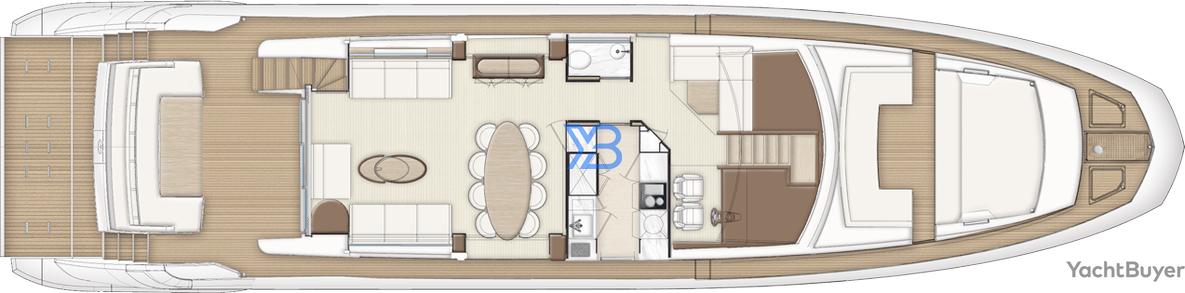
Step through the saloon door and the Italian build announces itself straight away. The sofas are proper home from home pieces rather than boat banquettes, and the coffee table sits between them with a big dining area forward on the main deck. Storage is built into the furniture, so crockery and drawers disappear neatly into cabinetry.
The galley sits forward on the main deck rather than aft, and it can close off with a sliding door across the opening. There is also a blind that drops down, so you can fully separate it if you want to. Refrigeration runs along one side, cooking equipment and extractor sit inboard, and there is a dishwasher tucked into the cabinetry. Two side access doors, one each side of the main deck, let you step straight outside, and that is useful for ventilation on humid days as well as for handling lines when short handed. A main deck day head sits close by, and that is not something you always see on an 24.4m (80ft) yacht.
The helm position sits forward with gentle separation, almost like a small pilothouse. There is a straight steering wheel, engine controls, Raymarine navigation screens, Bonning displays for engine data, and bow and stern thrusters. The view out should be excellent.
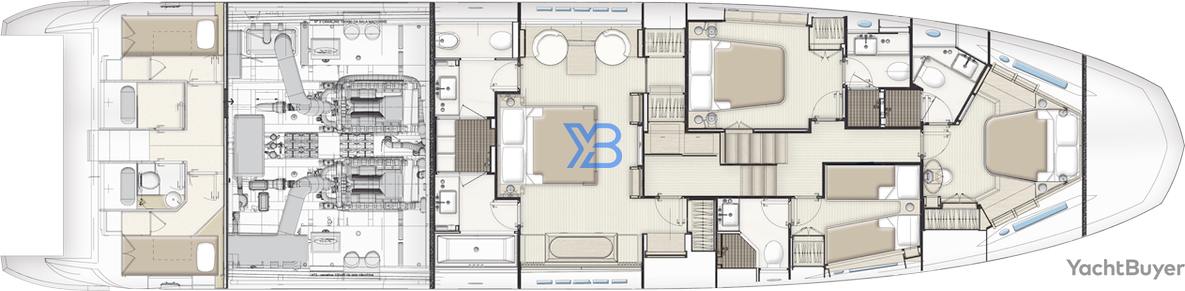
Head down to the lower deck and the layout is four cabins with four heads, so every cabin is en suite. A feature wall along the companionway stops the space from feeling flat, and the finishes start to play with contrast between pale matte tones and darker gloss surfaces.
Owner's Cabin
The owner cabin sits aft and runs full beam on this 24.4m (80ft) yacht, and before you reach it there is a lobby that handles real life. One side holds housekeeping gear such as towels and cleaning kit, and the other side houses laundry equipment, with Miele units specified. Floor to ceiling mirrors in this lobby open the space up visually.
You do not step straight into the cabin, as you first pass through another small dressing lobby with hanging lockers, drawers that feel like built in furniture, and a small seat for getting ready. Then the cabin opens out across the beam, and it feels generous for this length. AV equipment is built in, and storage units with neat opening sections hold remote controls and TV gear.
The en suite works as a dressing area first, so the loo is not front and centre. Drawers and hanging space run along the sides, and there is an opening port with a blind that drops down over it. Finishes mix a pale matte look with a dark high gloss, and the shower sits centrally with a rainfall head and proper scale.
There is a second door into a separate sink area, so two people can use different spaces at the same time, and the toilet sits behind its own privacy door. Storage continues into every corner. Behind a pocket door, a walk in wardrobe provides another hanging rail and enough room to move around without feeling boxed in.
Guest Accommodation
Forward in the bow is the VIP cabin, and it could pass as an owner cabin on many boats. There is extensive storage with a hanging rail, drawers beneath, and additional lockers. The finishes continue the Italian theme, with a deliberate contrast between light matte surfaces and very dark high gloss panels. Mirrored sections suggest a TV hidden behind them, which is typical for this style of fit out. The en suite sits behind the door and includes a sink and a separate rainfall shower.
A twin guest cabin sits aft of the VIP, with two single berths and a Pullman that drops down from above. When not needed, it lifts back up and disappears neatly. Air conditioning works hard on humid days like this, and you can hear it doing its job. Even though this is the smallest cabin on board, it still has its own en suite with a proper separate shower compartment, plus wardrobes and drawers for storage.
Opposite is a larger guest cabin with more floor space and shelving along the side. The finish palette shifts again, with high gloss dark wood, upholstered panels, pale matte wood, and a cream finish, so each area feels slightly different. The cabinetry reads more like furniture than simple lockers. This cabin also has full air conditioning, its own en suite, and a rainfall shower. That completes the three guest cabins, with the fourth cabin reserved for the owner aft.
Crew Accommodation
Crew accommodation sits aft with access off the transom, and it is more than the basic two berths and a heads you often find on a 24.4m (80ft) yacht. There is a small mess area, and two berths sit in a separate cabin. A microwave is fitted down here as well. Alongside is a second cabin for the captain. Headroom through the crew area is full standing. The crew head is a wet room with a shower curtain and a pull out shower wand.
Performance & Engine Room
Access to the engine room comes via the transom and also through an emergency route that exits straight into the cockpit, so you can reach the machinery space without stepping down onto the platform if conditions are rough. Lighting is generous, with multiple switches that properly illuminate the space.
Power comes from twin MAN V12 engines rated at 1,800 horsepower each, and that gives a top speed just under 30 knots. Cruise sits comfortably in the low to mid 20 knot range. At 12 knots, range is around 450 miles, and if you push up into the high 20s you can expect roughly half that range.
The engine room carries a fire suppression system, MAN control boxes, and twin Cummins Onan generators. Fuel tanks sit outboard of the engines, and battery charging equipment is mounted to one side. There are watermaker controls and the watermakers themselves are visible in the compartment. Exhaust systems run aft, and there is space to move down the sides of the engines for service access.
Hydraulic thrusters are fitted, with their control equipment in the engine room, and the benefit here is that they can run for extended periods without the thermal limits you find on some electric units. Shore power conversion equipment is installed as well, so voltage and frequency can be adapted when moving between countries. A monitoring screen is also fitted in the crew area, adding another layer of system oversight.
Ownership Considerations
With an asking price around $2.9 million, the 2018 Azimut 80 sits in a part of the market where buyers expect serious capability without stepping fully into 30m-plus territory. At 24.4m (80ft), it also crosses an important regulatory and operational threshold in many regions, and that has practical consequences.
First, scale. A yacht just over 24m is typically subject to more formal coding, survey standards, and in some jurisdictions additional registration requirements compared with sub-24m vessels. That does not make ownership difficult, but it does mean paperwork, compliance checks, and safety equipment are taken more seriously. Buyers planning charter use should factor in commercial coding, inspections, and crew qualification requirements from the outset.
Engine specification matters on the used market. Many Azimut 80s run twin MAN V12 engines, commonly in 1,550hp or 1,800hp form. The higher output version delivers stronger top-end performance, just under 30 knots in good conditions, but it will also carry higher fuel consumption at comparable speeds. Buyers comparing listings should check engine rating, service history, and total hours carefully, as rebuild and major service intervals on high output V12s represent significant scheduled expenditure.
Annual running costs for a yacht in this size range are commonly estimated at 10-15% of purchase price, depending on age, crew structure, and cruising intensity. On a $2.9 million yacht, that suggests a broad planning figure in the region of $290,000 to $435,000 per year. That envelope typically includes:
- Dockage or marina fees, which scale directly with length overall and location
- Insurance, often around 1-2% of insured value annually
- Engine and generator servicing, including MAN and Cummins Onan maintenance schedules
- Haul-outs, antifoul, and hull care
- Systems upkeep for hydraulics, thrusters, air conditioning, and watermakers
- Crew salaries, if carried
The Azimut 80 is equipped with twin generators, hydraulic thrusters, shore power conversion, and watermakers. These systems extend cruising range and international usability, but they also expand the service matrix. Hydraulic thrusters remove some of the thermal limits associated with electric units, yet they introduce pumps, lines, and fluid management into the maintenance picture. Shore power converters add flexibility when moving between 50Hz and 60Hz regions, though they are another high value electrical component to monitor.
Depreciation should also be considered in context. The Azimut 80 was part of the builder’s Flybridge Collection and production has now ceased, which places current examples firmly in the pre-owned market. Condition, refit history, electronics updates, and documented service records will influence resale value more than cosmetic styling trends. Well-maintained examples with complete engine and generator records typically hold stronger market position.
Finally, crew strategy shapes the cost profile. This layout provides genuine crew accommodation with two separate cabins and a dedicated head, so running with one or two professional crew is realistic. An owner-operator approach is possible, particularly for experienced skippers, but many owners in this segment opt for at least a captain for insurance and stress reduction. Crew choice has a direct and measurable impact on annual spend.
For buyers researching Azimut 80 running costs, 80ft yacht ownership expenses, or 24m yacht annual maintenance, the key point is that this is a true mini-superyacht in systems and structure. It offers ocean-capable build standards, large-engine performance, and long-range systems, and ownership should be budgeted accordingly.
Discover more about the Azimut 80, or explore the entire fleet by checking out all Azimut Yachts for sale. Alternatively, view all yachts for sale for other options.
Looking to own a Azimut 80? Use YachtBuyer’s Market Watch to compare all new and used Azimut 80 Yachts for sale worldwide. You can also order a new Azimut 80, customized to your exact specifications, with options for engine choice and layout configuration. Alternatively, explore our global listings of new and used yachts for sale and find your perfect yacht today!
Specifications
- Builder Azimut
- Range Fly
- Model Azimut 80
- Length Overall 25.2m
- Beam 6.18m
- Draft(full load) 1.97m
- Hull GRP
- Cabins 4
- Berths 5
- Crew 2
- Cruising Speed
- Max Speed
- Fuel Capacity 6,000 Litres
- Fresh Water Capacity 1,100 Litres
- Engine Model 2x MAN V12-1800
- Engine economic speed 10.4 knots
- Engine max range (speed type) 728 (nm)
Interested in a Azimut 80?
NEW Build
Find your local dealer for a personalised, no-cost consultation
or just request
Brochures & Pricing
Used & In Stock
Looking for a ready-to-go Azimut 80 or pre-owned options? Explore all inventory of the Azimut 80 available worldwide