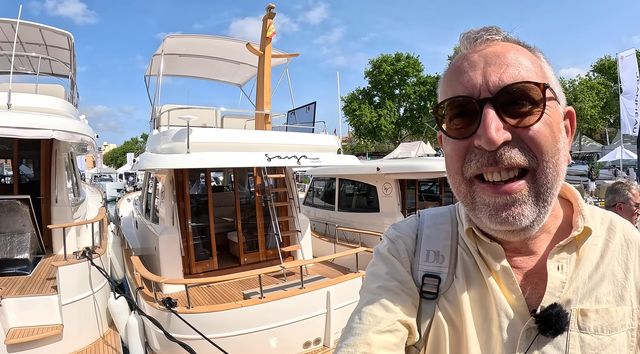
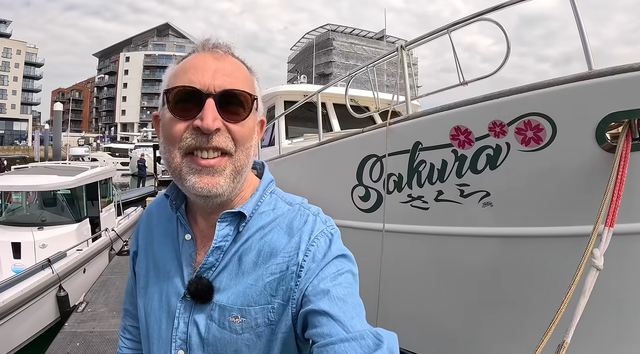
The Sasga Menorquin 48 FB comes from a very different school of thought to most modern 15m cruisers. Its rounded stern, deep overhangs and timber details draw on the traditional working boats of Menorca, while the semi-displacement hull, shaft drives and wide side decks point towards steady, owner-run cruising
Video Tour
Sasga Menorquin 48 FB At A Glance
Why you'll love it
- Semi-displacement hull suits steady cruising
- Wide side decks aid owner operation
- Galley-up or galley-down layout choice
Things to know
- Traditional styling
- 23-knot top speed is fairly modest
On Deck
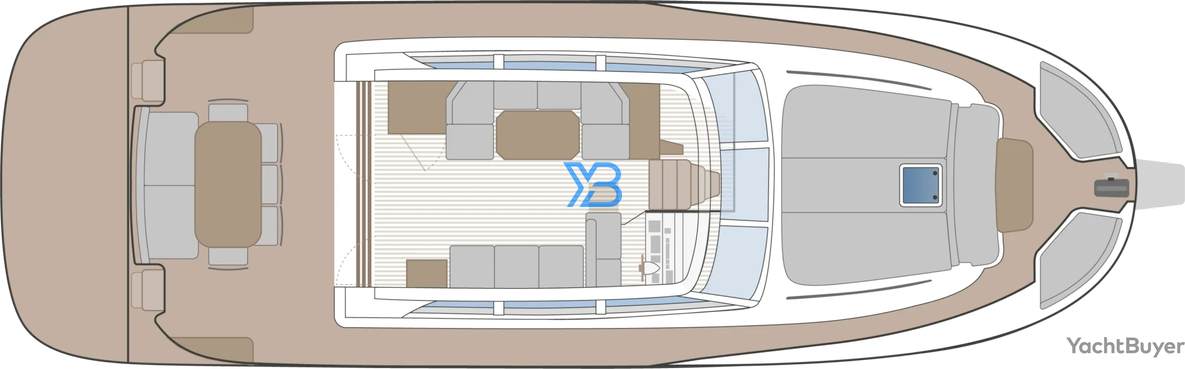
The rounded stern gives the Menorquin 48 FB much of its character, but there is plenty of practical stuff going on back here too. The bathing platform lifts to carry the tender, while the passerelle retracts into the stern and can extend, raise and lower for stern-to berthing. Gates close off the cockpit, and the whole arrangement feels straightforward rather than overdone.
The cockpit itself is a nice, comfortable family space. A big roof overhang gives plenty of shade, while the timber-lined ceiling and doors bring some warmth without making the boat feel too dressy. The aft doors fold and hinge right back, so you can open the saloon almost completely to the cockpit when the weather suits.
This is also a very easy boat to move around. The side decks are wide, there are rails where you want them and side boarding points make life easier when you are alongside. That fits the whole owner-run nature of the boat. There is no crew cabin here, and the 48 FB feels set up for a couple or family to handle themselves rather than hand everything over to crew.
Up forward, the deep overhang wraps around the front of the wheelhouse and shades the windscreen. That is a useful detail in the Mediterranean sun because it helps stop the glass and helm area becoming a heat trap. There are sunpads on the foredeck and a separate seating area right in the bow, which is a lovely place to sit underway. It also makes sense in harbour. When you are stern-to, it gets you away from the quay and gives you a bit more privacy.
The traditional touches are most obvious up here. The timber mast and raised anchor gear are a nod to the working boats this style came from, where similar fittings were used for ropes and nets. It gives the Menorquin a slightly old-school, little-ship feel, and on this boat it does not seem forced because the practical side of the design is still very much there.
The flybridge adds another proper living area rather than just an upper helm. The boat toured has a bimini for shade, sunbathing space aft and a folding table that can open out for meals or fold away when you want more room. There is also a bar area with another fridge, a small hob and a sink, so you do not need to keep heading below every time someone wants a drink or something to eat.
The helm seat is reversible and flips into position when needed. Ahead of it are the engine controls, thruster controls, multifunction display and autopilot, with the usual good flybridge view around the boat. Storage is tucked under the seats and in lockers around the deck, with the canopies kept up here as well. A hatch can close off the flybridge stair opening, which is useful in poor weather and handy if the upper deck is busy.
There is another nice bit of thinking in the cockpit floor. A large powered hatch lifts to open up the engine space, but the cockpit table would normally sit in the way. Sasga has put a release on the table so it can turn through 90 degrees before the hatch comes up. There is also a smaller access point for daily checks, so you do not have to open the whole thing every time you want to nip down and have a look.
Interior Accommodation
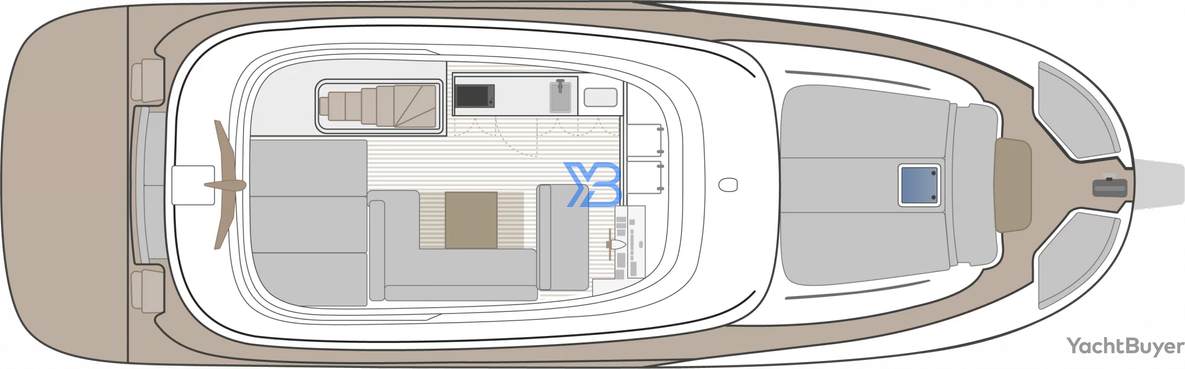
The saloon has the same warm, easy feel as the cockpit. The boat toured has the galley below, so the main deck is left as a full living space, with a big seating area, a height-adjustable table and storage opposite. Drop the table and the seating can turn into a daybed or an extra berth if needed. The TV rises from the cabinetry, while opening side windows and the sliding window beside the helm help keep plenty of air moving through the space.
The lower helm sits forward to starboard and keeps things pleasantly straightforward. There is a multifunction display, engine instruments, autopilot and bow and stern thrusters, plus those lovely old-school rocker switches for the wipers and other systems. It feels like a helm made for somebody who wants to use the boat themselves rather than stand back while someone else gets on with it.
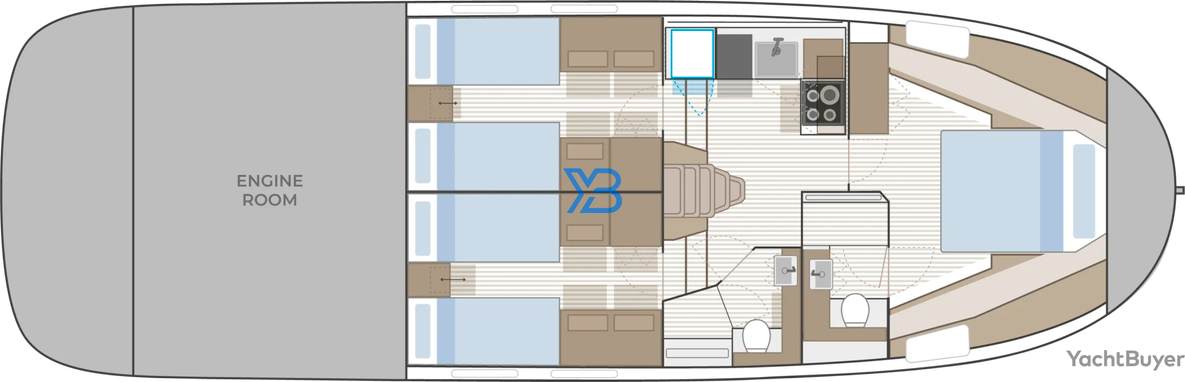
Head below and the galley is off to one side, with a fridge-freezer, electric cooking, a sink and a good amount of storage. It is a proper working galley rather than a token one, and keeping it down here means the saloon stays clear. That is only one way to do it, though, because Sasga will move the galley upstairs if the owner would rather give more of the lower deck over to the cabins.
Guest Accommodation
The owner's cabin is right forward and has a nice big feel to it. One detail stands out straight away - the bed is low. You are not clambering up onto it every night, which sounds like a small thing until you have lived with a high berth for a week. There is an en suite alongside with a separate shower, plus hanging space and more storage behind the glass panels.
Access panels get you to tanks and systems without much fuss, and one lower storage area can take a washing machine if the owner wants one. On the boat we toured, that space had simply been kept for storage. The day heads sits nearby and has another proper separate shower rather than turning the whole room into a wet compartment every time someone uses it.
The two guest cabins sit farther aft and are much the same as each other, with twin beds, hanging lockers, storage and hull windows. Full standing headroom helps them feel like proper cabins rather than spaces you only use when every other berth has gone. The fact that they are so similar also removes the usual argument over who gets the better one.
Owners who want more guest space can take the other route. Move the galley upstairs and one of these aft cabins grows into a much bigger VIP, with the bulkhead pushed farther out and its own en suite. The other cabin becomes smaller, with one berth running fore and aft and another set higher across it. That gives the boat three heads rather than the two fitted here, so the choice is really about how you expect to use the boat rather than which layout looks best on paper.
Performance & Engine Room
Engine access is unusually good for a boat of this size. A large powered hatch lifts from the cockpit floor to open up most of the machinery space, while a smaller access point handles daily checks. The cockpit table would normally sit in the way, so Sasga has put it on a release that lets it turn through 90 degrees before the hatch comes up. It is a small detail, but exactly the sort of thing that makes life easier once you start using the boat properly.
The Menorquin 48 FB we toured has a pair of Volvo Penta D6-480 diesels on V-drives, so there is just under 1,000hp in total. The V-drive arrangement lets the engines sit farther aft. Power runs forward into the gearbox and then back to the shafts, which keeps the machinery out of the accommodation rather than pushing it farther into the lower deck. Underneath, this is still a conventional shaft-drive boat, with shafts, propellers and rudders rather than pods or sterndrives.
The hull is semi-displacement, and that tells you quite a lot about the way the boat is meant to run. Top speed is around 23 knots, with a cruise of about 16 knots, so this is not a fast 15m cruiser and it is not trying to be one. The point is a steadier ride when the sea gets up. A planing boat may carry more speed, but once it starts to slam you soon know about it. The Menorquin is happier to push through at a lower pace without quite the same banging.
At around 16 knots, the quoted range is about 250 miles. Drop the speed back to displacement pace and it should go a good deal farther.
Down in the engine room, the generator sits alongside the main machinery, with fuel tanks outboard on either side and the hydraulic systems around them. The best bit is how easy everything is to get at. There is enough room to move around the engines, the main service points are visible, and the separate daily-check access means you do not have to lift half the cockpit every time you want to nip down and have a look.
Discover more about the Sasga Menorquin 48 FB, or explore the entire fleet by checking out all Sasga Yachts for sale. Alternatively, explore more choices by browsing all yachts for sale.
Pricing
Price as reviewed: €953,000 (£811,781 approx)
The Menorquin 48 FB is still new, so there is little used-market data yet. YachtBuyer MarketWatch will track resale prices as examples reach the brokerage market in our Sasga Menorquin 48 FB Prices section.
Looking to own a Sasga Menorquin 48 FB? Use YachtBuyer’s Market Watch to compare all new and used Sasga Menorquin 48 FB Yachts for sale worldwide. You can also order a new Sasga Menorquin 48 FB, customized to your exact specifications, with options for engine choice and layout configuration. Alternatively, explore our global listings of new and used yachts for sale and find your perfect yacht today!
Rivals to Consider
The Absolute Navetta 53 is probably the closest rival if the appeal of the Menorquin 48 FB lies in its slower, more comfortable cruising pace rather than outright speed. At 15.98m (52ft), with a 4.65m (15ft) beam, it has three cabins for six guests and a separate crew berth. Twin Volvo Penta D6-IPS650 engines produce 480hp each and give a top speed of around 24 knots, so there is very little between the two boats on outright performance. The big difference is how the space is used. The Absolute has a full-beam owner's cabin aft, a galley on the main deck and a more modern saloon with loose furniture, while the flybridge has U-shaped seating, a bar and a fixed bimini. Its semi-displacement hull also puts it in much the same cruising territory as the Sasga. The Menorquin feels more traditional and more owner-run, with V-drive shafts, wider use of timber and a layout that can put the galley below. The Absolute gives you a more contemporary interior and a dedicated crew option, but it loses some of the little-ship character that defines the Sasga.
The Okean 52 goes in a different direction. At 15.86m (52ft) long and 4.4m (14ft) across the beam, it still sits in the same basic size bracket, but its layout is more social and its machinery is more powerful. Three cabins sleep up to seven guests, with a midships owner's cabin, a double guest cabin and a third cabin with three berths. Twin Volvo Penta D8-IPS800 engines at 600hp each are a sizeable step up from the Menorquin's twin D6-480s, although the quoted top speed remains around 23 knots. That tells you something about the Okean's priorities. It is not simply chasing speed. The flybridge has U-shaped seating, sunpads, a wet bar and BBQ, while the main helm is central and has a sunroof above it. Fuel capacity is 1,600 litres, against 2,000 litres on the Menorquin 48 FB toured. The Okean gives you an extra guest berth, more installed power and a more open entertainment-led layout. The Sasga counters with conventional shafts, greater fuel capacity on the reviewed boat and a much more traditional look and feel.
The Beneteau Gran Turismo 50 is a more modern alternative and sits very close to the Menorquin on price. At around 16m (52ft) long with a 4.48m (15ft) beam and 1.18m (4ft) draft, it has three cabins for five guests and starts at around €950,000. Twin Volvo Penta D6-IPS650s produce 480hp each, with an estimated top speed of about 28 knots and roughly 250nm of range. That makes it the quicker boat, while the IPS set-up also gives it a very different feel from the Sasga's V-drive shafts. The layout is more sportscruiser than traditional flybridge cruiser, with the galley on the main deck, a full-beam forward owner's cabin with en suite and dressing area, a sunroof, foredeck seating and sunpads, plus a hydraulic bathing platform aft. The flybridge is also more tech-led, with provision for up to three 16-inch multifunction displays. Against that, the Menorquin gives you six guest berths rather than five, a more traditional interior and the semi-displacement character that is really the point of the boat. The Beneteau makes more sense if you want extra speed, a big-brand dealer network and a cleaner, more modern layout; the Sasga is the one for buyers who prefer the slower, more old-school way of doing things.
Considering a new yacht? Explore Sasga's entire current range to find the model that best suits your needs, and compare it with alternatives from competitors to ensure you make the perfect choice.
Specifications
- Builder Sasga Yachts
- Range Menorquín Fly Bridge
- Model Menorquin 48 FB
- Length Overall 15.2m
- Beam 4.85m
- Draft 1.1m
- Hull GRP
- Cabins 3
- Berths 5
- Cruising Speed
- Max Speed
- Fuel Capacity 2,000 Litres
- Fresh Water Capacity 750 Litres
- Engine Model 2x Volvo Penta D6-440/DPI
Interested in a Menorquin 48 FB?
NEW Build
Find your local dealer for a personalised, no-cost consultation
or just request
Brochures & Pricing
Used & In Stock
Looking for a ready-to-go Menorquin 48 FB or pre-owned options? Explore all inventory of the Menorquin 48 FB available worldwide