How to choose the right hull type for your style of yachting? Fast and exhilarating? Slow and steady? Or is efficiency your priority? Whatever performance you want from your yacht, there's a hull type to suit.
There is quite a selection of alternative hull designs, and with a growing emphasis on fuel efficiency, environmental impact, and range, the variety is increasing. We take a look at yacht hull design and advise on what to consider for your next yacht purchase.
- The Dawn of Speed
- How a Planing Hull Works
- What is a Vee Hull Design?
- Vee and Deep Vee Hulls
- Medium Vee Hull
- How do Modified Vee Hulls work?
- The Versatility of Semi-Displacement
- Displacement Hulls Explained
- Displacement Hull: Round Bilge
- Chine: Hard or Going Soft?
- Displacement and Hull Speed Explained
- Hull Speed Considered
- Fast Displacement Hulls
- Multihulls: Are Two Better than One?
- Trihedral (Cathedral) Hulls
- Frequently Asked Questions (FAQ)

Streamlined objects, whether it's an airplane fuselage or a knife, tend to excel in performance, regardless of their application. In the realm of yacht design, a sharp, narrow, and slender hull proves to be more efficient at navigating through water compared to a bulkier, boxier design.
Boxes, however, excel at efficient space utilisation: a wider, fuller hull is ideal for comfortable accommodation, spacious saloons and suites. This encapsulates the enduring challenge yacht designers have grappled with for decades.
There are three broad types to understand: displacement, semi-displacement and planing. These describe how a yacht's weight is supported by buoyancy and lift as speed increases. Terms such as deep-V, modified-V and round-bilge refer to hull shape. A deep-V hull can also be a planing hull, for example.

The Dawn of Speed
Displacement yachts push through the water without rising onto the plane, and a long, narrow hull can make efficient progress at modest speeds. A longer waterline allows a higher displacement speed, although a narrow hull can compromise cabin space.
If yacht speed is the less important factor, then choosing a slightly wider, fuller hull type will gain some extra internal space, losing only a little in cruising speed.
If you do have a need for speed, the space vs speed compromise is through the planing hull design. A planing hull has sections designed to generate lift, allowing the yacht to rise up and skim over the water's surface at high speeds.


Planing hulls were introduced in the early twentieth century, an innovation that revolutionised yacht culture by offering the thrill of high-speed cruising. A far cry from the luxurious planing yachts we have today, the early designs featured flat-bottoms that allowed for high-speed skimming across the water. They were responsive and fast, but incredibly uncomfortable.
The evolution of planing hulls progressed with the introduction of Raymond C Hunt's deep vee hull design. This design features a sharp entry at the bow and a pronounced V-shaped bottom. The angle of the hull bottom to the horizontal is called deadrise, and a deeper vee can soften the impact of waves at speed. However, more horsepower is generally required to generate the necessary lift.
As the deadrise became deeper, even more power was needed to get the yacht onto the plane. This high power requirement, especially for larger and heavier cruising yachts, made it costly and less efficient in terms of fuel consumption and overall operation.

Additionally, a deeper vee can also cost you usable space low down in the hull, particularly in smaller boats. So we are back at square one, with less interior space, only this time from faster, more expensive yachts.
The real eureka moment came not in a revolutionary moment but over decades of evolving hull design, calculating where the deeper vee sections had to be to deliver a smooth ride, and where they could flatten out to create both efficient lift and interior volume.
The modified vee hull design serves as the foundation for many fast-cruising yachts in use today. High-quality examples of this hull design offer a nimble, well-controlled, and smooth ride, efficiently transitioning the yacht onto the plane.
It’s also important to acknowledge the semi-displacement hull design for its significant, but less glamorous, contribution to yacht owner hull choice.
This design, as the name implies, combines elements of both displacement and planing hull types. Some have rounded sections and a keel, while others use harder chines and flatter aft sections to generate extra lift.
How a Planing Hull Works
A planing yacht hull works by using the lift generated by its high-speed forward motion to rise up and skim across the water's surface.
To get onto the plane, the boat needs to build enough speed for the water beneath the hull to generate lift. The transition is gradual, and the speed at which the yacht starts to plane depends on its size, weight and hull design.
As the yacht rises onto the plane, less of its hull remains in contact with the water. This reduces the wetted surface and helps control resistance, although higher speeds still demand considerable engine power.
Browse planing yachts for sale to see which models use this hull type.
What is a Vee Hull Design?
A vee hull is a boat hull design with a V-shaped bottom that can provide a more comfortable ride in choppy conditions. It can be designed for displacement or planing, depending on its intended use. The angle of the hull bottom to the horizontal is called deadrise: a flatter or lower angle generally generates lift more efficiently, while a deeper vee can soften the ride at speed in rougher water, although it may require more power.
The V-shaped bottom forms a sharper entry at the bow, so when the boat encounters waves or rough seas, the hull helps slice through them and soften the impact. Many fast planing yachts also use vee-shaped hulls.
Vee hulls are found on everything from cruising yachts to fishing boats and fast offshore craft. Fuel efficiency depends on the hull's overall design, weight and speed, not simply the amount of vee.

Vee and Deep Vee Hulls
A deep vee hull is a specific type of vee hull design characterised by a sharp and pronounced V-shaped bottom, typically with a deadrise angle of around 20° or more at the transom. The sharp entry helps soften the impact of waves at speed, although a deep vee usually requires more power than a shallower hull of comparable size and weight.
Deep vee hulls are versatile and used for offshore fishing boats, high-performance powerboats, and some larger recreational cruisers due to their ability to handle various sea conditions.
Yacht owners often choose deep vee hulls for their ride comfort at speed in choppy water and their offshore handling. There are trade-offs, though. The extra deadrise can increase fuel consumption, and some deep vee boats roll more at rest than shallower hulls.
Our XO EXPLR 44 sea trial provides a good example of a modern deep-V hull at work. The 13.4m aluminium boat reached 45 knots and remained composed across its own wake at almost 40 knots, although conditions were relatively calm and the Seakeeper Ride system also helped.
At a Glance Vee Hulls
Pros
- High speed
- Comfortable ride
- Good grip and directional stability
Cons
- Roll at rest
- Fuel consumption
- Deeper draft can be restrictive


Medium Vee Hull
A medium vee hull falls between a shallow vee and a deep vee hull in terms of its V-shape angle or deadrise. There isn't a precise standard for what constitutes a "medium" vee, although typically it refers to a deadrise angle of approximately 15 to 20° at the transom.
This hull design strikes a balance between stability and wave-handling capability, and is therefore found in a wide range of boat types, including runabouts and smaller fishing boats. Their design allows them to perform well in various conditions, from relatively calm waters to moderately rough seas.
A medium vee yacht hull can achieve a fairly good balance between speed and fuel efficiency.
Medium Vee Hull At A Glance
Pros
- Efficient cruising performance
- Speed and comfort
- Generally more stable at rest than deep vee hulls
- Effective wave handling in moderate conditions
Cons
- Can require more power than shallower vee hulls
- Firmer ride than deep vee hulls in steep chop


How do Modified Vee Hulls work?
Combining elements of flatter-bottomed and deep vee designs, a modified vee hull generally has a sharper entry at the bow and less deadrise towards the stern. There is no fixed deadrise angle that defines a modified vee, and the term can overlap with medium vee hull designs.
A modified vee hull offers better stability at rest compared to deep vee hulls, making them suitable for activities like fishing where stationary stability is important; although not as effective at cutting through waves, they do provide a reasonably comfortable ride in moderately choppy conditions.
A modified vee hull is a versatile and balanced option for recreational boaters, with the shallower aft sections potentially providing more usable space inside than a deeper vee of similar size.
Modified Vee Hulls At A Glance
Pros
- Good internal volume
- Efficient cruising
- Comfortable cruising
- Stability at rest
Cons
- Firmer ride than a deep vee in steep chop
- Can require more power than a flatter hull


The Versatility of Semi-Displacement
The best of both worlds? Unlike planing hulls, that aim for high-speed performance, or full displacement hulls that prioritise stability and efficiency, the semi-displacement hull strikes at the middle ground, and has delivered some of the best cruising yachts ever built.
The clever bit about a semi-displacement hull is its ability to operate at quite different speeds. At lower speeds, it behaves much like a displacement hull, with good fuel economy and a relaxed ride. Push the throttles forward and the hull gains some lift, allowing it to travel faster without fully climbing onto the plane. That extra pace comes at a cost in fuel, but it's a useful option to have.
Semi-displacement yachts are popular for those who appreciate the ability to explore at a leisurely pace, with the option to pick up the pace when required. At modest speeds, some designs also have excellent range.
The difference is clear in our Sirena 48 sea trial. The semi-displacement hull felt happiest at around 15-16 knots, but our estimated range fell from 500-600nm at 8-10 knots to roughly 200nm at 16-17 knots. There's a price to pay for that extra speed.
Semi-displacement yachts can have excellent seafaring qualities. A fine entry at the bow helps soften the impact of waves, although no hull can eliminate slamming altogether. Where fitted, a keel can also help the yacht hold its course.
The hull sections typically have a round bilge, characterised by a smooth and rounded form that extends to the waterline. Some designs may incorporate additional smaller bilge keels on each side to further enhance stability and assist during beaching for drying out.
As an alternative, some semi-displacement designs opt for a squarer hull shape, with a hard chine or edge at the waterline. These harder chines and flatter aft sections can generate extra lift as speed increases, although ride quality depends on the individual hull design and sea conditions.
Browse semi-displacement yachts for sale to compare models with different cruising speeds and ranges.
Semi-Displacement Hulls At A Glance
Pros
- Wider choice of cruising speeds
- Good long-range potential at modest speeds
- Stability
- Fuller hull designs can offer more interior space
Cons
- Higher fuel use at faster cruising speeds
- Generally slower than comparable planing yachts


Displacement Hulls Explained
A displacement hull, often referred to as a full displacement hull, is designed primarily for slow and efficient cruising through the water. The primary principle behind this yacht hull design is to displace, or move aside, the water as the yacht moves forward, rather than trying to rise up onto the water's surface, as planing hulls do.
Despite their modest speed, many full-displacement yachts are built for ocean passages, although they can roll in a beam sea. A keel can help the yacht hold its course, while stabilisers, where fitted, can reduce that movement and improve comfort.
Displacement hulls can offer excellent fuel economy and range at modest speeds. Many yachts of this type have fuller hull sections that provide spacious interiors, although not all displacement designs are wide or offer generous accommodation.
Our Nordhavn 75EYF onboard review puts that trade-off into perspective. The 22.7m (74ft 5in) yacht has a quoted range of around 3,200nm at 7.5 knots and a top speed of approximately 12 knots. It's built to cross oceans, but nobody is going to mistake it for a fast sportsfisher.
Browse displacement yachts for sale to compare long-range cruisers and ocean-going passagemakers.
-
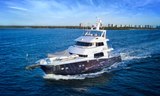 ON BOARDNordhavn 75EYF Review (2009 Edition)
Displacement Hulls At A Glance
Pros
- Good range at modest speeds
- Strong load-carrying potential
- Generous accommodation on fuller designs
Cons
- Can roll in beam seas
- Limited top speed

A displacement yacht's useful cruising speed is strongly influenced by its waterline length. A longer waterline generally allows a higher speed before wave-making resistance climbs steeply.
Displacement Hull: Round Bilge
Characterised by its smoothly rounded shape below the waterline, the term "round bilge" refers to the hull's cross-sectional shape, with no sharp chine where the bottom meets the sides. This form is common on displacement yachts, where a well-designed hull can offer excellent fuel economy and long cruising range at modest speeds.
Round-bilge hulls can deliver a comfortable ride at sea, but the shape alone doesn't guarantee stability. Some yachts roll quite noticeably in a beam sea, which is why bilge keels or stabilisers are often fitted. Whether passengers feel seasick depends on the yacht's overall motion, not simply the shape of its bilges.
As with other conventional displacement hulls, this isn't the design a yacht buyer would choose for outright speed. Push far beyond its characteristic hull speed and wave-making resistance rises steeply, so a little extra pace can demand considerably more power.

Chine: Hard or Going Soft?
A chine refers to a distinct edge or angle on the hull where the bottom of the hull meets the sides (or topsides). The presence or absence of chines can significantly influence a boat's performance, handling, stability, and overall design characteristics.
Yachts with hard chines have a clear, well-defined transition between the two surfaces, and are often associated with planing hull designs, where the chine plays a role in providing lift and stability as the boat rises onto the plane.
Whereas a soft chine features a more gradual, rounded transition between the bottom of the hull and the sides, resulting in a smoother and less angular appearance along the hull's edges.
Hard chines can help throw spray clear of the hull and generate lift at speed, particularly when they incorporate a flat section. But a sharp chine doesn't automatically make a yacht faster, any more than a rounded bilge guarantees a comfortable ride. The overall hull shape, weight and intended cruising speed all have a part to play.

Displacement and Hull Speed Explained
Hull speed is a useful rule of thumb for a conventional displacement yacht, but it isn't a firm speed limit. It's based on waterline length (LWL), the length of the hull where it meets the water. As a yacht approaches its characteristic hull speed, wave-making resistance can rise sharply, so another knot may need a surprising amount of extra power. A longer waterline generally allows a higher hull speed.
But hull speed doesn't tell you the most economical speed to cruise. A yacht may travel much farther on the same fuel at a lower speed, and the best range depends on the hull, engines, load and conditions. Nor does a number on a chart guarantee a smooth ride. A skipper still needs to choose a speed that suits the sea.
Approximate Hull Speed by Waterline Length
| LWL | Speed |
|---|---|
| 10m | 7.6 knots |
| 15m | 9.4 knots |
| 20m | 10.8 knots |
| 30m | 13.2 knots |
| 50m | 17.1 knots |
| 100m | 24.2 knots |
*These figures are theoretical estimates based on waterline length, not actual top speeds or the most economical cruising speeds.
Fast Displacement Hulls
By increasing lift at higher speeds, a fast displacement hull aims to combine the efficiency and seakeeping qualities of a displacement hull with the potential for higher speeds. These designs can perform well across a broader range of cruising speeds, although not every fast displacement yacht will rise fully onto the plane.
Van Oossanen's patented Fast Displacement Hull Form (FDHF) is a well-known example, developed to reduce resistance across a wide speed range. It allows for economical cruising at modest speeds, with the option of a faster passage when required. Extra speed still comes at a cost in fuel, but the flexibility can be useful for owners who cover long distances and occasionally need to make quicker passages.
Browse fast displacement yachts for sale to compare cruising speeds, range and performance.
Fast Displacement Hulls At A Glance
Pros
- Efficient across a range of speeds
- Good range at modest speeds
- Higher speed potential
Cons
- Higher fuel use at faster speeds
- Not all designs reach planing speeds


Speed and Superior Performance
When looking at speed and performance, it's interesting to look at the innovative designs of hydrofoil hulls and high-performance hulls. In recognition of their distinctiveness and the keen interest surrounding their hull designs, we have separate articles dedicated to each.


Multihulls: Are Two Better than One?
A monohull (mono, as a prefix, meaning ‘one’ or ‘only’) is a single hull, whereas a ‘multi’ hull is a vessel featuring multiple hulls: typically two, a catamaran or even three, a trimaran.
Multihulls boast a distinctive design and are popular for their exceptional stability. Their widely spaced hulls create a solid base, with far less heel than most monohulls. However, they aren't immune to capsizing, and their motion at sea isn't always more comfortable. That broad, level platform remains a big attraction for family cruising and charter holidays.
Catamarans can be fast and efficient. Their long, slender hulls can reduce wave-making resistance at certain speeds, but they don't necessarily have less wetted surface or use less fuel than a comparable monohull.
For interior space, a 'cat' is hard to beat, with wide saloons and generous outdoor areas. Cabins within the narrower hulls can be less spacious than you might expect, though, and fuel and water capacity vary considerably between models.
Our Prestige M8 boat test demonstrated both sides of the argument. Its 8.85m (29ft) beam gives enormous living space, but beam-on swell at slow speed caused more rocking than we'd expect from a stabilised monohull.
Browse multihull yachts for sale to compare catamarans and trimarans, from family cruisers to large superyachts.
Catamarans At A Glance
Pros
- Lateral stability
- Generous deck and saloon space
- Often shallower draft
- Good efficiency on some designs
Cons
- Wide marina berths can cost more
- Bridge-deck slamming in certain seas
- Narrower cabins in individual hulls


Trihedral (Cathedral) Hulls
A trihedral, or cathedral, hull might look like a multihull from the bow, but it's actually one connected hull. It has a central vee with smaller V-shaped sections on either side, separated by channels that run along the bottom. The result is a broad, stable platform that can get onto the plane at relatively low speeds.
There's a catch, though. Those outer hull sections can slam hard against waves, so cathedral hulls aren't always comfortable at speed in choppy conditions. They're more common on smaller fishing boats and workboats than large motor yachts, where their stability at rest and load-carrying ability can be more useful than outright performance.
Trihedral Hulls At A Glance
Pros
- Good stability at rest
- Strong load-carrying ability
- Can plane at modest speeds
Cons
- Harsh ride in choppy seas
- Slamming and spray at speed


Frequently Asked Questions (FAQ)
What Yacht Hull Design is Best for Stability?
Multihulls are famous for their stability, and for good reason. The wide-set hulls of a catamaran create a broad platform that heels very little and tends to roll through smaller angles than an unstabilised monohull at rest.
However, strong initial stability doesn't guarantee a comfortable ride in every sea. Catamarans can have a short, sharp motion in waves, and they aren't immune to capsizing. The yacht's design, weight distribution and sea conditions all play a part.

What Yacht Hull Design is Best for Spacious Accommodation?
For deck and saloon space, a catamaran is hard to beat. Its wide beam gives designers plenty of room to work with, although guest cabins within the individual hulls can be narrower than you might expect.
Monohulls have advantages of their own, particularly when it comes to deep lower-deck accommodation and full-beam owner's suites. Some large power catamarans also offer cabins that stretch across both hulls.
Ultimately, it's worth comparing the actual layouts, beam and internal volume of individual yachts. Hull type alone won't tell you which has the most usable space.


What Yacht Hull Design is Best for a Beginner?
A semi-displacement yacht can be a sensible choice for a first-time owner, but it isn't automatically easier to handle than other hull types.


Clear views from the helm, predictable low-speed control and manageable size are far more important for beginners. Semi-displacement yachts offer a useful choice of cruising speeds, with good economy at modest speeds and the option to pick up the pace when conditions allow.
Whatever the hull type, time at the helm and proper training will count for more than the shape of the boat.
What Yacht Hull Design is Best for Speed?
For most conventional motor yachts, a planing hull is the obvious choice for outright speed. As the yacht accelerates, the hull generates lift and rises higher in the water, which allows it to travel faster than a conventional displacement yacht.

But lots of fast offshore yachts use deep-V planing hulls. Their sharp entry helps soften the impact of waves at speed, although the extra deadrise can demand more horsepower than a shallower hull. A deep-V isn't a separate alternative to a planing hull. It's one of the shapes a planing hull can take.
What Yacht Hull Design is Best for Efficiency?
There's no outright winner here. A well-designed displacement yacht can cover remarkable distances on relatively little fuel at modest speeds. Some power catamarans are also highly efficient, as their slender hulls can reduce wave-making resistance.

However, two hulls can mean more wetted surface area, so a catamaran isn't automatically more economical than a monohull. Planing hulls have their own efficient cruising speeds, although fuel consumption can rise sharply outside that range.
For a fair comparison, look at litres per nautical mile at the speeds you actually intend to cruise. Engine choice, weight and sea conditions can make a considerable difference.
What Yacht Hull Design is Best for Rough Weather?
Deep-V hulls earn their keep in rough water at speed. Their sharp forward sections can soften the impact of short, steep waves, which explains their popularity on fast offshore boats.


But the picture changes for long ocean passages. A well-built displacement yacht, with suitable stability, range and hull strength, can be an excellent choice for serious offshore cruising. Yachts such as Nordhavn's passagemakers are designed for precisely this job.
No hull design guarantees a comfortable or safe passage through heavy weather. The yacht's size, construction, stability and the skipper's decisions are just as important as the underwater shape.