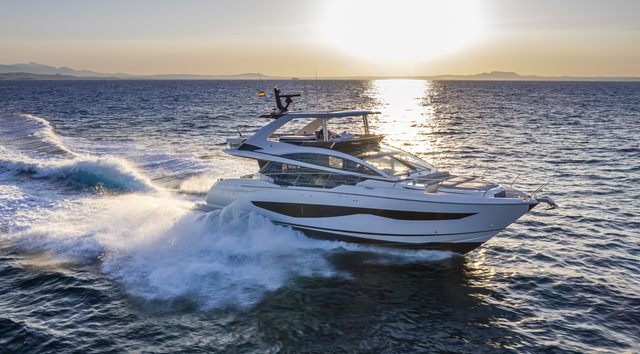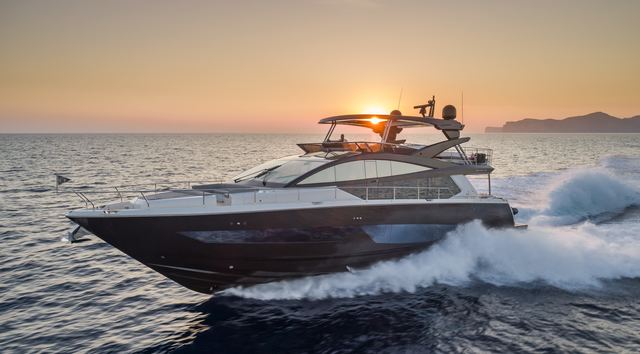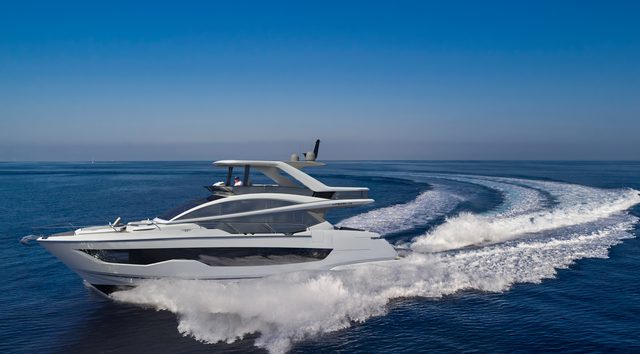
What if someone told you they could substantially increase the range of a 30m motor yacht while reducing fuel consumption and engine hours? Sounds pretty appealing, doesn't it? Well, that's exactly what Pearl says it can achieve with its new 100 Hybrid. And rather than charge owners a small fortune for the technology, it's included in the standard specification.
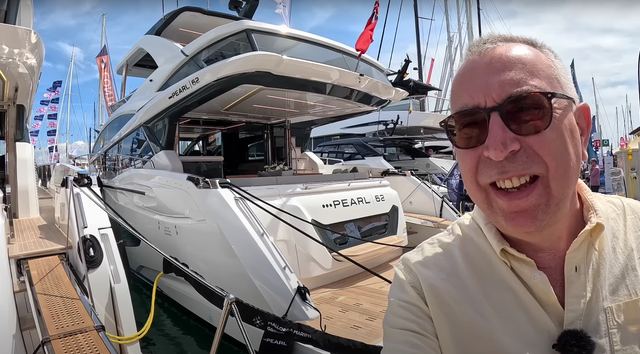
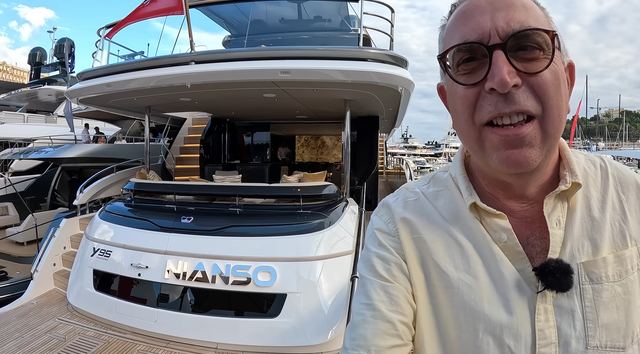
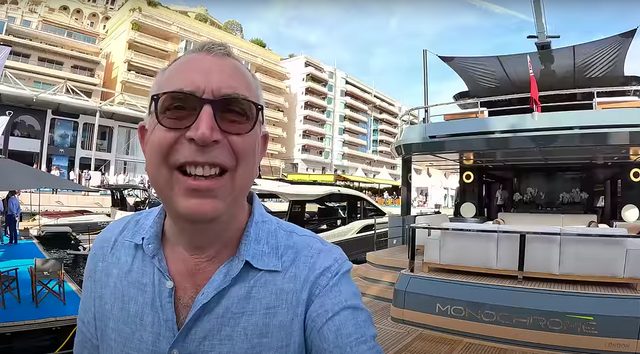
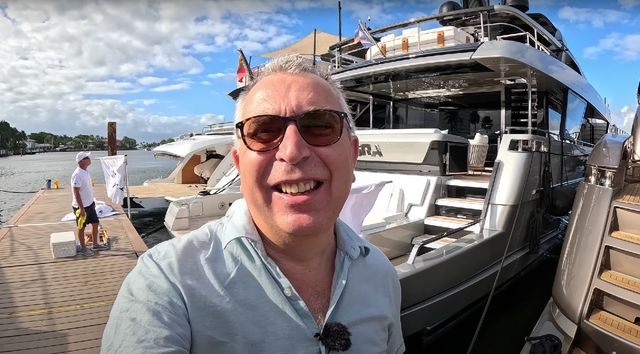
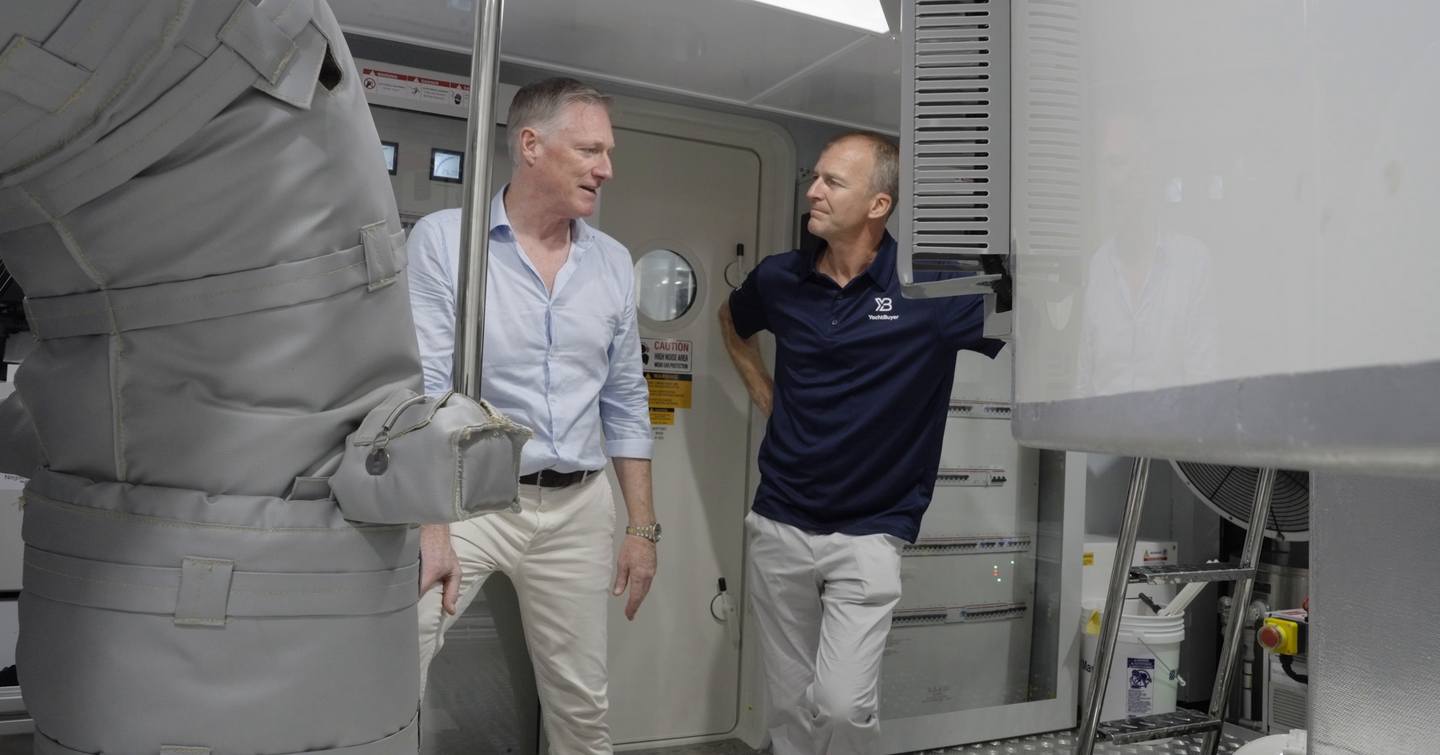
I caught up with Pearl's founder and managing director, Iain Smallridge, at the 2026 Fort Lauderdale Boat Show to find out how it all works. With the first yacht fresh from the yard and definitive hybrid performance figures still to come, there were some questions he couldn't yet answer. But there was plenty to get excited about elsewhere.
Pearl 100 Hybrid
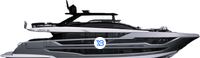
- LOA 96' 7"
- Model Year 2026
- Cabins 5
- Crew 4
- Max Speed 24 knots
- Status In Production
- Yacht Type Raised Pilothouse
- Use Type Cruising
- Vessel M/Y Pearl 100/01
Review Video
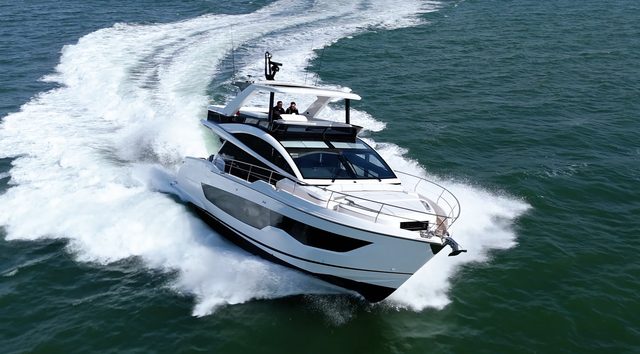
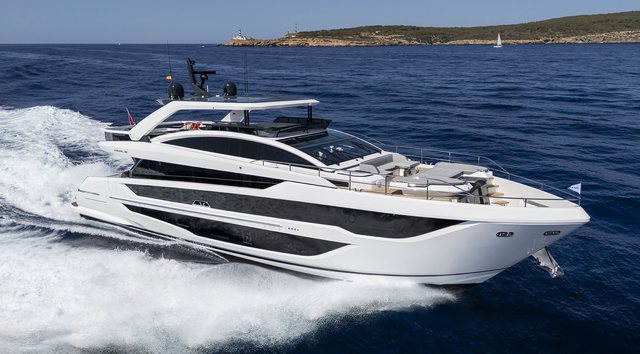
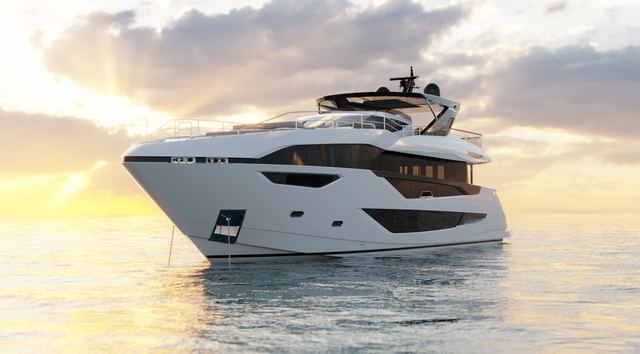
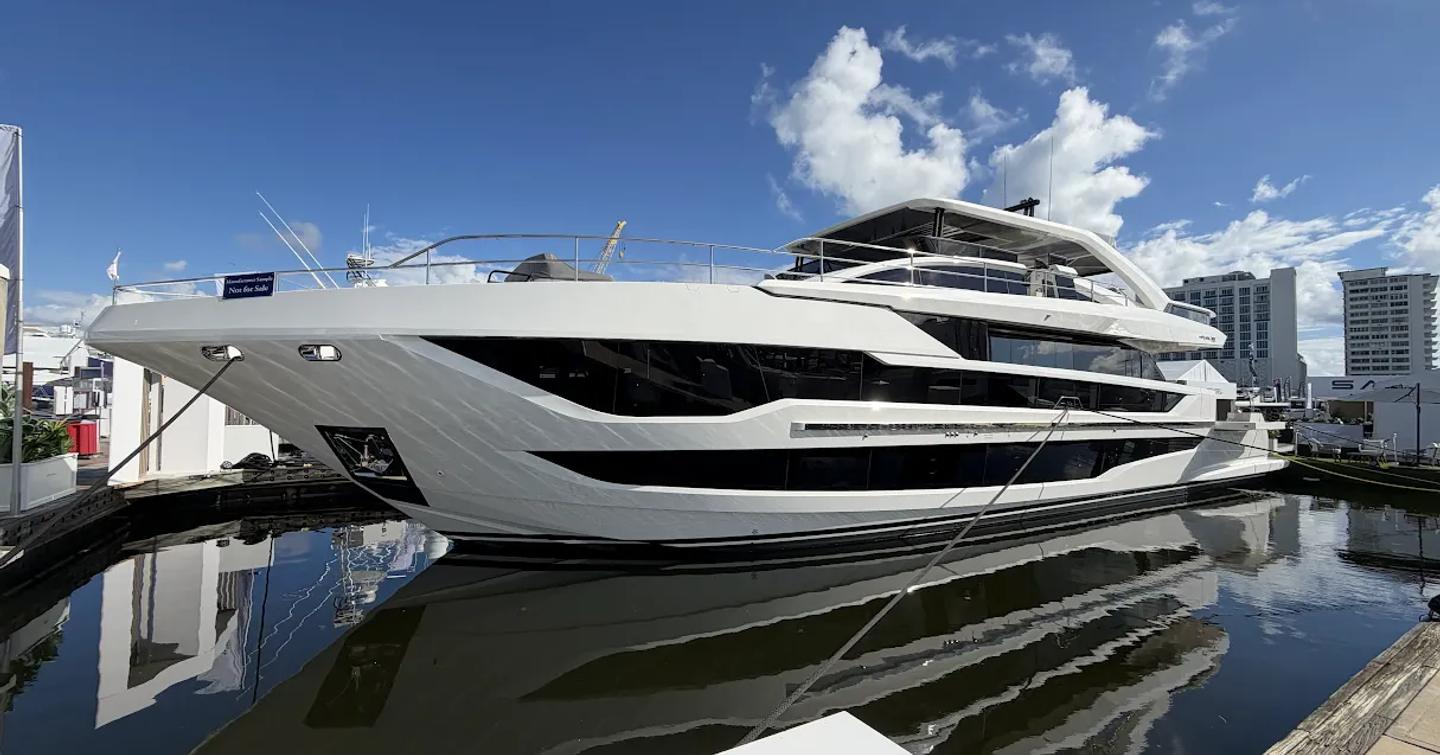
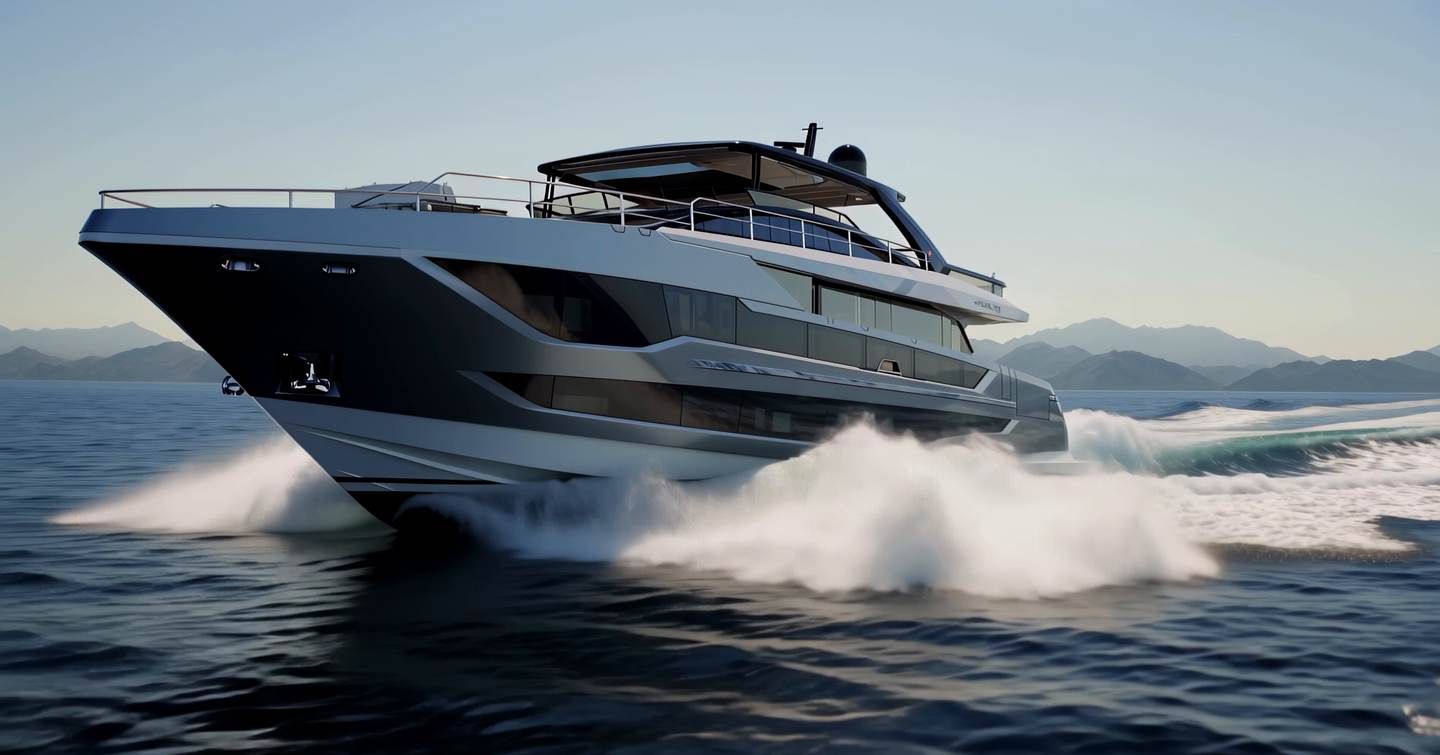
At 29.43m (96ft 7in), the Pearl 100 Hybrid is just 21cm longer and 5cm wider than the Pearl 95 it replaces, yet somehow its designer, Bill Dixon, has managed to fit in a magnificent main deck master suite, up to five further ensuite guest cabins and a plethora of inside and outside entertaining spaces. That's an impressive piece of packaging, particularly on a yacht that comes in under 30m (98ft).
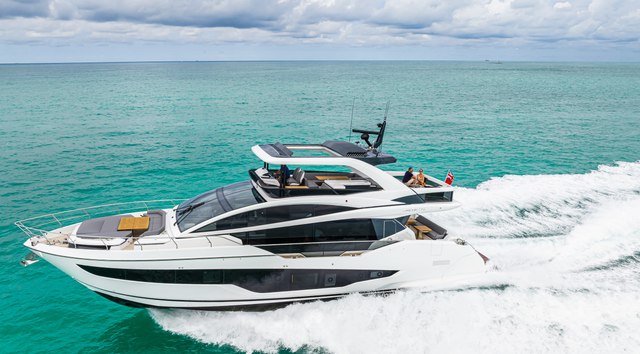
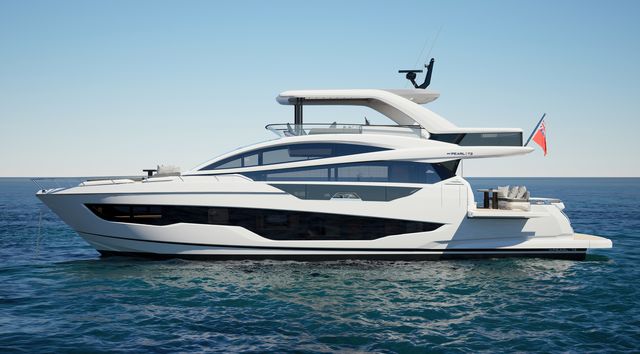
And despite all that accommodation, it doesn't look like a block of flats. With a published gross tonnage of 154GT, there's an awful lot of yacht here, but Dixon's long, horizontal exterior lines do a good job of disguising the height of the superstructure. The extensive glazing also helps break up what could otherwise have been some imposing stretches of GRP. It's a handsome boat, especially when you consider how much is packed into it.
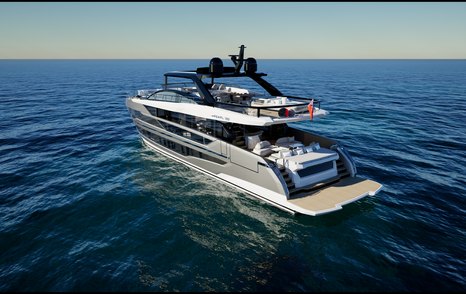
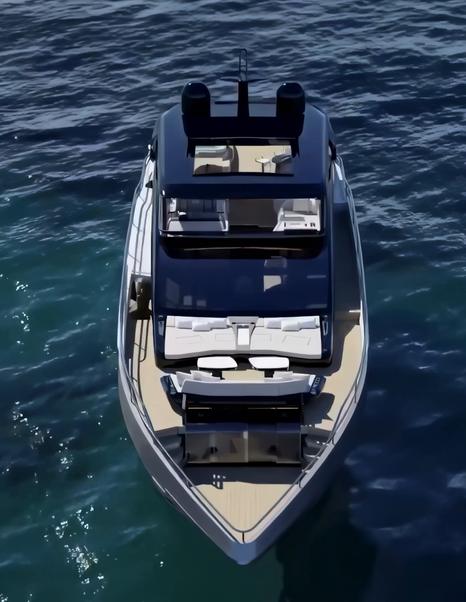
Much of the improvement comes from a rethink of the layout. That starts with an all-new aft cockpit with folding balconies at deck level (rather than adjoining the bathing platform) that substantially increase the space and open up the views. The flow around the decks has also been changed so guests can now move directly from the flybridge to the foredeck lounge along a raised port side deck.
The other big change is the addition of a VIP double in the bow and either a second full-beam master suite amidships or two more guest doubles. On the old Pearl 95, the bow space was occupied by the crew cabins and although you could opt for a second master suite, it came at the expense of two guest cabins. Here you get both, with either five or six ensuite cabins in total. That opens up some interesting possibilities for owners who want to share the yacht without compromising on accommodation. The main deck owner's suite also has direct access to its own private forepeak terrace, an idea first seen on the Pearl 82.
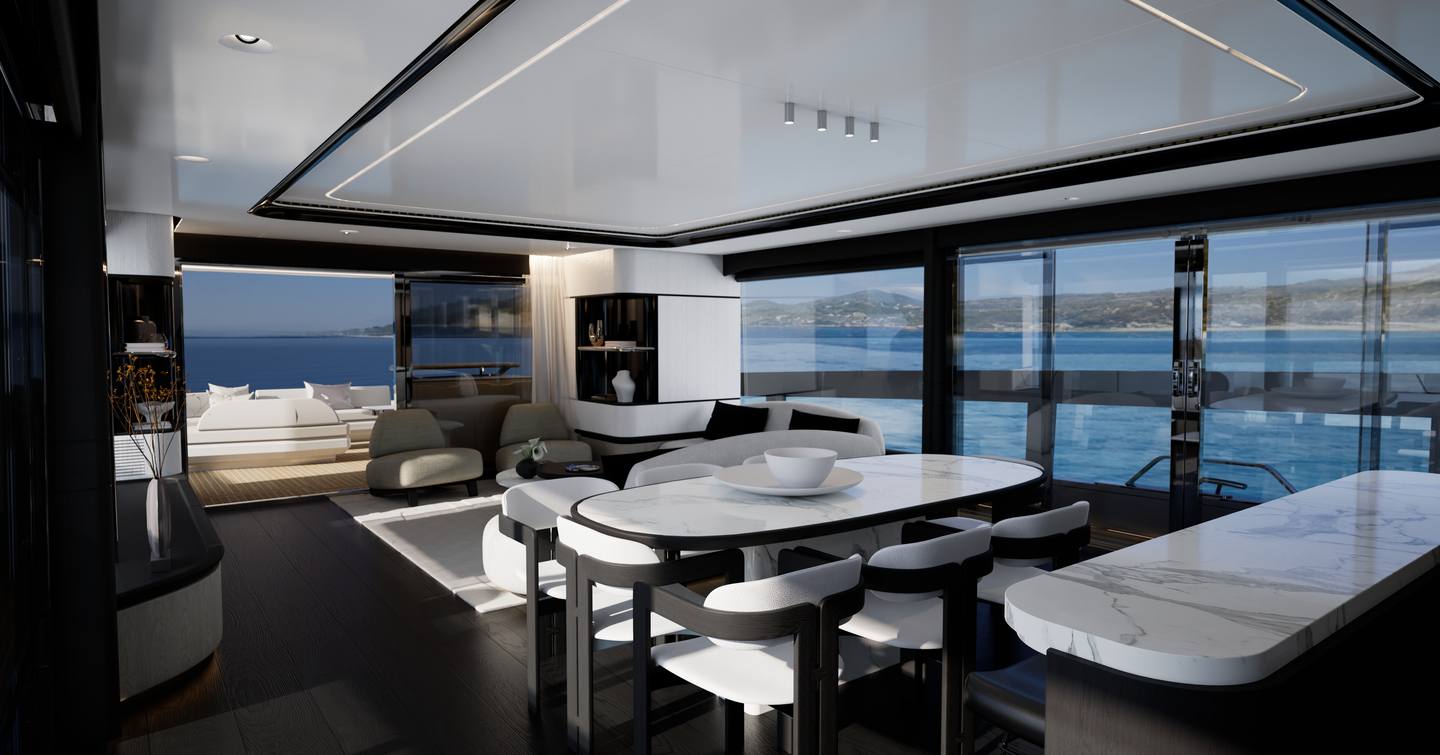
Inside, Kelly Hoppen's choice of four interior design schemes brings a slightly different character to the Pearl 100 Hybrid, with more curves, intricate joinery and decorative detail than some of the yard's earlier interiors. Pearl has worked with Hoppen for more than a decade, but Pearl's founder and Managing Director, Iain Smallridge, describes this as having more of a superyacht feel.
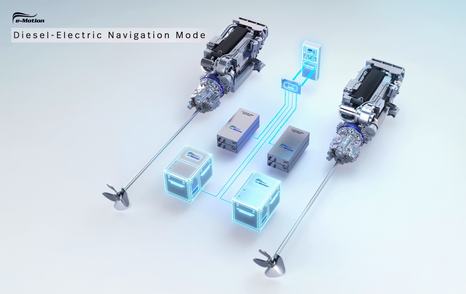
The most significant change, however, is hidden beneath the decks. Pearl has designed the 100 around an e-Motion diesel-electric hybrid system rather than offer it as an expensive extra. Twin 2,000hp MAN diesels provide conventional shaft propulsion, while electric motors and a substantial battery bank give the yacht several other ways to operate. Accommodating all that additional machinery without sacrificing the guest accommodation is no small feat.
There's a real wow moment when you step through the electric aft doors and see just how much light pours into the saloon. Huge glass panels stretch almost from floor to ceiling, but what I particularly like are the electrically operated Opacmare doors on either side of the dining area. Press a button and they move outwards before you slide them apart by hand. Open both, along with the aft doors, and you get a lovely breeze flowing right through the boat. I'm a big fan of fresh air rather than air conditioning whenever possible, so this arrangement suits me down to the ground.
Kelly Hoppen's Monochrome interior has plenty of interesting detail once you start to look around. The wooden flooring gives way to a lovely soft carpet beneath the sofas, while the freestanding chairs have their own fabrics and finishes. There's a real mix of textures here, and it feels as though someone has thought about every surface rather than simply repeating the same materials throughout. Owners can choose from four fully furnished Kelly Hoppen schemes, right down to the artwork and accessories. After years of sitting buyers down with endless material samples, Pearl now lets Kelly and her team settle the details. As Iain puts it, "We just give it to Kelly Hoppen, she knows what she's doing." Too much choice can prove daunting to less experienced owners.
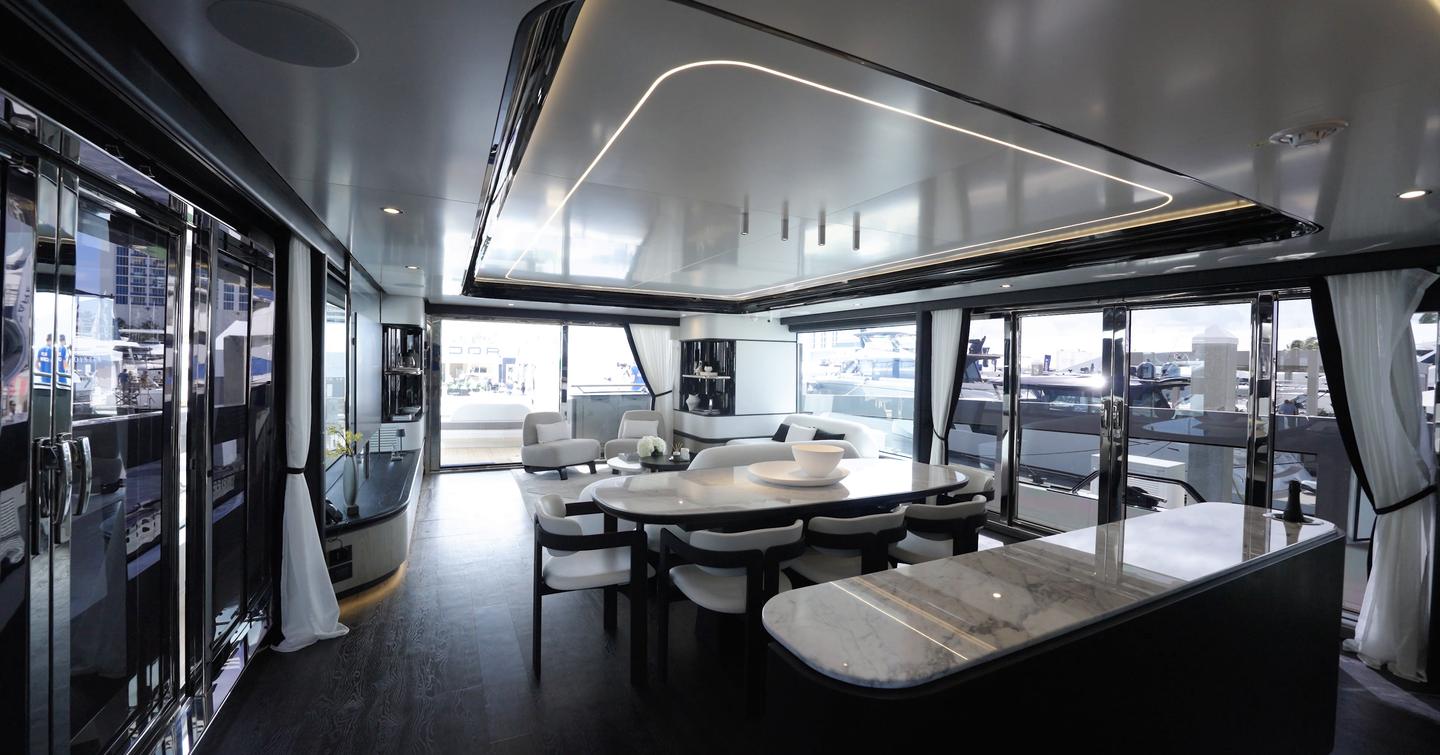
The dining table normally seats eight but extends to accommodate ten, with an extra leaf and two chairs brought in from elsewhere aboard. It's a sensible arrangement that leaves more room to move around when you don't need the extra seats. Nearby, there's a smart bar with stools, a built-in wine cooler, champagne storage and cupboards full of neatly secured Pearl-branded glassware.
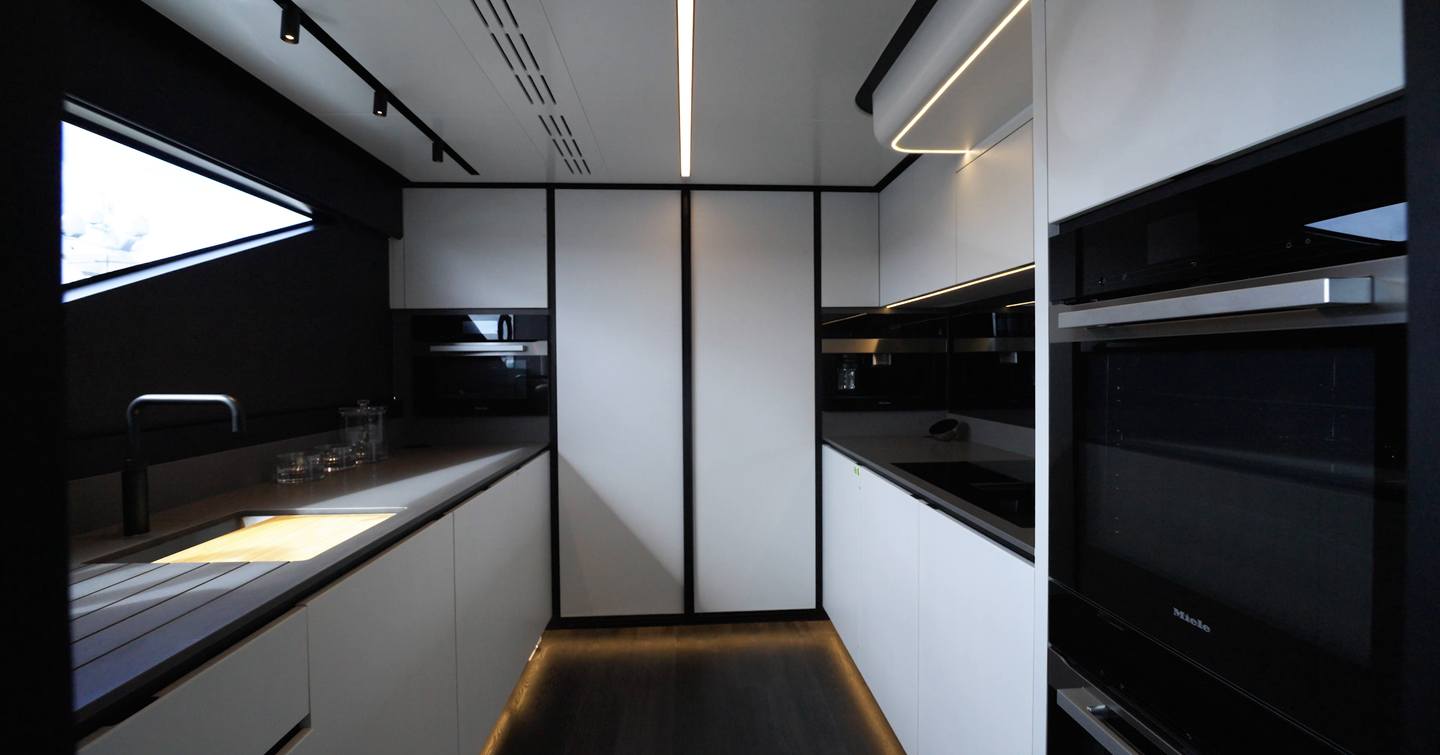
The galley is relatively compact for a yacht of this size, but it's certainly well equipped. There's a full suite of Miele appliances, including plenty of fridge and freezer space, an oven, microwave and coffee machine, plus a boiling-water tap and, very on trend, an air fryer. Iain assures me that professional chefs increasingly ask for these because they speed up certain dishes. Personally, I'm more interested in whether they can produce a decent portion of chips. Either way, there's some serious equipment packed into this space, even if a little more room to work wouldn't go amiss.
Owner's Cabin
The main deck owner's suite is a very impressive affair, and it starts with an entrance lobby, complete with a desk and a walk-through wardrobe. There are two ways into the bedroom, either directly from the lobby or through the wardrobe and bathroom, which is a clever way of making the most of the space.
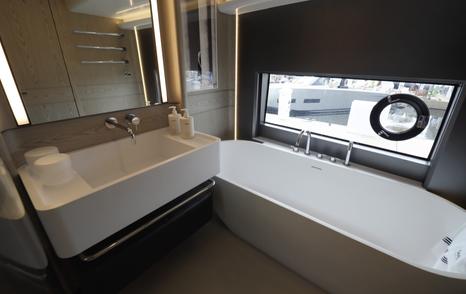
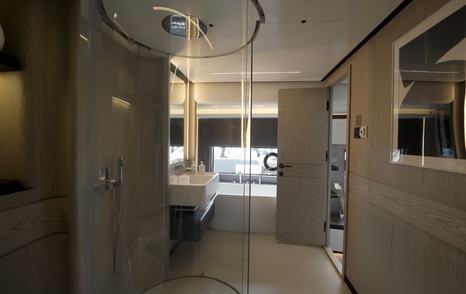
And what a bathroom it is. There's a full-size bathtub beside the window, complete with an opening porthole, and a rather elaborate electrically operated glass shower enclosure. Press a button and the curved glass doors slide shut around you, like something out of Star Trek. There's also one of those sophisticated Japanese-style loos with a heated seat and more functions than you probably knew you needed.
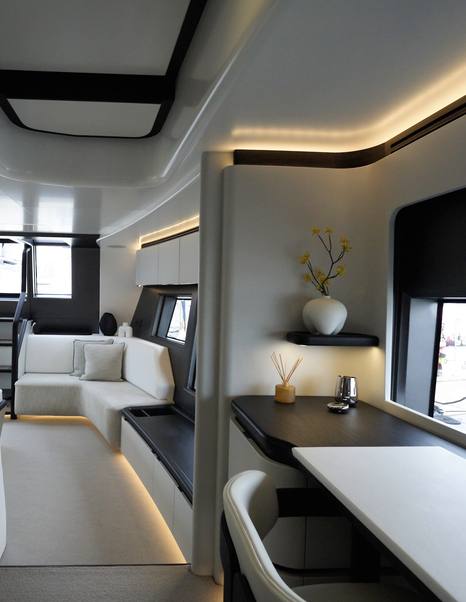
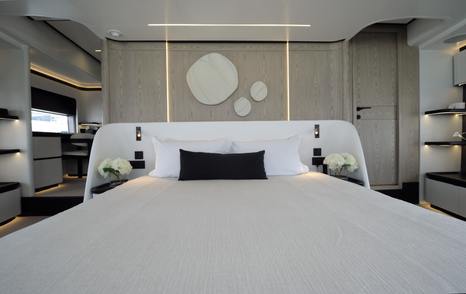
The bedroom itself is just as good, with huge windows and additional glass panels positioned so that you can enjoy the view even when you're lying in bed. The Monochrome scheme works particularly well in here, with a sculptural headboard, some lovely decorative details and plenty of natural light. Electric blinds provide privacy when required, while a Control4 touchscreen looks after the lighting, air conditioning and entertainment systems.
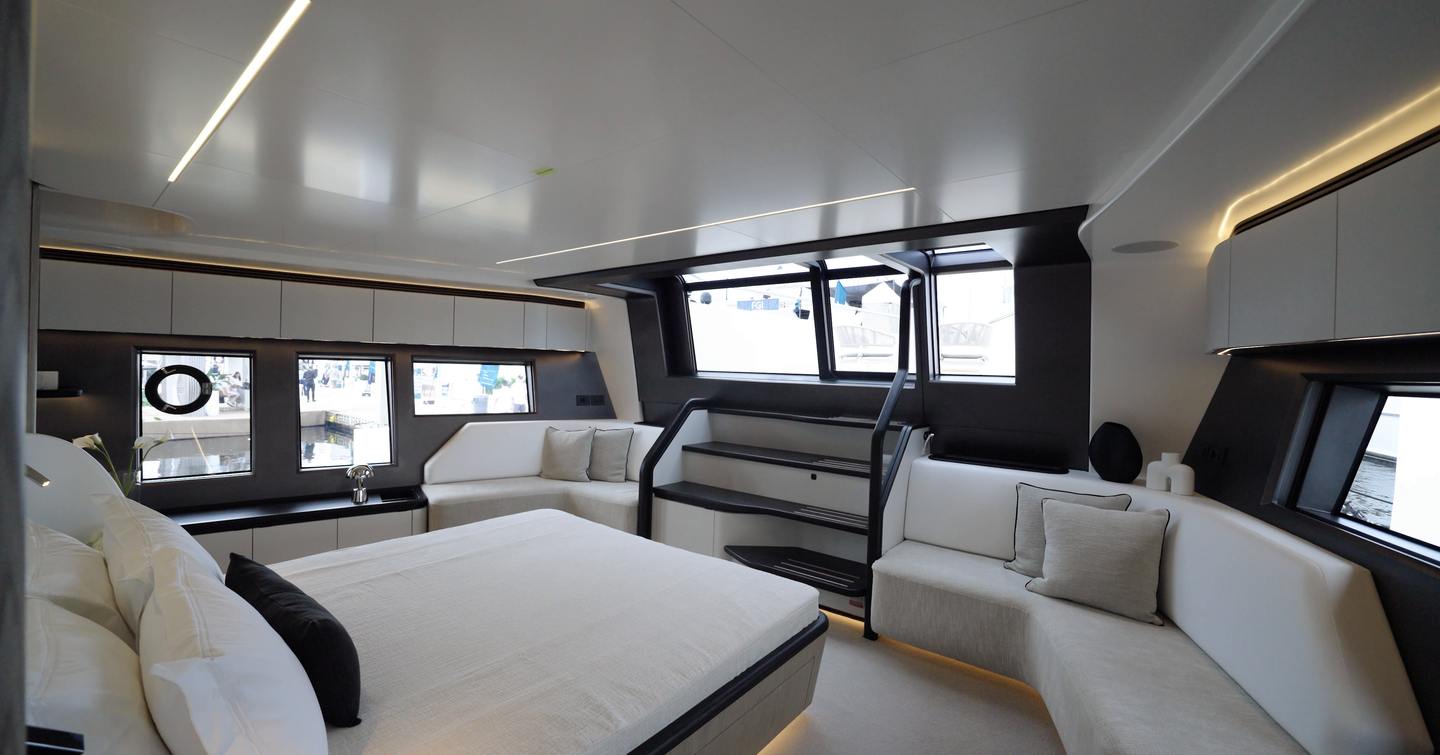
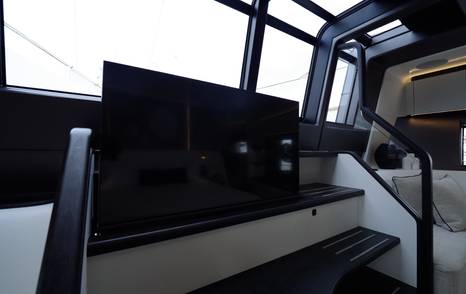
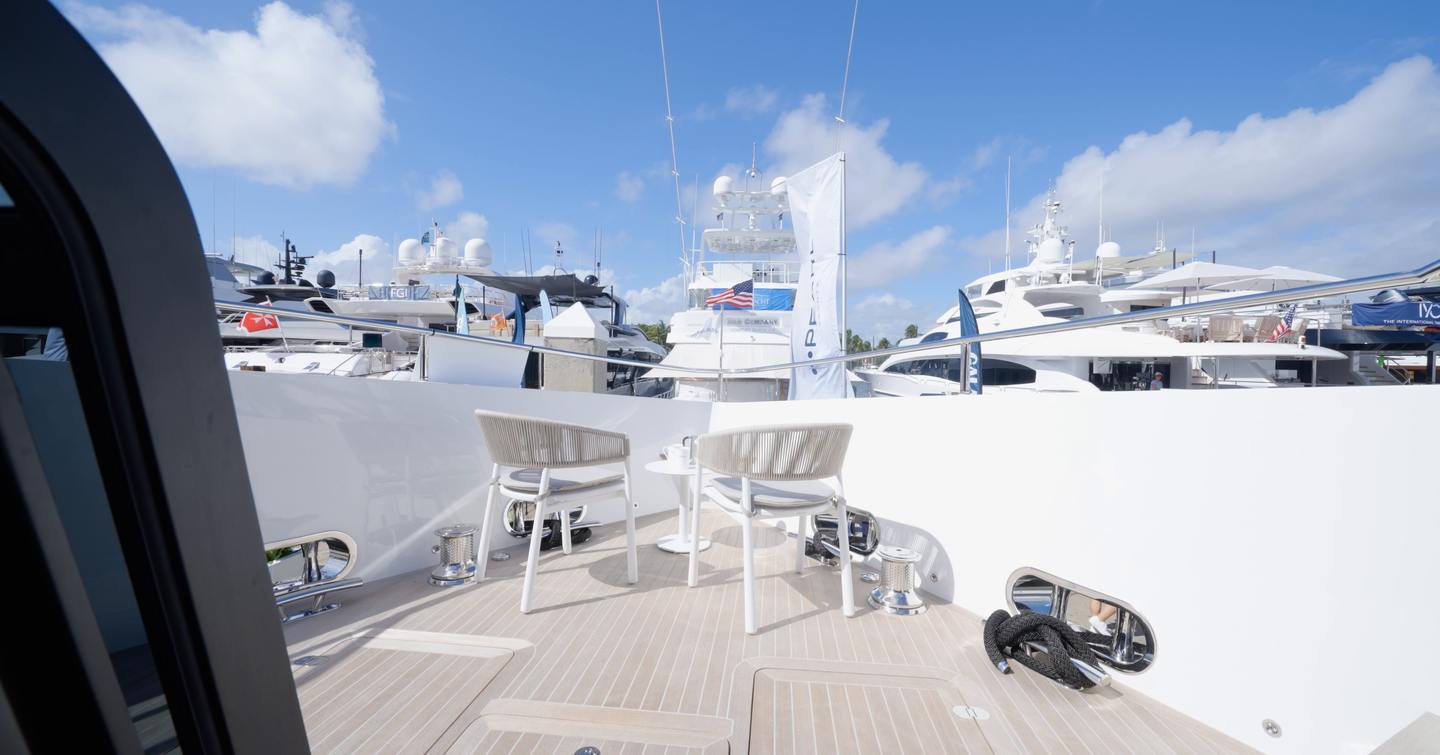
But the best feature is the private terrace directly in front of the cabin. An electrically operated watertight door opens onto a wonderful sunken seating area, tucked below the main foredeck lounge. It's surprisingly private, even when you're berthed stern-to in a busy marina, and feels nicely sheltered from the rest of the boat. You could quite happily sit out here with a coffee in the morning without the whole world knowing about it. Pearl has even managed to accommodate the anchor and mooring equipment beneath the terrace, so it's a clever use of what might otherwise have been a purely functional part of the yacht.
Guest Accommodation
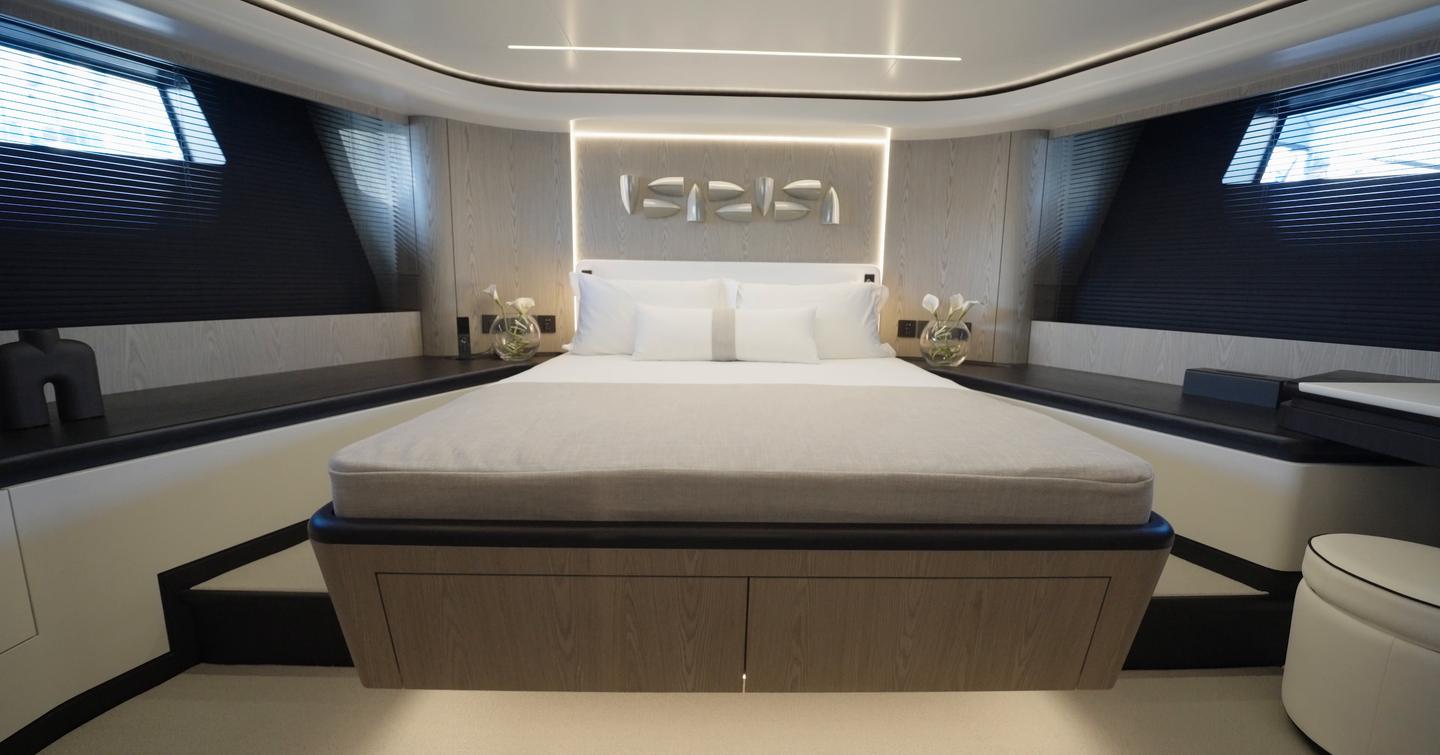
Having already seen that enormous main deck owner's suite, you might expect the cabins downstairs to be a bit of a letdown. Far from it. The Pearl 100 Hybrid has another full-beam master suite amidships, complete with large hull windows, a dressing table, sofa, drinks fridge and a generous ensuite bathroom. On plenty of yachts this size, this would be the principal owner's cabin, and you'd be perfectly happy with it.
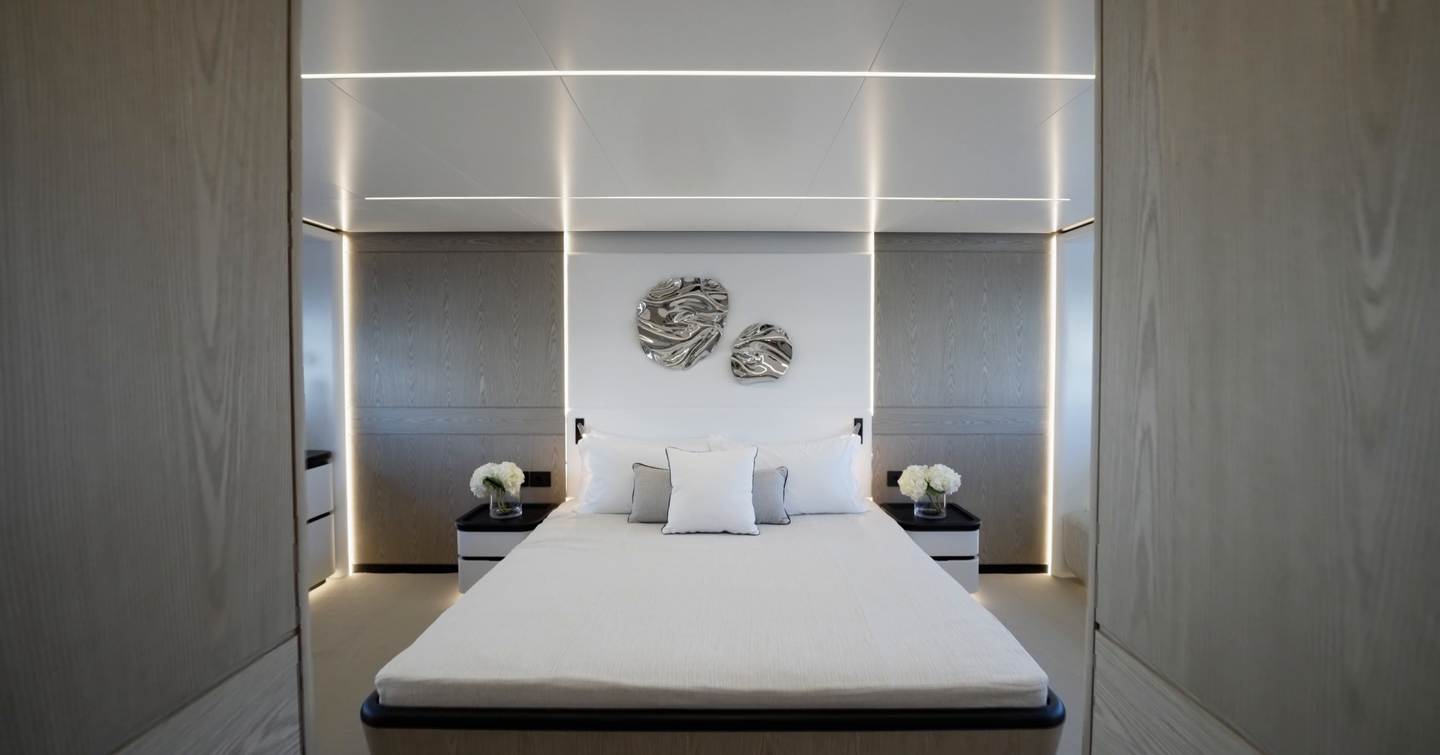
Iain makes an interesting point about the growing number of yachts shared by brothers, friends or business partners. If you're paying half the bills, you don't particularly want to find yourself tucked away in a second-rate cabin while your co-owner enjoys the penthouse upstairs. With two proper master suites, nobody has to draw the short straw. The lower suite can also be divided into two separate cabins, giving owners the option of six guest cabins rather than five, which could prove useful for charter.
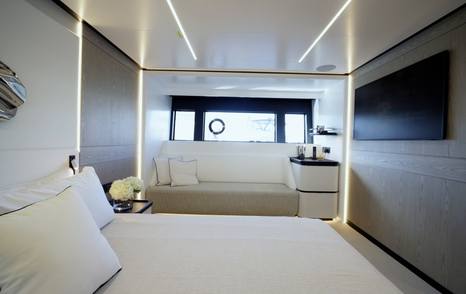
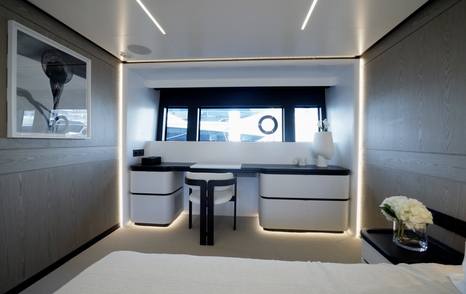
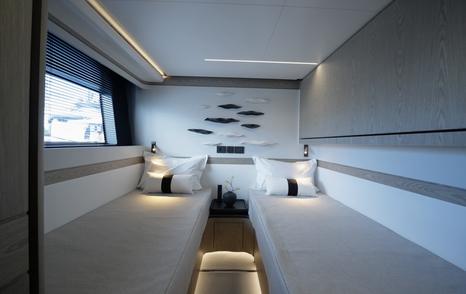
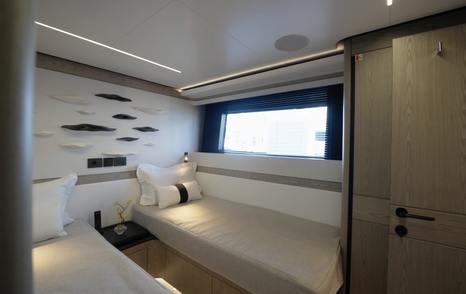
The remaining accommodation is pretty flexible, too. There are two twin cabins, one on either side, where one of the berths moves electrically across to form a double. Optional Pullman bunks provide extra beds for children, and each cabin has its own ensuite shower room and dedicated storage. They're obviously smaller than the two master suites, but they're nicely appointed and make good use of the available space.
Further forward is a more conventional full-beam VIP suite in the bow, with good-sized windows, plenty of wardrobe space, a dressing table and its own bathroom.
Crew Accommodation
The crew quarters have their own entrance from the port side deck leading down to a new location between the engineroom and the lower deck guest/master cabin. This does give the engineer direct access to the ship's hardware and crew can still move back and forth to the main galley along the port side deck but the space itself doesn't feel as generous as the crew area in the old 95. With just two ensuite cabins for four permanent crew and an additional Pullman berth for an occasional fifth, it's not quite as comfortable as the 95, which had a Captain's cabin and two further bunk cabins.
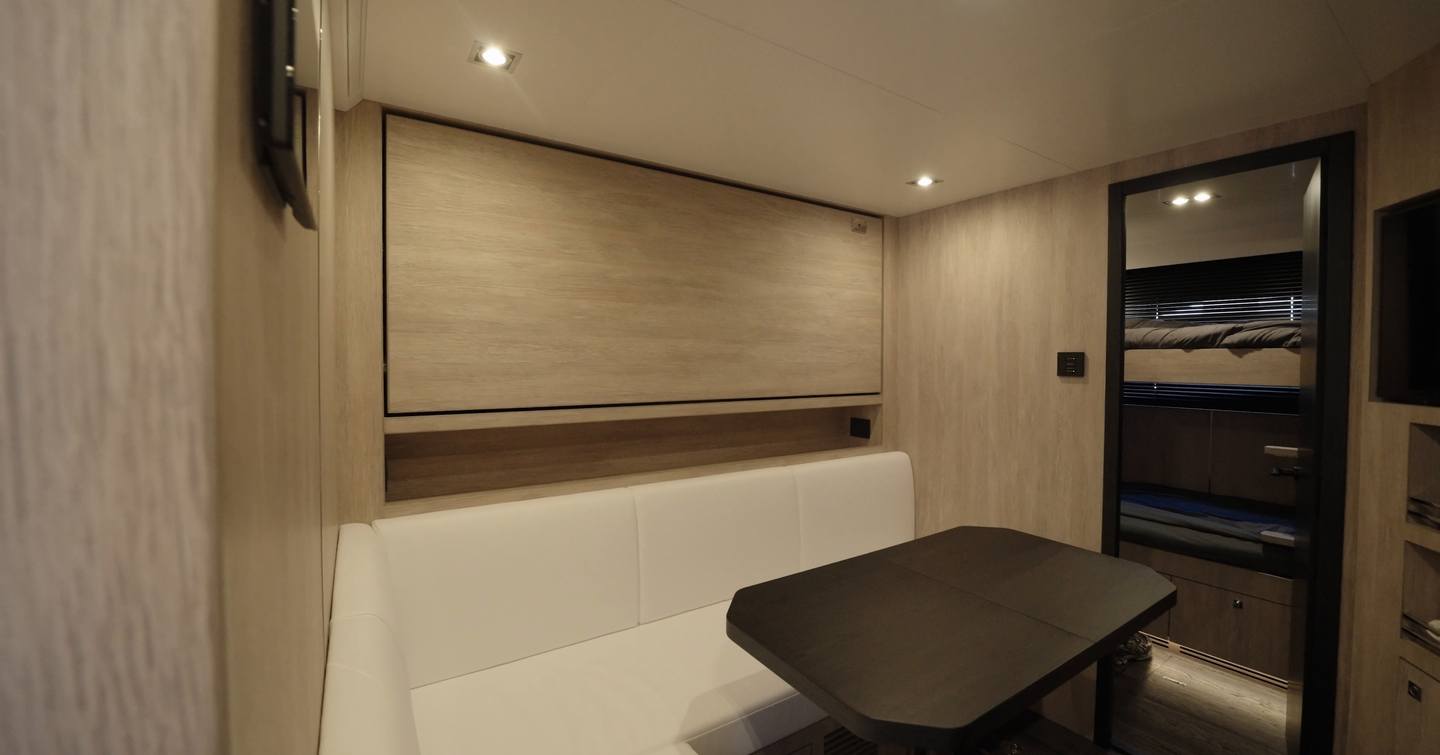
There is a small crew mess with seating, a television and even a games console, plus a separate galley area with a fridge, hob, sink and microwave. It's well enough equipped for the crew to prepare their own meals and relax when they're off duty, although the space is relatively compact for a yacht approaching 30m (98ft).
The laundry sits between the accommodation and engine room, with separate washing and drying machines. It's a sensible arrangement that keeps the noise and heat of the laundry away from the living quarters.
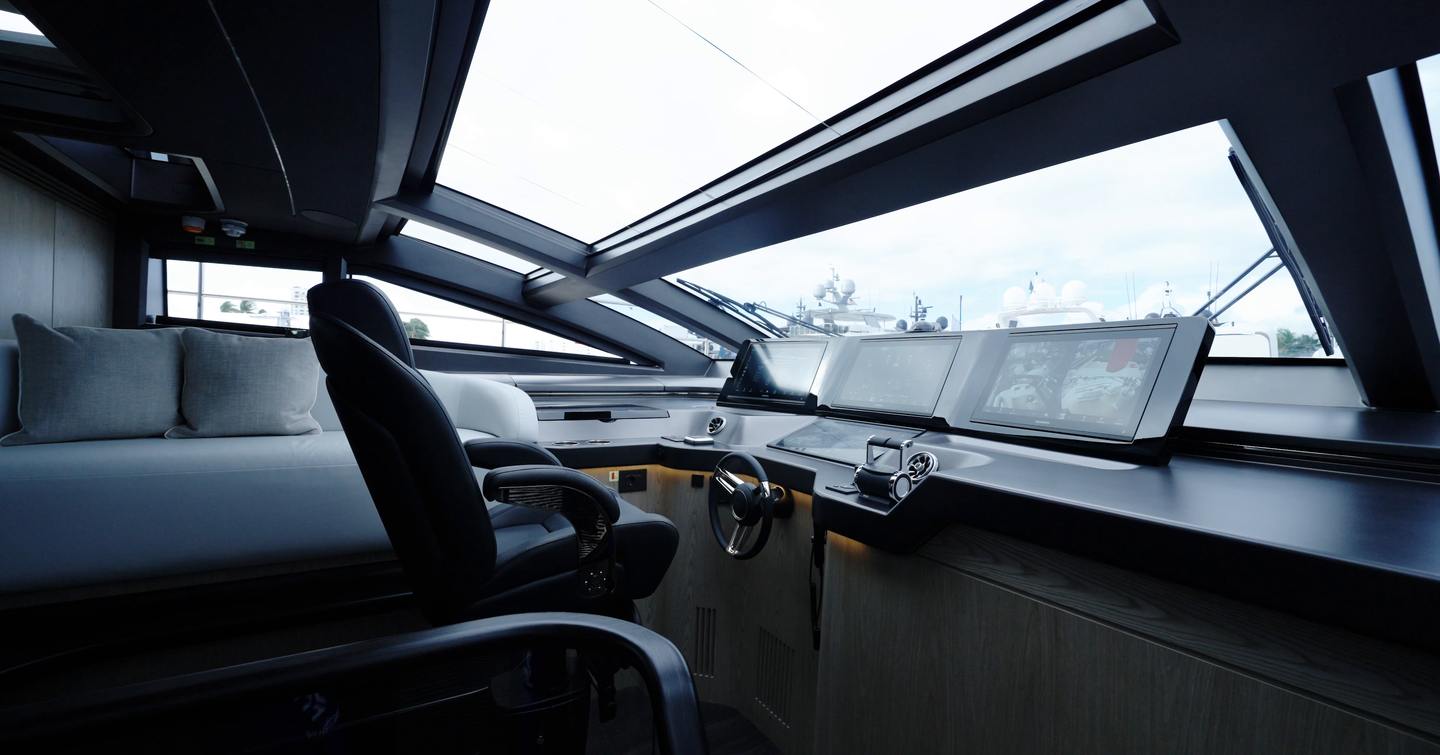
The Pearl 100 Hybrid has two well-equipped helm stations, but it's the raised pilothouse that feels like the command centre of the yacht. Settle into the main helm chair and you're faced with four large MFDs that handle everything from navigation to the hybrid propulsion system. What I particularly like, though, is the amount of glass. So many enclosed pilothouses feel as though you're peering through a letterbox, whereas this one has glazing above your head that makes the whole space feel wonderfully light and airy. It's a far more pleasant place to spend a long night passage.
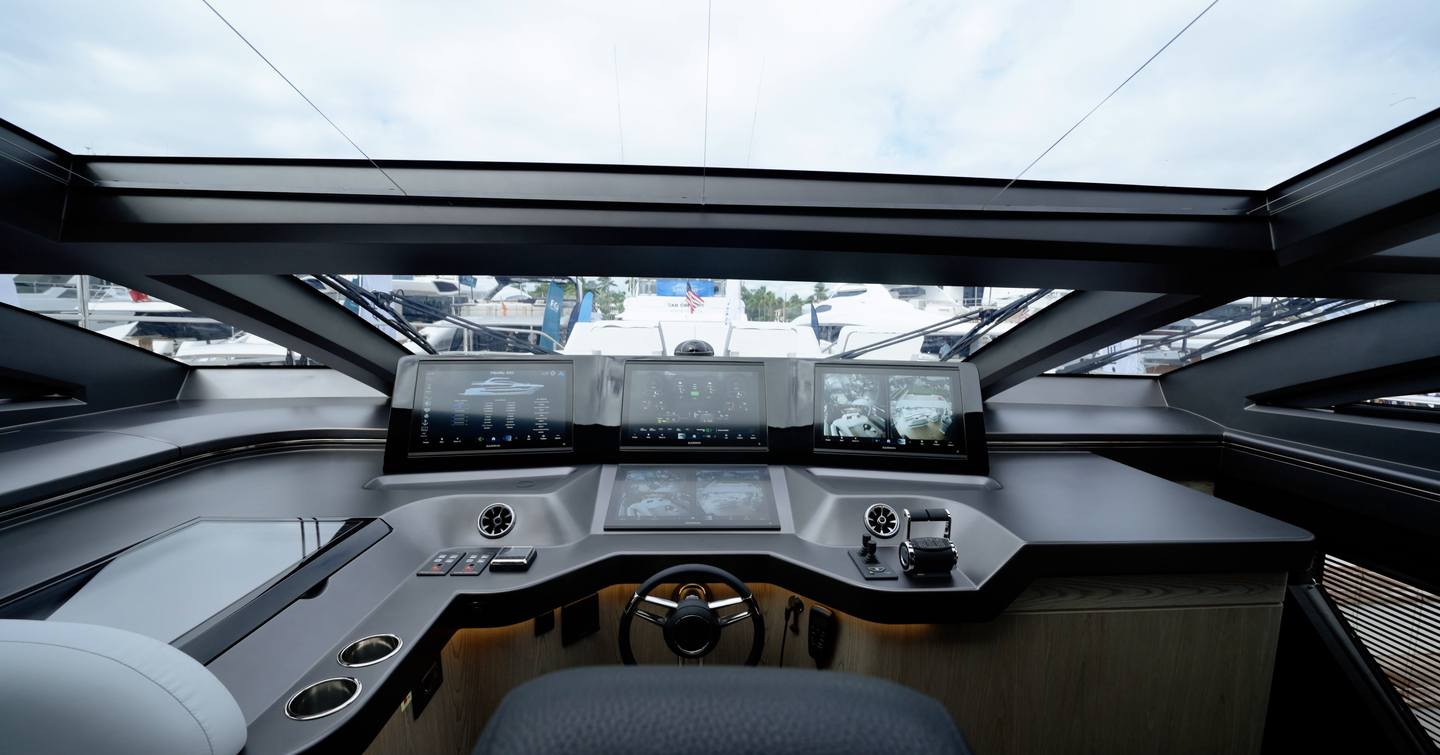
The most intriguing aspect of the helm is the choice of propulsion modes. Under conventional diesel power, the twin 2,000hp MAN engines give the Pearl a quoted maximum speed of 24 knots and a range of around 1,150nm at 10 knots. Switch to full electric and both main engines and the generator can shut down, with the batteries alone powering the propellers. Pearl estimates around an hour at six or seven knots, ideal for a quiet trip along the Intracoastal Waterway or an early departure from a marina without waking the neighbours.
There's also a diesel-electric mode, where the generator supplies power to the electric motors for longer passages at lower speeds. Pearl expects around eight or nine knots, with the prospect of a substantial range increase over conventional diesel propulsion. Each of the main engines can also be used to turn both shafts – one directly and the other by feeding electrical power to its electric motor. This should allow very efficient long range cruising while halving the number of engine hours and their associated running costs.
The catch is that all the performance and range figures were still estimates when I visited. Nobody has yet had a chance to put the Pearl 100 Hybrid through its paces at sea, so there's no firsthand assessment of its handling, noise levels or fuel consumption. Hopefully we'll get a chance to test those at a later date.
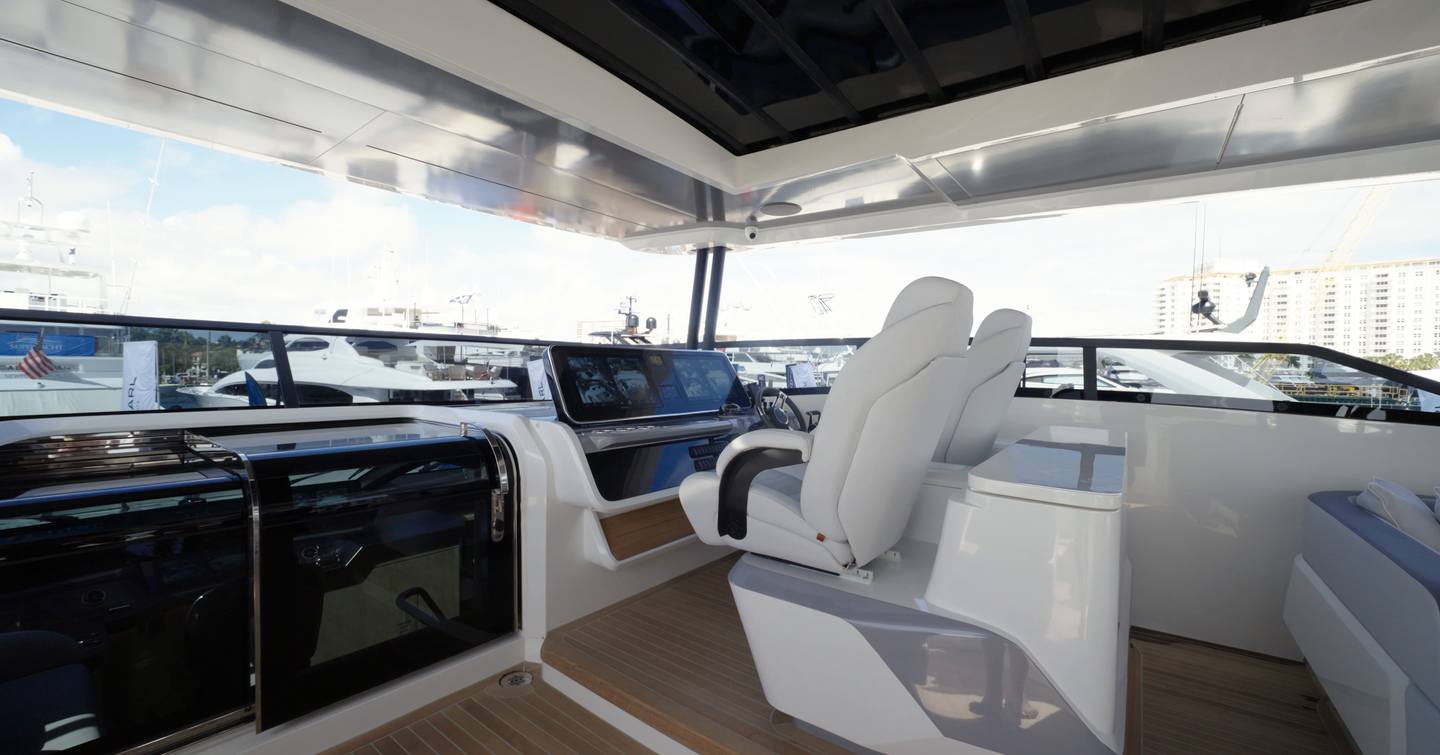
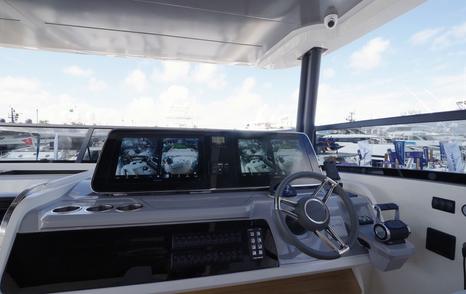
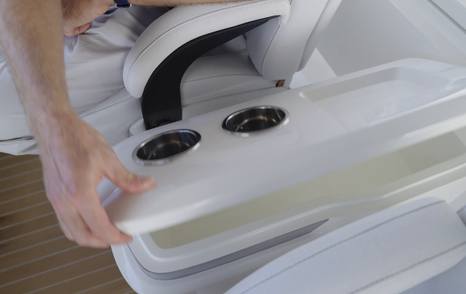
On the flybridge, there's another pair of helm seats, two Garmin 9000 displays and additional forward-facing seating so guests can enjoy the view underway. All the essential navigation equipment is repeated up here, along with controls for the stabilisers, underwater lights and other yacht systems. There's even a beautifully made glovebox that looks as though it's come straight out of a Bentley. Personally, I'd be tempted to fill it with ice and a bottle of champagne, although I suspect Pearl had something else in mind.
For close-quarters work, there's an aft docking station with engine controls and separate controls for the CMC bow and stern thrusters. That's a welcome addition on a yacht of this size, especially for stern-to berths, but I would have liked to see bridge wing stations as well. An uninterrupted view down either side of the hull can be invaluable when you're coming alongside a quay.
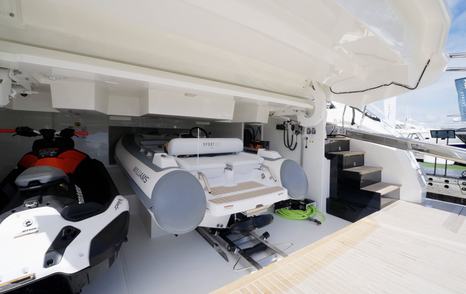
There's an extraordinary amount of kit tucked away in the stern of the Pearl 100 Hybrid. The hydraulic bathing platform lowers into the water, while a huge garage behind it can house a Williams 435 Dieseljet, a Sea-Doo Spark PWC and a collection of SeaBobs. Roller tracks allow the tender and jet ski to launch straight into the water, and there's even a full height shower that can plug into sockets on either side of the platform. Iain tells me that the owner of hull #2 has gone a step further and specified a single larger Williams 505 tender in place of the usual tender and jet ski combination.
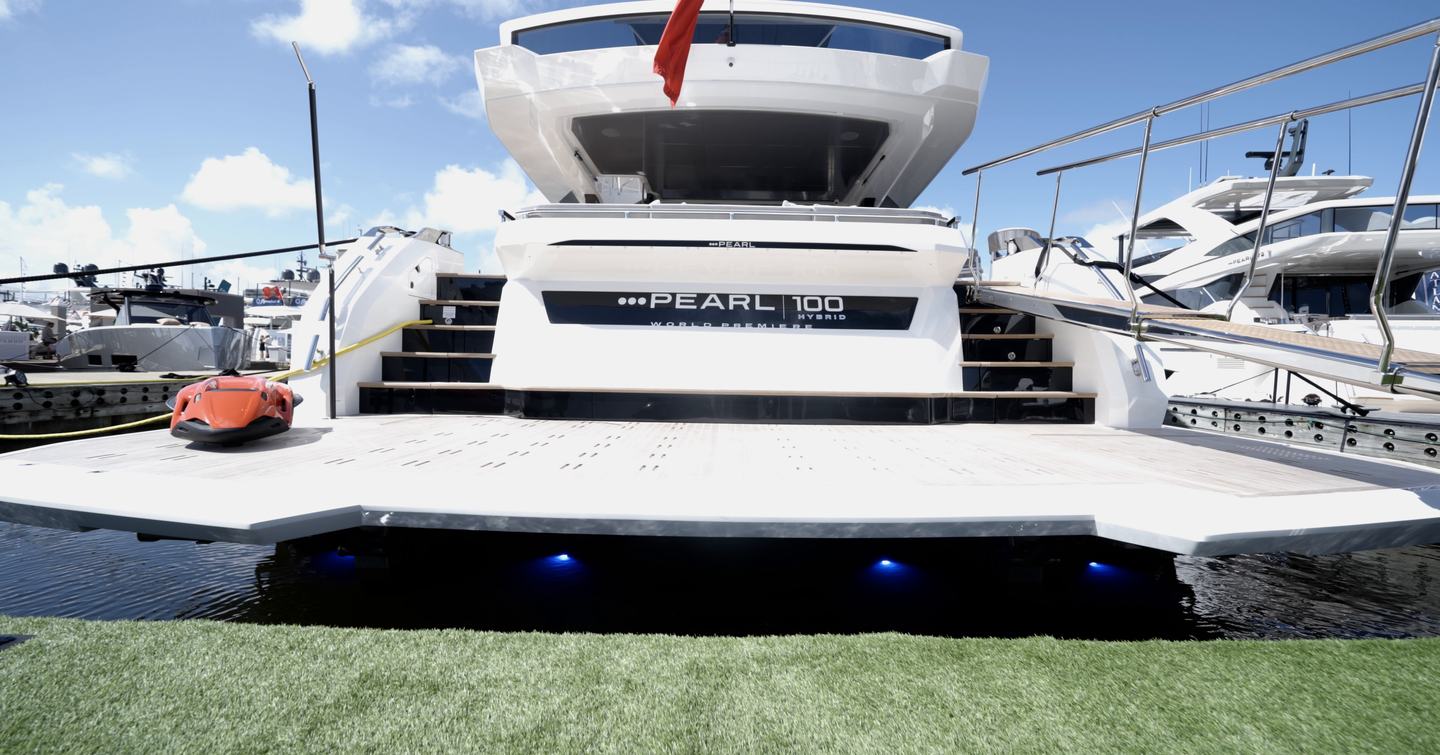
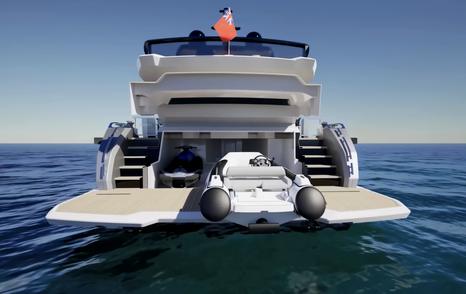
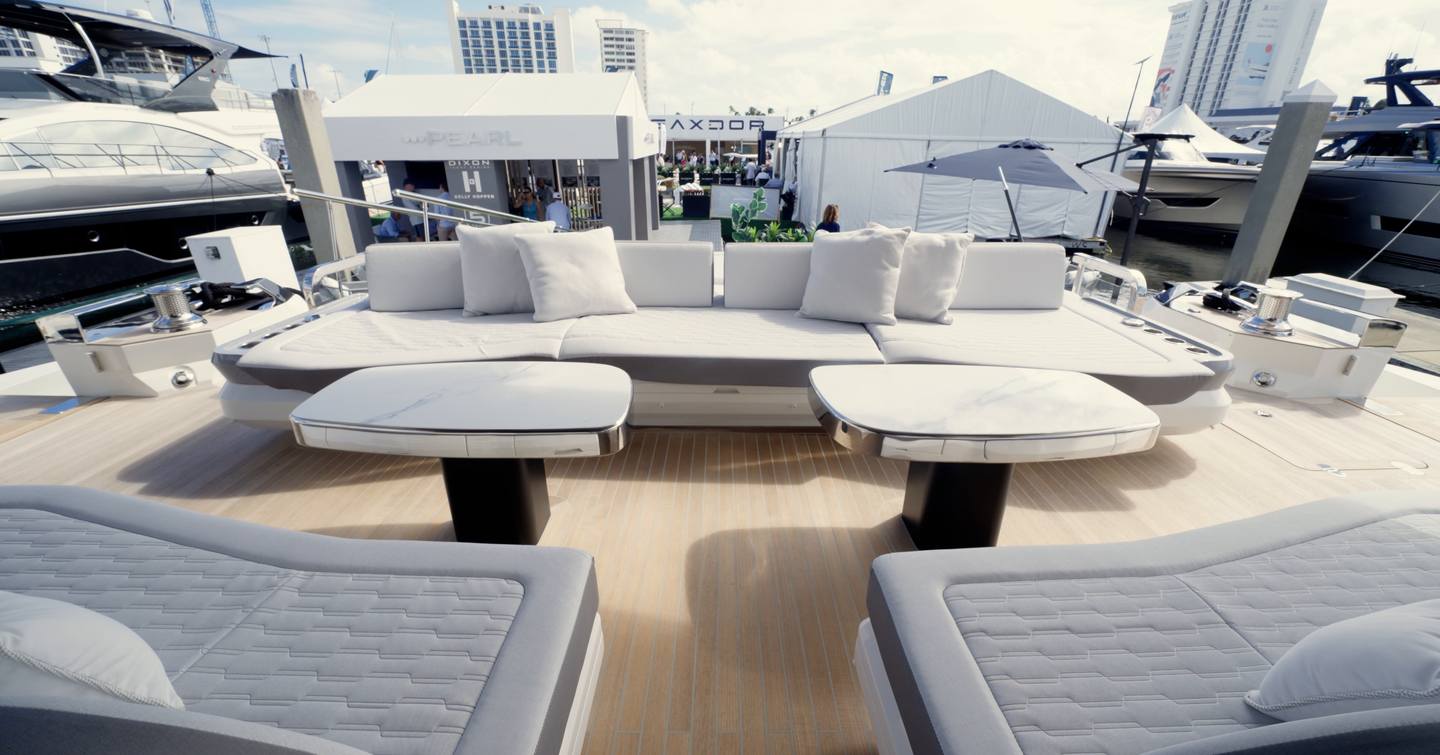
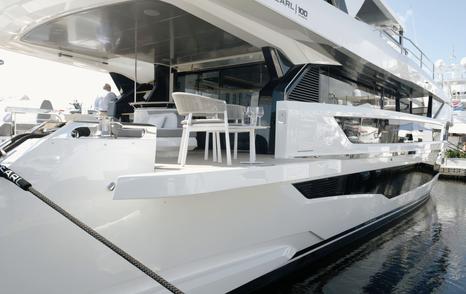
Up in the aft cockpit, fold-down balconies on both sides open the space out over the water. What I particularly like is the almost uninterrupted view from the sofas. There's barely a sense of a transom behind you, and it feels as though you're sitting right on the edge of the sea. Pearl calls this its Riviera layout, with informal seating and weighted backrests that move forward to turn the sofas into large sunpads. There's a bar with a fridge, ice maker and sink, too. It is a natural place to gather while others are out on the water toys. Buyers can opt for a more conventional cockpit arrangement with a dining table and glass balustrade, but Iain says the Riviera version is the more popular choice.
There are also side boarding gates on both sides, which make life easier when you're berthed alongside a quay.
Flybridge
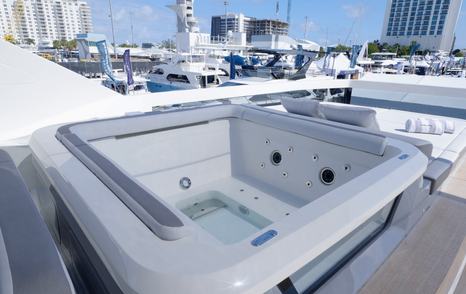
The flybridge is another matter altogether. It's absolutely enormous, with enough space at the aft end for an optional hot tub, sunpads and freestanding furniture. Owners can also specify exercise equipment up here, with treadmills and bikes in place of the usual lounging area. There are even glass panels set into the bulwarks so you can enjoy the view while lying on the sunpads.
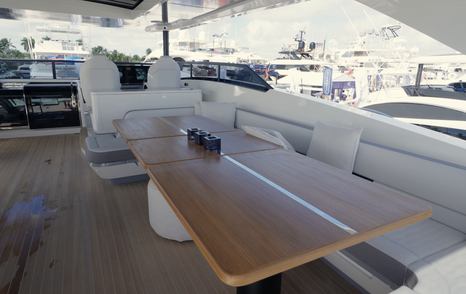
Further forward, a long electric awning provides shade over the dining area, where the table has a removable centre section that stows neatly behind the seating. It's a small point but so often on yachts like this nobody has thought about where you're supposed to put it afterwards. Here, there's a place for everything.
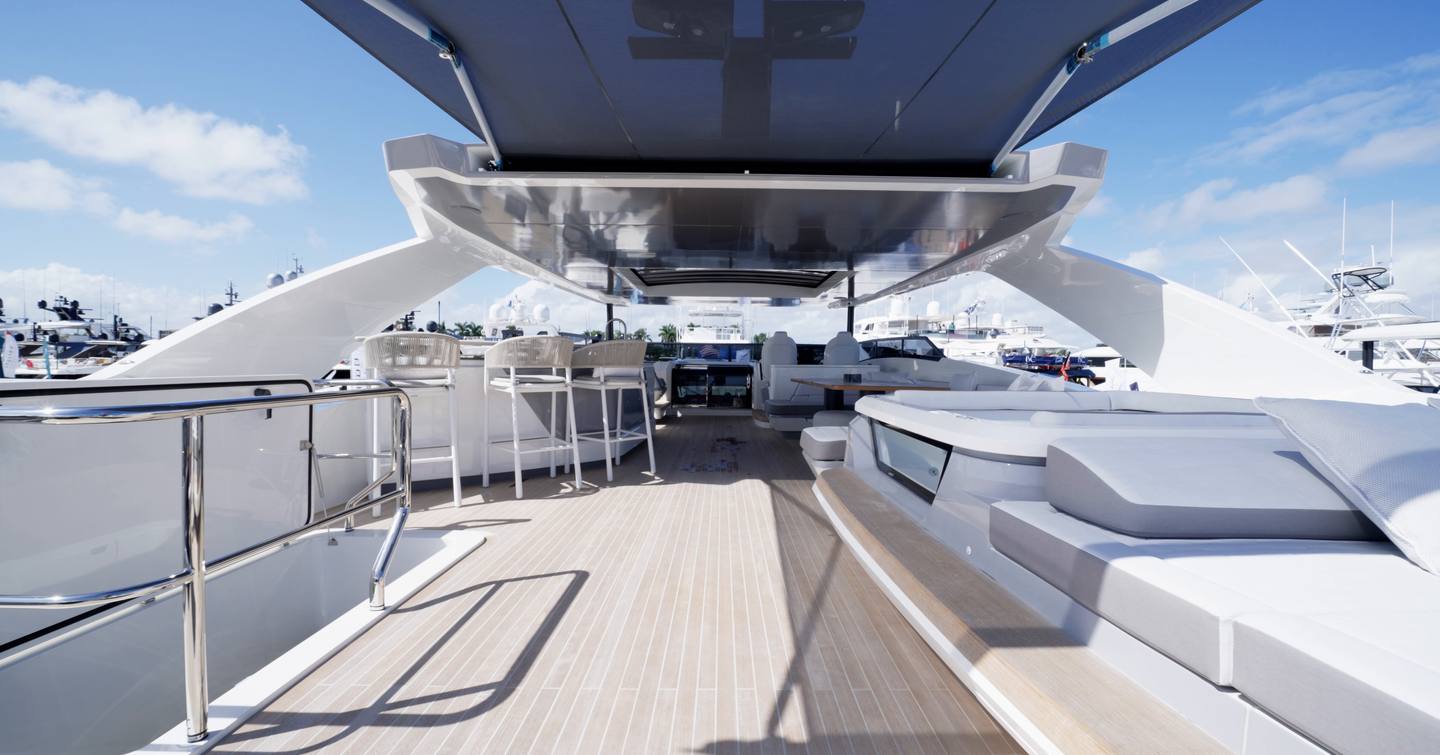
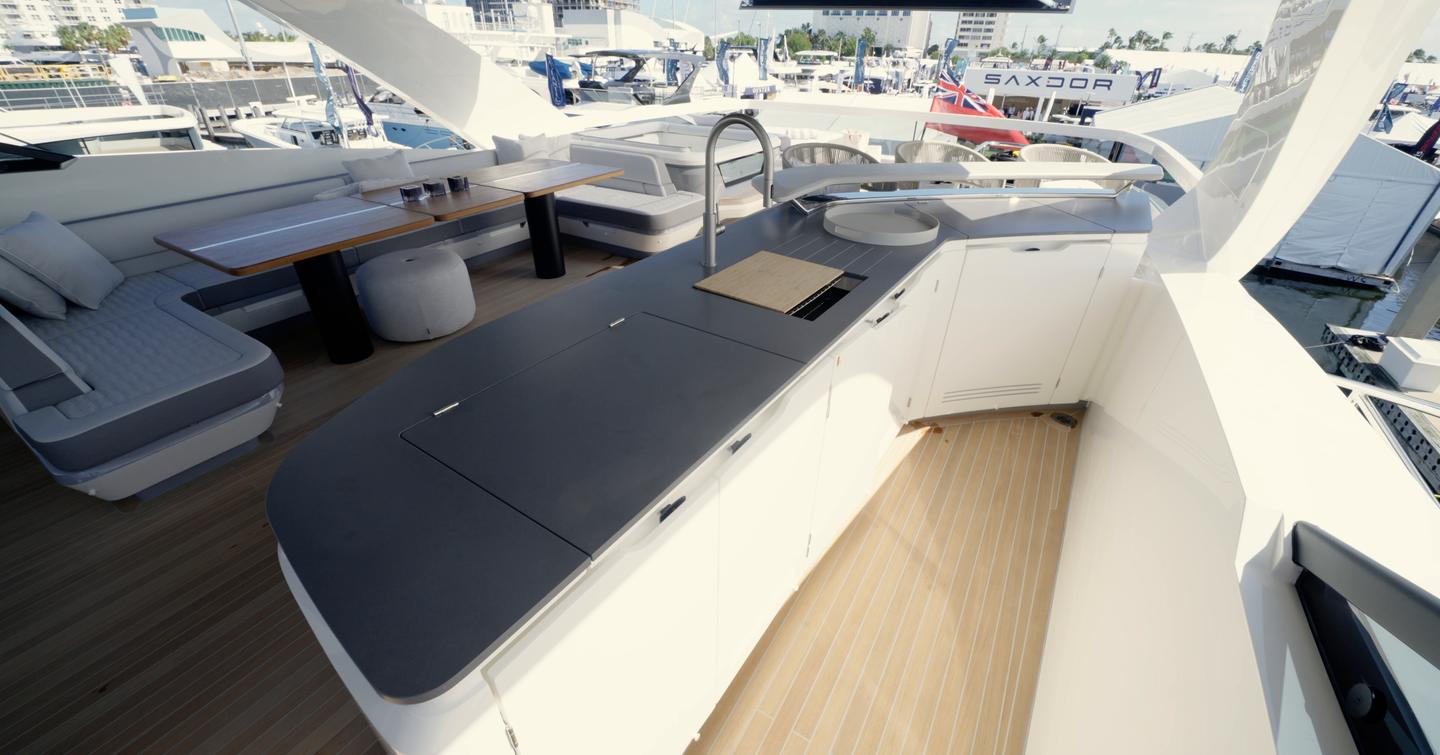
Opposite is one of the best features of the flybridge: a fully equipped outdoor galley rather than the usual glorified wet bar. There's a grill, sink, fridge, ice maker and an enormous cool box, all beneath substantial stone worktops. Pearl has even provided a complete set of crockery, cutlery and glassware for use up here, all of them secured in their own fiddled lockers. When guests want to eat outside, it makes far more sense for the chef to prepare and serve a meal up here than have the crew ferry plates up and down the stairs.
The hardtop has another neat trick up its sleeve. Its louvres can tilt to let in a little sunshine or slide back to open the roof almost completely. There's also a pop-up television, so you can watch a film or the Grand Prix from the comfort of the flybridge.
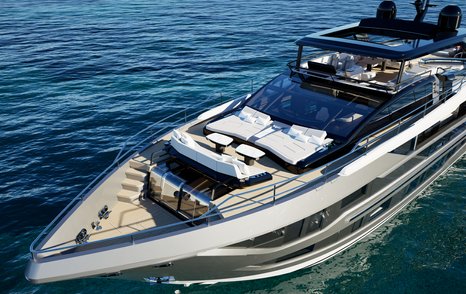
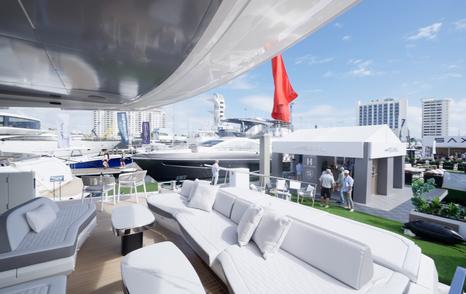
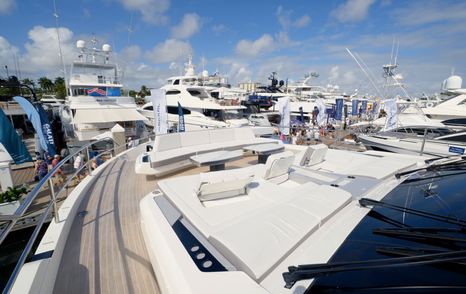
What makes this upper deck particularly unusual, though, is the direct route forward to the bow. A gently sloped passage, with just one step to negotiate, leads straight from the flybridge to another substantial lounge on the foredeck. It's a lovely way to move around the yacht without constantly having to duck inside.
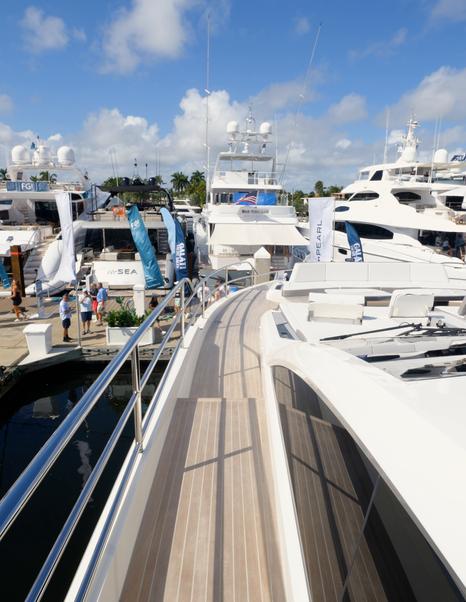
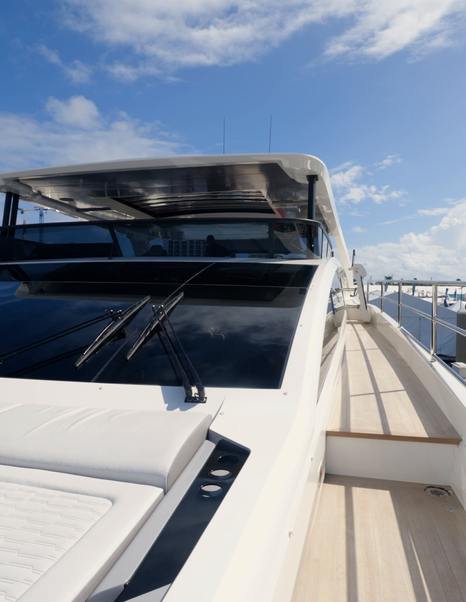
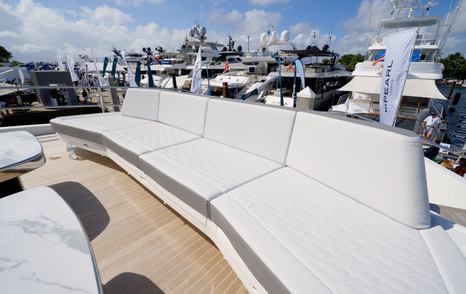
The foredeck seating follows much the same idea as the aft cockpit, with movable backrests that convert the sofas into sunpads. These can also be removed and stowed beneath the lockers to improve the helmsman's view when underway. There are pop-up deck lights, too, which still give me a little thrill whenever they appear, along with discreet lighting set into the bulwarks.
It's an impressive arrangement. Pearl has managed to create several distinct outdoor areas without making any of them feel like an afterthought, and the direct route between the flybridge and foredeck makes the whole yacht feel unusually open. For a boat under 30m (98ft), that's quite an achievement.
Engine Room
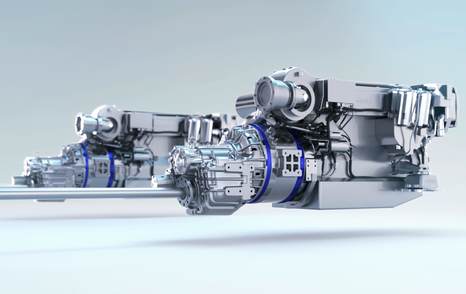
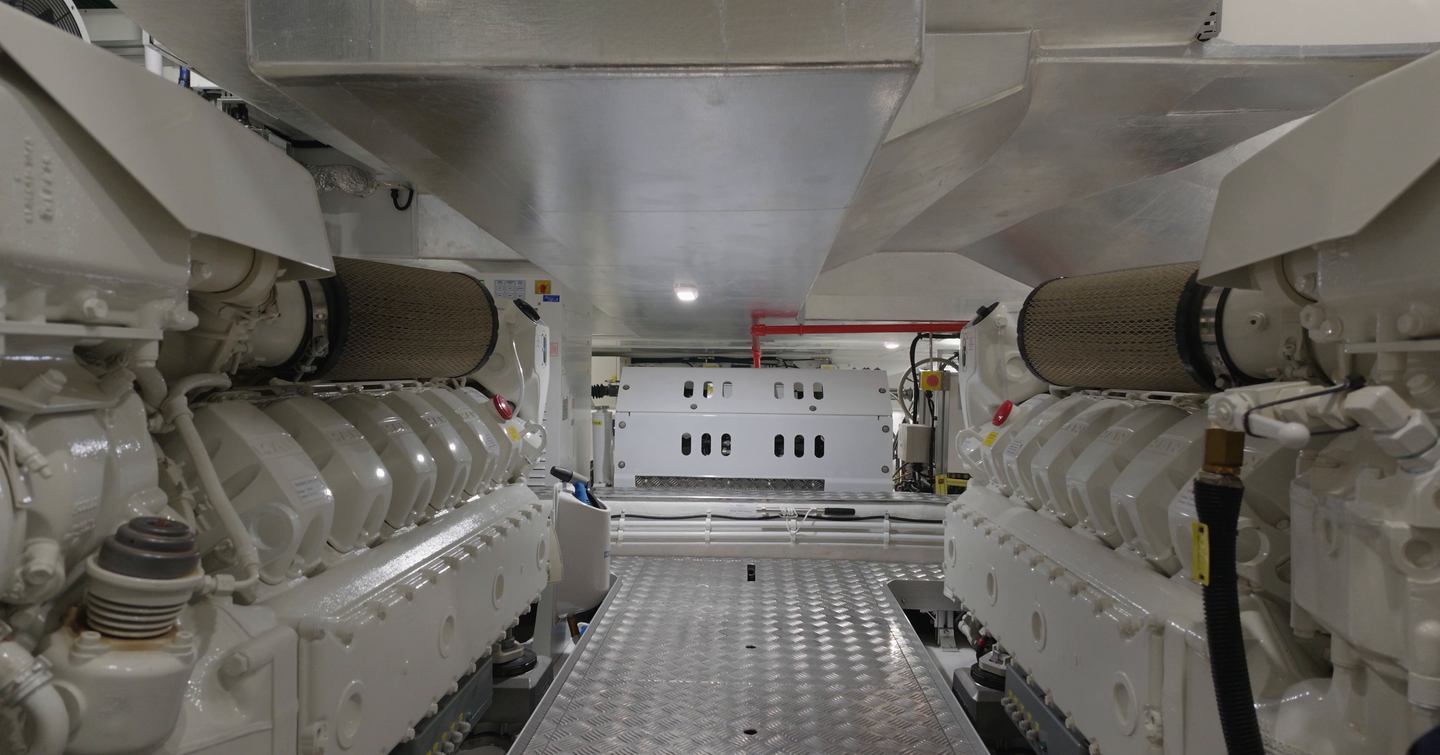
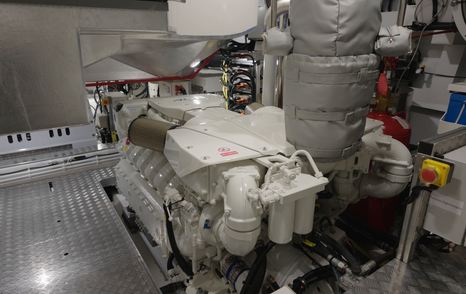
If the hybrid system is the Pearl 100's party trick, this is where the magic happens. The engine room is dominated by a pair of MAN V12 diesels, each producing 2,000hp, connected to conventional shafts through V-drive gearboxes. But tucked between the engines and gearboxes are two big e-Motion electric motors, each rated at 235kW. These are what give the Pearl its ability to operate without firing up both enormous diesels every time it needs to move.
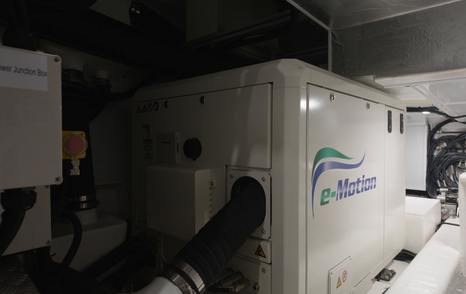
The electric motors draw their power from either the batteries or a 180kW Yanmar generator, depending on the operating mode. Now, you might wonder how a generator producing 180kW can drive two motors rated at a combined 470kW, but at displacement speeds they need nothing like their maximum output. Pearl says the hybrid system can also use one main diesel engine to drive both propellers.
Pearl estimates that the diesel-electric system could extend the yacht's range to somewhere between 1,500nm and 2,000nm, depending on speed. That's a substantial improvement on the quoted 1,150nm under conventional diesel power alone. The figures were still estimates when I visited, and the fuel savings will depend on how the boat is used. Nevertheless, the prospect of covering longer distances while reducing main-engine hours, and the associated servicing costs, is certainly appealing.
For me, though, one of the greatest attractions is what happens when you stop. The Pearl has a lithium battery bank with a reported capacity of 160kWh, which can supply the yacht's domestic electrical systems without the generator running. That includes the air conditioning, lighting, appliances and stabilisation systems. Pearl estimates eight to 12 hours of quiet-ship operation, depending on how much power everyone is using.
Just imagine arriving at a beautiful anchorage in the Bahamas, shutting down the engines and spending the evening without the constant background thrum of a generator, or exhaust fumes drifting across the aft deck. The generator is designed to start automatically when the batteries reach a low state of charge and top them up in short bursts. Pearl suggests around half an hour for a recharge cycle, although it has not specified how much charge that restores. It's a fascinating prospect, particularly for owners who spend several nights at anchor.
There's plenty of conventional equipment down here, too, including a Seakeeper SK40 gyrostabiliser and CMC fin stabilisers, giving this yacht two separate forms of stabilisation. The installation also includes variable-speed machinery and a sewage treatment system. It's a substantial technical package, although the hybrid hardware inevitably adds another layer of complexity to the engine room.
At £8.9 million excluding tax, the Pearl 100 Hybrid has a competitive price for a yacht of this size, particularly when you consider that the twin 2,000hp MAN engines and full diesel-electric hybrid system are included as standard. Similar hybrid installations can add well over £1 million to the price of rival yachts. With the Pearl, there isn't a separate 'green premium' to pay or a horribly expensive option box to tick.
The yacht I toured is considerably more expensive, at around £12.5 million, with extras including dual stabilisation, tropical air conditioning and an extensive onboard control system. Pearl's five-year warranty is another welcome benefit, although the level of cover varies over its term.
Our Verdict
So what do I make of the new Pearl 100 Hybrid? Well, there's an awful lot to like. The outdoor spaces are exceptional, there's masses of natural light, two master suites and some lovely detailing in the Kelly Hoppen interior. But lots of other yachts offer that. What really sets this Pearl apart is the fact that it comes with a full diesel-electric hybrid system as standard.
I love the fact that Pearl has grasped that nettle. The prospect of greater range, lower fuel bills, fewer engine hours and peaceful nights at anchor without a generator chuntering away is enormously attractive. And when you consider the amount of yacht and equipment you're getting for the money, it's a compelling package. For me, it's worthy of five stars.
But, and there is a but, Pearl still needs to prove that the hybrid system can deliver all those benefits in the real world. I haven't tested it at sea, and the projected performance figures still need to be verified. Long-term reliability is another unknown. They need to demonstrate that it can do all this day in, day out. If they can, I'm convinced they're onto a real winner.
Reasons to Buy
- Diesel-electric hybrid propulsion as standard
- Two full-beam master suites
- Exceptional flybridge
- Private owner's forepeak terrace
- Big garage for toys and tenders
Things to Consider
- Hybrid performance figures remain unverified
- Limited crew space
Pricing
Price as reviewed: £12,500,000 ($16,696,252 approx)
Base price is £8,950,000.
Looking to own a Pearl 100 Hybrid? Use YachtBuyer’s Market Watch to compare all new and used Pearl 100 Hybrid Yachts for sale worldwide. You can also order a new Pearl 100 Hybrid, customized to your exact specifications, with options for engine choice and layout configuration. Alternatively, explore our global listings of new and used yachts for sale and find your perfect yacht today!
Rivals to Consider
The 29.1m (95ft 6in) Princess Y95 is probably the closest match to the Pearl, with almost identical internal volume at 155GT, five guest cabins and the option of the same twin 2,000hp MAN engines. It even has two full-beam suites, so Pearl can't claim a monopoly on that particular trick. The difference lies in the propulsion and fuel capacity. The Princess carries 13,400 litres of diesel against the Pearl's 10,400 litres, and YachtBuyer quotes a range of up to 2,000nm at 10 knots against 1,150nm for the Pearl under conventional diesel power. Those aren't independently matched trial figures, but they suggest that Princess has taken a more traditional route to long-distance cruising, with larger tanks rather than hybrid machinery. The Y95 also offers a choice between a tender garage and an optional beach-club arrangement aft. The Pearl counters with its fold-down cockpit balconies, extensive outdoor spaces and the prospect of silent electric operation.
If outright performance and accommodation flexibility matter more than hybrid technology, the Sunseeker 100 Yacht makes a persuasive alternative. At almost 30m (98ft), it has 155GT of internal volume and a main-deck owner's suite with its own private bow terrace, much like the Pearl. The standard layout has five cabins, but a sixth is available, with additional guest berths that could appeal to larger families. Sunseeker also offers a choice of MTU engines, including a pair of 2,600hp V16s that give it a considerable advantage over the Pearl's quoted 24-knot maximum. There's a huge flybridge, direct access to the foredeck and a tender garage, although the Pearl's fold-down cockpit balconies are a notable difference.
The 29.06m (95ft 4in) Sanlorenzo SL96 Asymmetric takes a different approach to the problem of fitting a quart into a pint pot. At a published 104GT, it has substantially less enclosed volume than the 154GT Pearl, but Sanlorenzo has used an unusual asymmetric deck layout to make the main saloon feel particularly spacious. The conventional side deck remains to starboard, while the port passage moves up to flybridge level, freeing around 10m² (108ft²) of extra interior space. It's a fascinating solution, although the standard accommodation is limited to four cabins for eight guests, against the Pearl's five cabins and ten. Twin MTU diesels give the Sanlorenzo a quoted maximum speed of up to 28 knots, and its published range of 1,250nm at 10 knots is slightly greater than the Pearl's conventional diesel figure.
Considering a new yacht? Explore Pearl's entire current range to find the model that best suits your needs, and compare it with alternatives from competitors to ensure you make the perfect choice.
Specifications
- Builder Pearl Yachts
- Model Pearl 100 Hybrid
- Length Overall 96' 7"
- Beam 22' 2"
- Draft(full load) 6' 10"
- Hull GRP
- Cabins 5
- Berths 10
- Crew 4
- Yacht Type (Primary) Raised Pilothouse
- Use Type (Primary) Cruising
- Cruising Speed
- Max Speed
- Fuel Capacity 2,747 Gallons
- Fresh Water Capacity 476 Gallons
- Engine Model 2x MAN V12-2000
- Engine HP 2000
- Engine economic speed 10 knots
- Engine max range (speed type) 1150 (nm)
Tenders
The Pearl 100 Hybrid supports tenders with a max length of 14' 3"
Pearl 100 Hybrid Layout
-
Flybridge
-
![Flybridge Pearl 100 Hybrid]()
There's room for a hot tub or gym, but it's the outdoor galley that saves the crew from endless trips up the stairs.

-
Main Deck
-
![Main Deck Pearl 100 Hybrid]()
The Riviera cockpit swaps formal dining for sofas and sunpads, with fold-down balconies that bring everyone that bit closer to the water.
-
![Main Deck Pearl 100 Hybrid]()
For owners who prefer a dining table aft, this layout adds that and glass balustrade, although the Riviera's relaxed seating is lost.


-
Lower Deck
-
![Lower Deck Pearl 100 Hybrid]()
The second full-beam master means co-owners needn't draw the short straw, but it can also become two cabins if six are needed

Interested in a Pearl 100 Hybrid?
NEW Build
Find your local dealer for a personalised, no-cost consultation
or just request
Brochures & Pricing
Used & In Stock
Looking for a ready-to-go Pearl 100 Hybrid or pre-owned options? Explore all inventory of the Pearl 100 Hybrid available worldwide