-
Guests
12
-
Cabins
7
-
Crew
22
| Length | GT | Built (REFIT) |
|---|---|---|
|
71.61m
|
1,859 GT | 1983 (2022) |
| Beam | Draft | Top Speed |
| 12.82m | 5m | 12 Kts |
€13,900,000
More DetailsNansen Explorer is a 71.61m expedition yacht for sale delivered by Oy Laivateollisuus Ab in 1983. Her naval architecture and exterior design comes from the drawing boards of Oy Laivateollisuus Ab.
Key Features
- 1A ice-class hull
- Commercially certified helipad
- 12,000nm cruising range
- Twin tender boat deck
Design & Construction
Designed around a displacement ice class steel hull and superstructure she features a 12.82m beam and a 5m draft. The yacht has an internal volume of 1,859 GT (Gross Tonnes).
Exterior Design
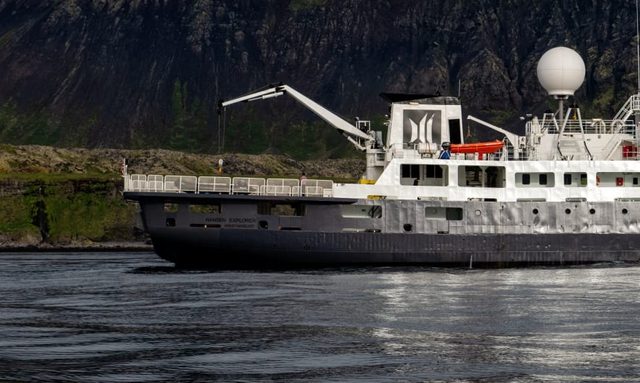
Nansen Explorer still reads as a working ship first and a yacht second, and the 2022 conversion has not tried to hide that. The original OY Laivateollisuus profile remains intact, with a high bow, upright superstructure and a long aft working deck dominated by cranes, tenders and aviation equipment rather than terraces and beach clubs.
Guest and crew accommodation sit in a compact central block, while a huge amount of the aft half is kept for operations. The upper passenger deck opens onto the commercially certified helipad, and the boat deck below carries two substantial tenders side by side with dedicated handling space around them.
That arrangement is quite different from a modern explorer yacht designed around large exterior lounges. Here, aviation and tender handling have their own proper working zones, so a helicopter, dive programme or shore party does not have to take over a guest deck every time equipment needs to move.
The stern is correspondingly industrial. There is a broad open deck, cranes and clear loading space rather than a stepped beach club, and the plans show direct routes between these working areas and the interior technical spaces. For heli-skiing, diving or extended expedition work, that is a much more useful use of the hull.
The foredeck is comparatively simple, leaving the accommodation and command spaces concentrated amidships while the yacht's heavy operational machinery sits farther aft. It gives Nansen Explorer a very honest profile, and one that still makes sense more than four decades after the ship was launched.
The 2022 refit brought Nansen Explorer up to Class 1A, the highest level below icebreaker classification, while stern thrusters were added to improve manoeuvrability. The yacht is commercially registered and can therefore be run around a much more demanding operating programme than a purely private pleasure yacht.
Interior Design
The 2022 refit changed the guest side of Nansen Explorer far more dramatically than the exterior. NMI and Åshild Landevaag of Landz Architects created a Scandinavian-influenced interior while retaining the scale and straightforward circulation of the original ship.
The main lounge was enlarged during the conversion, with bigger windows, higher ceilings and a bar added. That is one of the clearest differences between Nansen Explorer and her nine sisterships, and it gives the principal living space much more daylight than the relatively small exterior windows might suggest.
A substantial dining room occupies the centre of the main deck, with large service and circulation spaces around it, while additional lounges sit on the decks above.
The dining room itself is quite bold. Pale seating and dark flooring are paired with mirrored walls, sculptural gold-coloured ceiling lights and a large illuminated landscape panel. It has a more decorative character than the exterior would lead you to expect, but the room is still broad, simple and practical in layout.
Accommodation
Nansen Explorer accommodates up to 12 guests in seven cabins, with a separate staff cabin and quarters for up to 22 crew.
Seven guest cabins for 12 people gives the yacht an unusually low guest density. Rather than relying on a handful of very large suites, the layout provides more private rooms for a relatively small party, which suits longer expedition itineraries where guests may be aboard for weeks rather than days.
Much of the guest accommodationis placed together on the lower and main accommodation decks, arranged around broad central corridors. The repeated cabin modules are another reminder of the vessel's commercial origins, but they also make movement around the yacht simple and keep sleeping areas away from the busiest working decks aft.
Crew provision is on a completely different scale from a conventional 12-guest yacht. Nansen Explorer has 17 crew cabins, including a dedicated medic's cabin, and can carry up to 22 crew. That allows her to support yacht operations, engineering, tenders, diving, aviation and expedition logistics at the same time.
Performance & Capabilities
Powered by twin diesel Scania (GORKIJ/RUMO G-74) 1,558hp engines, motor yacht Nansen Explorer is capable of reaching a top speed of 12 knots, and comfortably cruises at 10 knots. With her 390,440 litre fuel tanks she has a maximum range of 12,000 nautical miles at 10 knots.
Tenders
Two substantial tenders are carried side by side on the dedicated boat deck, with their own lifting equipment and clear deck space around them.
That is a much more serious tender arrangement than a conventional side garage. Boats can be prepared independently of the main guest areas, and the open deck leaves space for additional expedition equipment alongside them.
Above, the helipad occupies a large, clear platform aft of the accommodation block. Its separation from the tender deck and principal interior spaces helps the crew run aviation and boat operations without turning the whole stern into one congested working area.
Nansen Explorer Yacht is For Sale
Nansen Explorer is currently on the market for sale with an asking price of €13,900,000 EUR.
If you're the yacht owner, broker, or captain, please use the "Update Sales Info" link to report any changes to the sales information. Update Sales Info