Beneteau Gran Turismo 40 Coupe (Mk2) Key Facts
- LOA 12.53m
- Model Year 2025
- Cabins 1
- Max Speed 32 knots
- Status In Production
- Generations 2
- Yacht Type Sportscruiser
- Use Type Cruising
Video Tour
Two Generations of the Beneteau Gran Turismo 40
The shift from the Mk1 Gran Turismo 40 to the Mk2 is more than a facelift. The Mk1, launched around 2016, ran at 12.67m (41ft 7in) LOA with a 3.86m (12ft 8in) beam and a 650 L fuel tank. The Mk2, unveiled under Beneteau’s 2025 redesign programme, moves to 12.53m (41ft) LOA and a 3.64m (11ft 11in) beam with an increased fuel capacity of about 805 L on the inboard sterndrive version. So although the Mk2 is slightly shorter and narrower on paper, the deck moulding and internal structure are reworked to free up more usable cockpit footprint rather than expand raw hull volume. That shows in the new dual L-shaped cockpit seating and aft-facing wet bar, which replace the GT40 Mk1’s more traditional C-shaped dinette opposite the bar. Below, the Mk2 drops the GT40 Mk1’s partitioned feel for a lighter open-plan space with simpler furniture lines. Propulsion options widen too: while the GT40 Mk1 stayed with diesel sterndrives, the GT40 Mk2 adds a full outboard configuration and the larger tank to suit longer, faster days. The redesign is part of Beneteau’s broader Sport-Lux update, with new glazing, a fresher hardtop profile and layout logic shaped around day boating rather than multi-cabin cruising.
On Deck
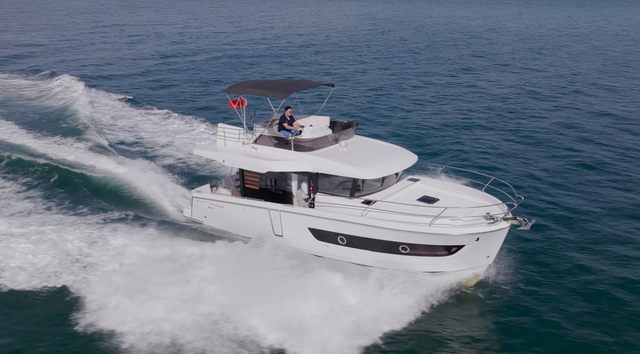
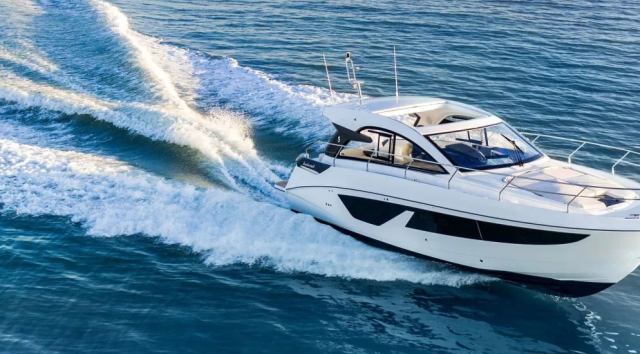
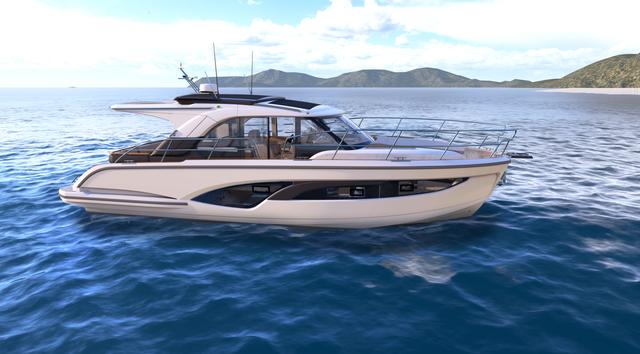
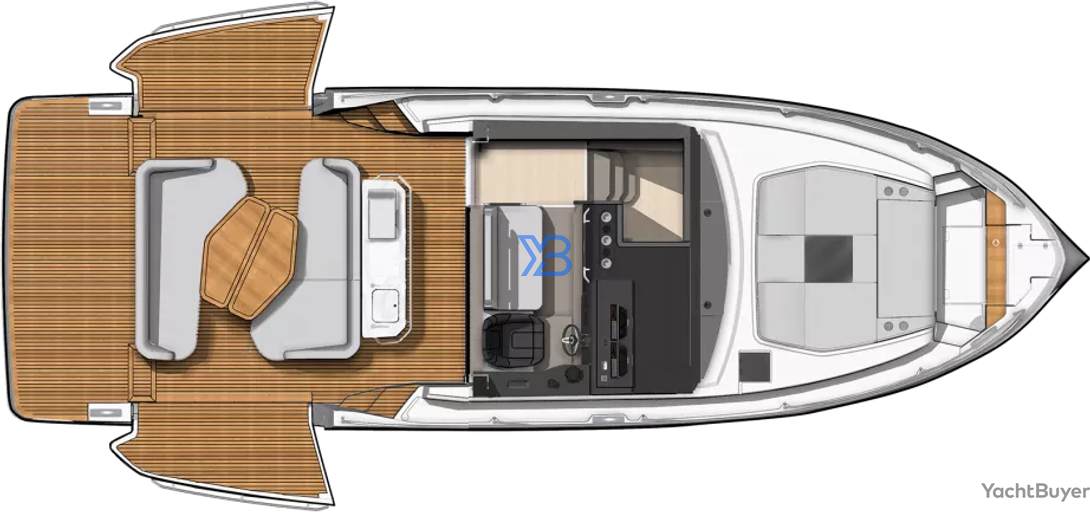
The Beneteau Gran Turismo 40 is a low 12m / 39.4ft sportscruiser set up as a big day and weekend platform rather than a mini flybridge with a “layer cake” of steps and garages. The cockpit starts on the integral bathing platform, where you step up into a full beam social zone with drop balconies to port and starboard. With the balconies down you gain a wide, open terrace effect over the water. With them up, as shown at the pontoon, the cockpit feels enclosed and secure.
The aft seating layout runs as a wraparound lounge rather than church pew benches. You face across the boat, you stretch out, you chat to someone opposite, you put your feet up. A central table sits in front of the seating and folds out either way. Fold it one way or the other and you uncover built in cup holders. The table drops down on a height adjustable pedestal so the whole aft area turns into a sunbed, which backs up the bow sunpad.
This particular boat carries the Alpine Edition styling package. That brings black rails, a black hardtop in place of the usual pale grey, Alpine branding on the back of the helm seat and a carbon fibre effect around the helm. It gives a more automotive look that's based on Alpine’s car roots without changing the core layout.
You can throw shade over most of the cockpit in hot weather and zip on canopy sections to enclose the area for UK or Northern European use. The boat shifts from open Med terrace to closed cockpit simply by plugging in canvas.
Forward, wide side decks lead up to the foredeck lounge. A one piece windscreen spans the full beam, which is a serious slab of glass that keeps sightlines clear from the helm. The foredeck has a sunpad with a backrest section that drops flat for sunbathing or stays up for better visibility when under way. A hatch under the shade pad sits over the forward berth and another section flips to create a flat spot for drinks and phones where they will not slide off.
The bow has a reverse profile, so the stem drops forward rather than raking back. That raises the obvious question about the anchor. The anchor sits in a concealed cradle inside the bow. A hinged lid opens backwards to expose the gear. Press the control button and the mechanism powers out like a sliding arm to move the anchor clear of the hull before you drop it. For regular anchoring days you can leave the handling kit extended so the anchor projects in the conventional way. That keeps anchoring simple from the helm while still giving the option to hide the cradle and chain when you want a fully “super sleek” bow profile.
On the hardtop you find radar, antennas and, on this Alpine Edition, a huge Alpine badge. The roof has a large electric sliding section over the helm and saloon area. Open roof, side windows down and the interior feels like part of the cockpit. Close the lot and the boat behaves like a quiet pickup cab, air conditioned and sheltered.
Clever deck details include cleats that fold flat and sit flush until you pull them up, plus deep cockpit seat lockers. The seat bases hinge in a “butterfly” motion so you access storage under both sides of the cockpit seating.
Interior Accommodation
The whole boat follows a “strip it back and keep it simple” brief. Rather than carve the interior into tight separate rooms, Beneteau chose an open space that suits day and weekend use.
Step in from the cockpit and the feel shifts from dark teak and outdoor textures to lighter, muted tones. The Alpine package adds a carbon fibre look around the helm and special trim with Alpine headrests on the helm seat, while the sound and light pack adds accent lighting along the furniture edges and down panels inside and out. The lighting runs as low level strips through the cabin and cockpit, so the boat glows at night without glare.
The galley and wet bar sit in the cockpit zone aft rather than deep down below. This boat has a grill, two fridges across the back unit and bins and stowage built in. At least one of the fridges has a digital temperature control, so you can set it as a freezer and fill it with ice bags that stay solid all day. Drawers sit under the worktop, with shelving below, while the sink hides under a cover with a low profile tap that lifts and swivels into place only when you need it. The key idea is to keep services tucked away so the cockpit reads as a big lounge but still functions as a proper day galley.
Forward, at the internal helm, the finish stays clean and technical rather than fussy. Two pods carry the main multi function displays for navigation and systems. The rest of the dash lies flat with touch style flush switches. Autopilot sits on one side, the bow thruster control on another, and Zipwake controls handle automatic or manual trim adjustment. Cup holders mix with Scanstrut wireless chargers so you drop a phone in and it charges without cables.
Large side windows slide along a track then push out at the aft end so the glass sits flush when closed yet opens wide for airflow when you move it. Air conditioning controls sit near the helm and repeat down below. The Seakeeper gyro stabiliser, fitted on this boat as an option, appears on the MFD so you view and adjust it from the helm.
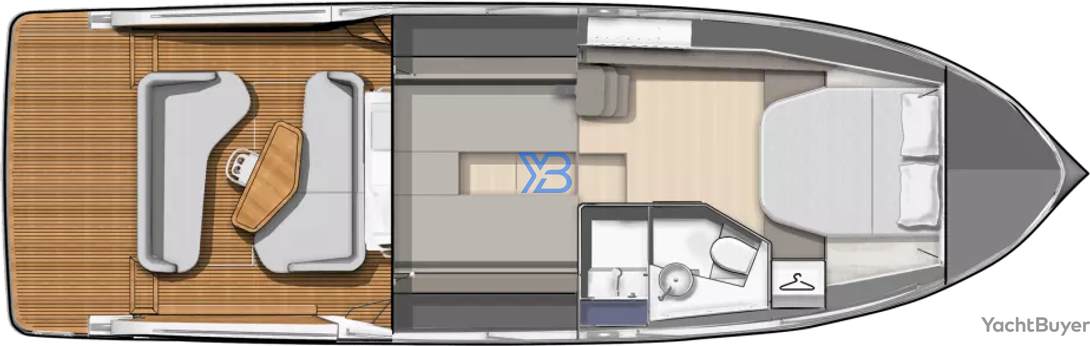
Down the companionway, the lower deck carries the same calm muted palette. The main space stays open plan rather than split into a forward dinette and a tucked away mid cabin. Instead, you have a fixed main berth and an extra twin berth area that also serves as a “crash out” or movie zone. The lighting sweeps around the cabin sides, opening portholes sit in the hull windows and an overhead hatch adds daylight and ventilation. A hanging locker gives proper clothes storage.
The heads and shower room feel a step up from a basic dayboat. The shower space sits behind its own doors, with a separate loo area, sink, mirror and stowage. You stand upright with decent headroom and the same soft lighting theme continues. For a boat used mostly as a day boat with occasional overnights or weekends, the lower deck gives more headroom and liveability than the “picnic boat” label suggests.
Owner's Cabin
The main berth sits forward on the lower deck. The berth lies under the foredeck hatch with opening portholes in the hull windows for cross flow.
The styling stays in line with the rest of the interior: light, muted fabrics, soft lighting strips that run around the cabin sides and a tidy hanging locker for clothes. Headroom works well for a boat of this size and keeps the space usable for a full week aboard if you choose, even though the concept of the boat is short cruising and long day use.
The forward cabin links to the rest of the lower space through the open plan layout rather than a solid bulkhead and door. That suits couples who run the boat themselves and want a more loft like feel rather than a warren of small rooms.
Guest Accommodation
Aft on the lower deck is a two bed berth that stretches under the cockpit, so you can treat it as a twin cabin when you need four on board overnight or use it as a “crash pad” the rest of the time.
The idea is that at the end of the day everyone comes down, stretches out, watches a film and cools off. Ventilation slots through opening ports, and air conditioning reaches this area if fitted. The space stays open to the main cabin rather than behind a door, so it feels like a casual movie den by day and a twin cabin by night.
For many owner couples the boat runs with just two people most of the time. When children or friends join for a weekend, the aft beds turn that zone into full size berths with no drama.
Performance & Engine Room
Access to the machinery space comes through the cockpit. First you lower the aft table with the height adjustment control. That allows the engine hatch to clear the table as it swings open. A separate button then lifts the hatch. The hatch opens in an unexpected direction across the cockpit rather than backwards, which feels odd at first sight but gives wide access once open.
Under the hatch sits a pair of Yanmar 8LV370 diesel engines on sterndrives. This is a notable break from the usual Volvo Penta choice on sportscruisers of this size. Beneteau already uses Yanmar units to good effect in its trawler range and extends that relationship here for the GT40. The yard expects a top speed of around 32 knots once full testing finishes, with a comfortable and efficient cruise around 26 knots and roughly 180 miles of range at that pace.
There is also an outboard version of the Gran Turismo 40 for markets such as the USA where owners often prefer outboards. That gives another route to similar performance with easier access to the power units.
The show boat carries a Seakeeper gyro stabiliser, a costly option but a strong draw for owners who want steady behaviour at anchor and in a beam sea. The boat also has a generator fitted. As an alternative, Beneteau offers a silent running package with lithium batteries and solar panels on the roof. That setup works with an inverter so you can run 240V services without a generator for many use cases. The choice between generator and silent running depends on where and how you plan to use the boat and how much time you stay off grid.
Ownership Considerations
Beneteau backs the Gran Turismo 40 with a ten-year structural warranty on the hull and deck and a three-year parts and labour warranty on mechanical and onboard systems, as long as the boat sees its scheduled annual dealer service. That routine visit covers engine checks, sterndrive work if fitted, and the broader onboard systems that keep the boat honest. Beneteau’s spares network is wide, so common parts reach dealers quickly, which helps keep downtime low.
Berthing a 12 m boat is straightforward. The GT40 sits in the standard 40 ft bracket, so most marinas can slot it into a regular berth without the need for a premium oversize slip. Draft is modest, so you can nose into shallower spots than you might expect from a hardtop sportscruiser of this size. Owners often dry stack or use a lift in some regions, but the boat is happiest in a regular water berth where those drop balconies and cockpit shades come into their own.
As for rival boats, in this size bracket the Princess V40 gives a more formal cabin plan and a deeper-V hull, while the Marex 390 has sheltered cruising with clever canopy systems and long-stay comfort.
In Summary
Beneteau’s Gran Turismo 40 takes a clean sheet approach to the 12 m hardtop sportscruiser. Instead of a stacked, multi level cockpit and dense lower layout, it offers a big social cockpit with drop balconies, an Alpine Edition styling option, a tailgate style aft lounge concept and a forward sunpad deck tied to a neat hidden anchor system in a reverse bow.
For more insights on the Beneteau Gran Turismo 40 Coupe, or an overview of the entire fleet, peruse all Beneteau Yachts for sale. For more options, see all yachts for sale.
Looking to own a Beneteau Gran Turismo 40 Coupe? Use YachtBuyer’s Market Watch to compare all new and used Beneteau Gran Turismo 40 Coupe Boats for sale worldwide. You can also order a new Beneteau Gran Turismo 40 Coupe, customized to your exact specifications, with options for engine choice and layout configuration. Alternatively, explore our global listings of new and used boats for sale and find your perfect boat today!
Specifications
- Builder Beneteau
- Range Gran Turismo
- Model Gran Turismo 40 Coupe
- Length Overall 12.53m
- Beam 3.84m
- Draft(full load) 1.2m
- Hull GRP
- Cabins 1
- Berths 2
- Yacht Type (Primary) Sportscruiser
- Use Type (Primary) Cruising
- Cruising Speed
- Max Speed
- Fuel Capacity 870 Litres
- Fresh Water Capacity 255 Litres
- Engine Model 2x Yanmar 8LV320
- Engine HP 320
Available Stock


Beneteau
Beneteau Gran Turismo 40 Coupe12m | Gran Turismo 40 Coupe (Mk2)
2026 M/Y noname
Features: Aircon, Joystick
Interested in a Gran Turismo 40 Coupe?
NEW Build
Find your local dealer for a personalised, no-cost consultation
or just request
Brochures & Pricing
Used & In Stock
Looking for a ready-to-go Gran Turismo 40 Coupe or pre-owned options? Explore all inventory of the Gran Turismo 40 Coupe available worldwide