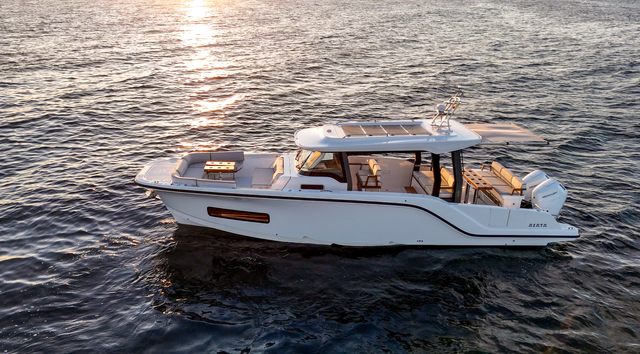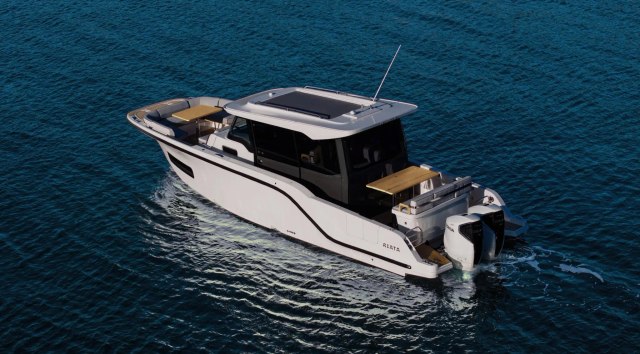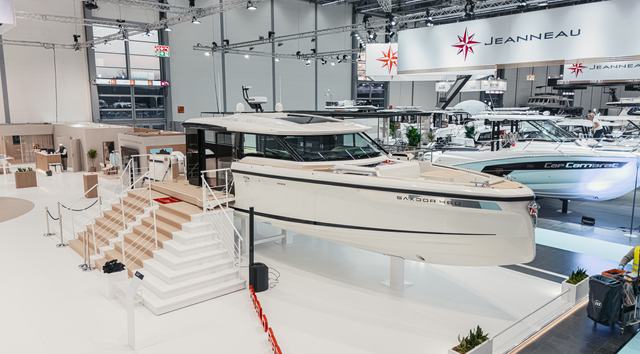
The Sunfinder 50 made its debut at boot Düsseldorf 2026, launched alongside the smaller Sunfinder 38 just one year after Aiata first entered the market. It arrives as a flagship from a brand still new to the segment, but with a layout, spec and pace that suggest it’s aiming high.
It boasts serious performance from a twin-stepped hull and triple outboards and a deck layout that should have its rivals sweating. Designed to be owner-run, it has a pair of double cabins below deck and a separate bathroom.
AIATA Sunfinder 50
- LOA 15.35m
- Model Year 2026
- Cabins 2
- Max Speed 50 knots
- Status In Production
- Yacht Type Centre Console
- Use Type Dayboating
Review Video
The Sunfinder 50 is Aiata’s largest model so far, at 15.35m (50ft) and launched alongside the Sunfinder 38 to mark a step forward in scale and ambition. While the earlier Wayfinder 38 series focused on enclosed cruising in all seasons, the 50 marks a shift toward open-air living, with flat structures, clean decks, and a layout designed for long days outside.
It was designed by Jarkko Jämsén, who also drew the Wayfinder 38 and played a central role in Axopar’s early success. His influence shows in the way the 50 balances form and function. The beam is wide and carried far forward, so the bow is high and creates real volume inside and on deck. The profile is upright and purposeful; it's a boat that looks a lot bigger than it is.
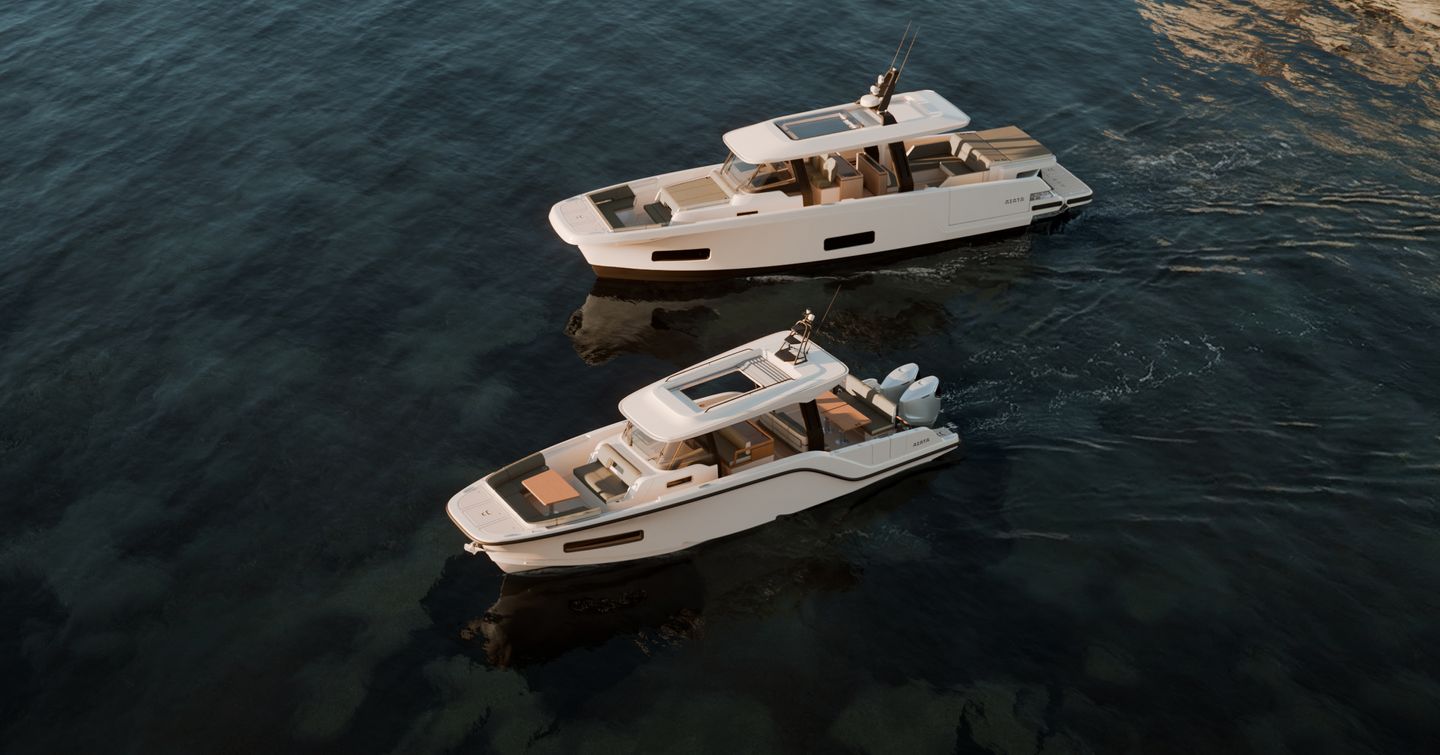
Below the waterline, the hull has two steps and a deep entry, with wide chines and a flared bow that helps throw spray clear at speed. The stepped form allows it to run flatter and plane earlier, while the wide forward sections prevent the bow from digging in when heading down-sea.
Carrying beam forward increases space above and below, so there is full headroom in the forward cabin, a standing shower, and enough room in the cockpit for proper seating and storage. The deck layout flows from stern to bow with minimal steps, and the sightlines are excellent. Lockers run down both sides of the bow lounge, and the cockpit floor lifts to reveal a technical space with room for a generator and/or Seakeeper. Every major piece of furniture includes built-in stowage.
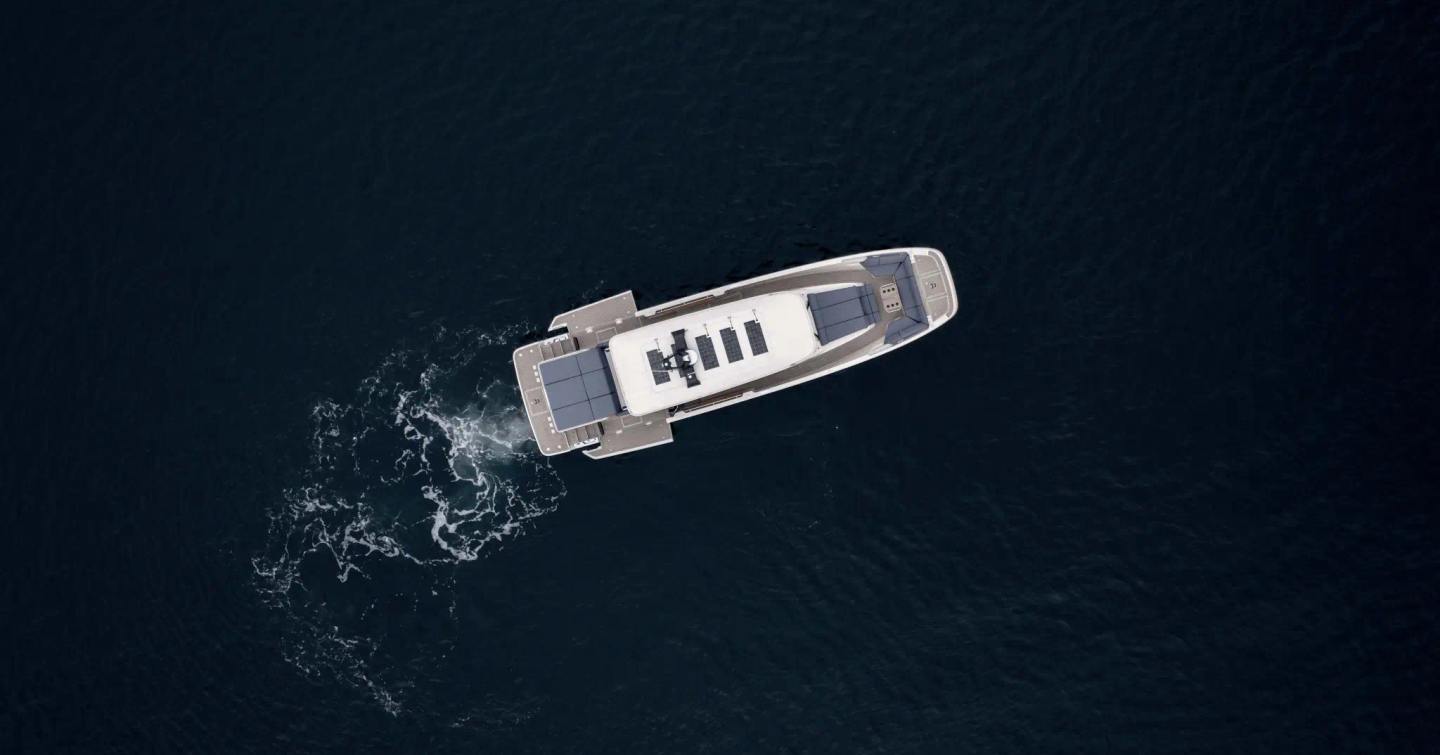
The hardware fits the scale of the boat. Cleats are large and well placed, the handrails are fixed low into the moulding, and the steps are wide with shallow rises. The hydraulic platform is standard, as are the folding balconies and hardtop.
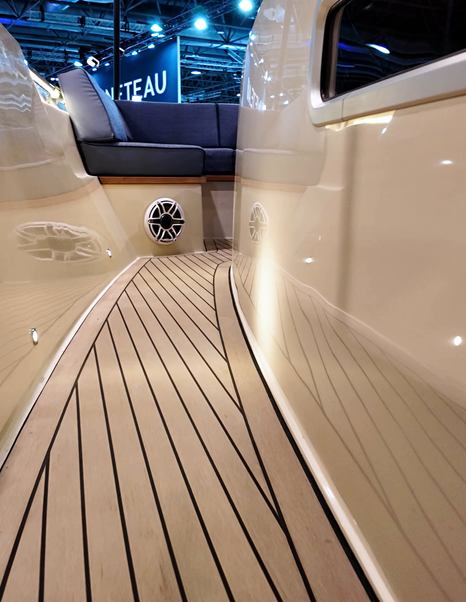
Lighting runs in strips through the deck, casting soft light under the seats and steps. Timber inserts add warmth and an elevated feeling of perceived quality compared to rivals. It is obvious in places that this is the first 50 they've built, with some rough finishing here and there, but that's not unusual for the first boat off the line.
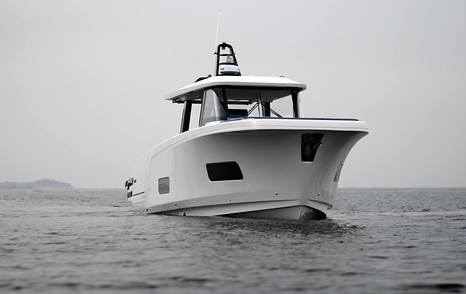
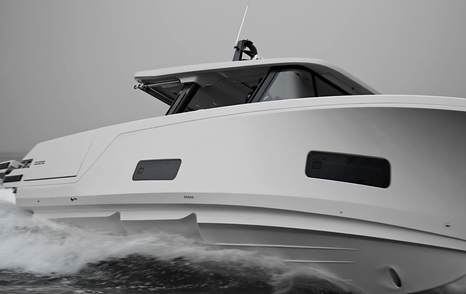
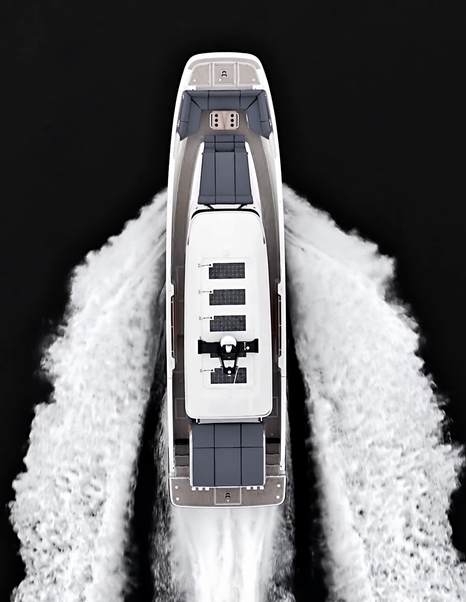
Engines
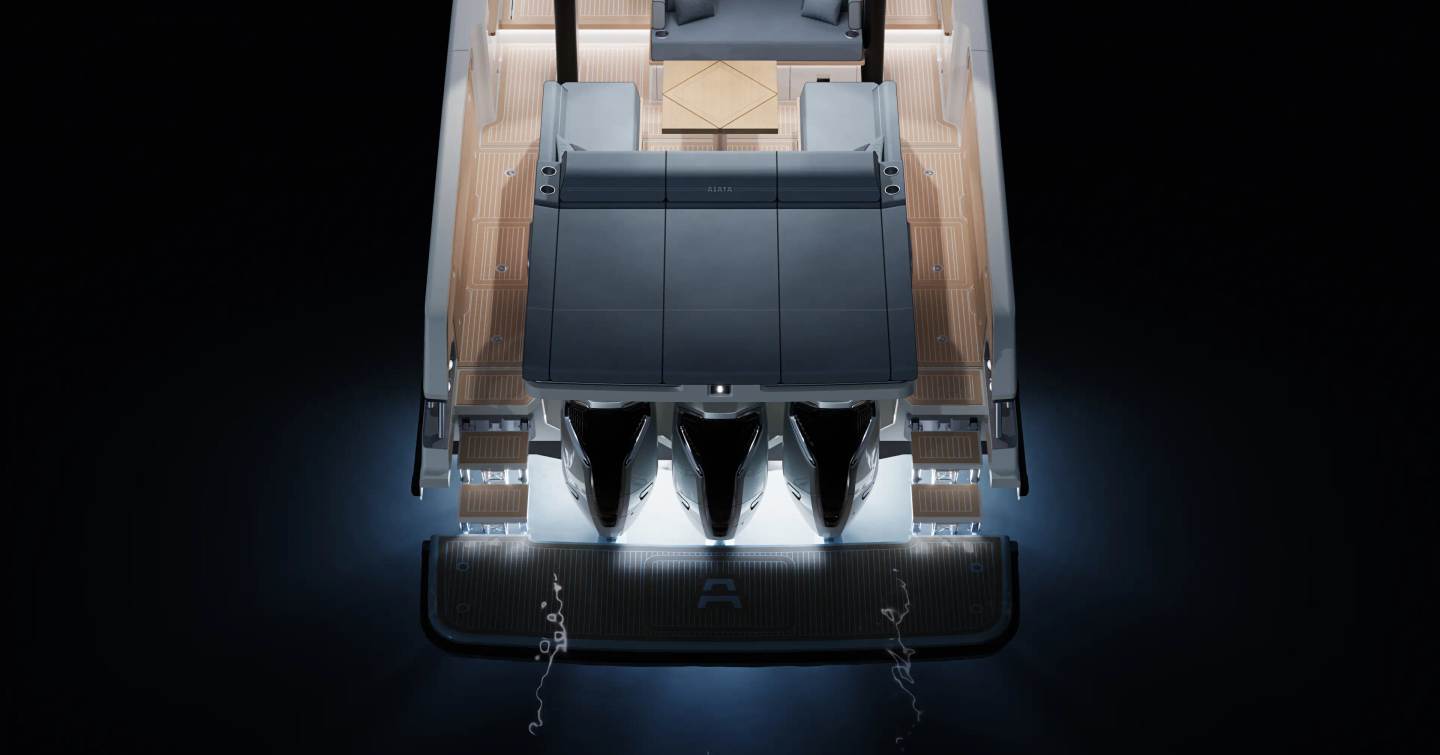
The Sunfinder 50 runs triple Mercury Verado V10 outboards, but there's a twist. The aft sunbed is fixed above, so the engines are easy to access while the deck gains a proper lounging space. Aiata hasn’t boxed them in like De Antonio does, so you have the benefits of outboards without killing deck space. A central cut-out between the seats leads down to the engine well, and there’s no need to move cushions or open lockers to reach it.
With three 400hp units fitted, Aiata quotes a top speed close to 50 knots and a fast cruising pace around 28 knots. The hull is twin-stepped and deep through the entry, while the bow carries extra volume forward with a flare that throws spray clear. A secondary chine above the waterline helps lift the nose and, according to Aiata, stops it from digging in when running down-sea. Fuel capacity is 1,600 litres, so the range should cover day runs, island hops and coastal trips without needing to top up too often.
Joystick control comes as standard, along with Mercury’s Skyhook station-holding system, so the boat should be easy to handle at low speed and simple to hold in position. That said, Aiata isn't beholden to a particular engine manufacturer, so if you want a different brand, you can have it.
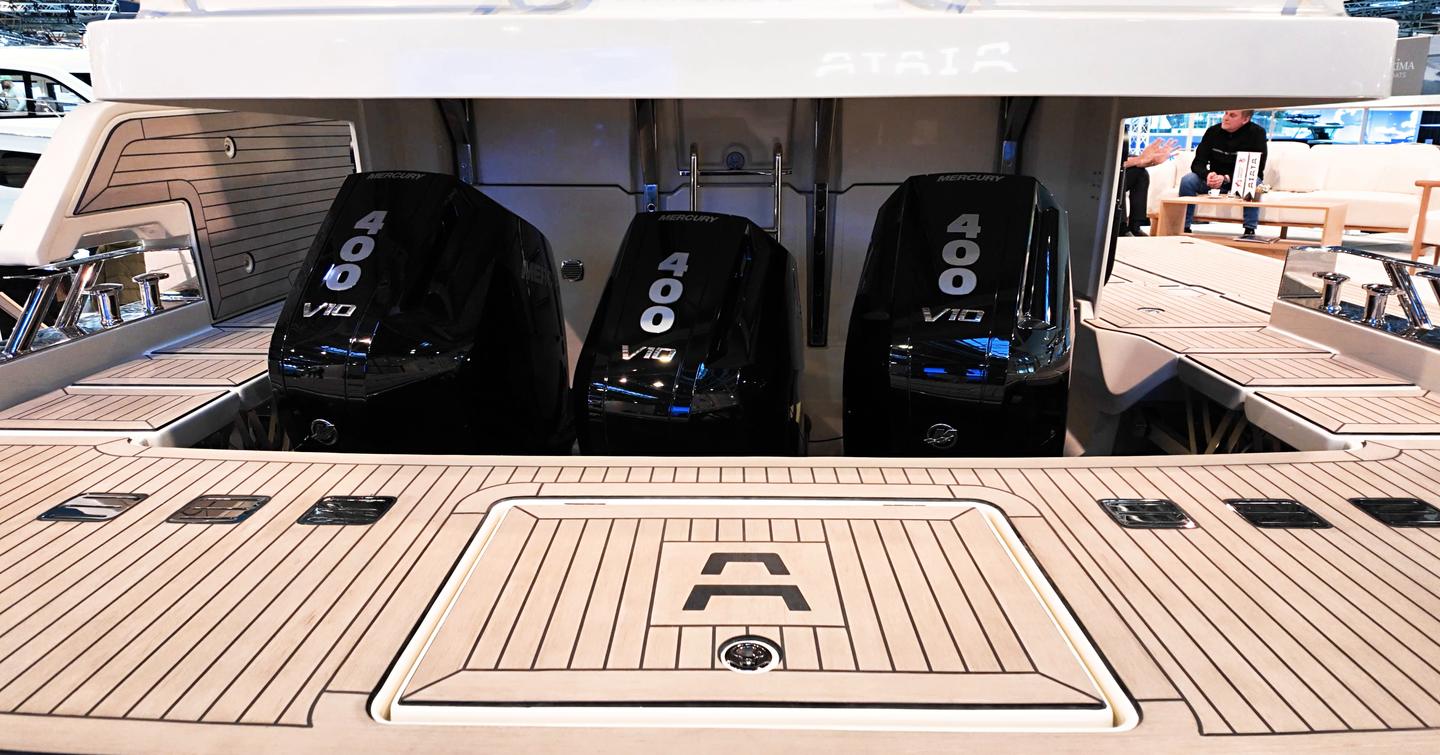
The aft end of the Sunfinder 50 is built around the platform. It runs full beam and sits just ahead of the engines, not behind them. A hydraulic arm lowers it into the water for swimming and lifts it to meet the dock when moored. This makes boarding easier from both the quay and the sea, while also acting as a barrier between the engine bay and anyone in the water. The platform is a fixed part of the design, and it’s included in the standard spec.
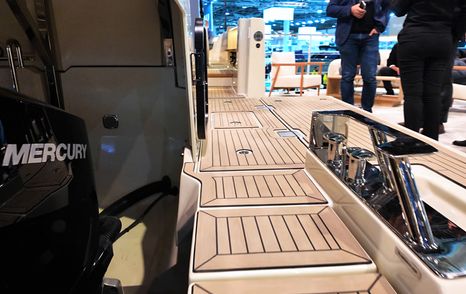
Fold-down balconies extend the deck space on both sides. They hinge outward from the cockpit walls and drop close to the waterline. When deployed, they widen the lounge and create more room to move across the back of the boat. These are also standard fit. They don't cut into the deck storage or disrupt the hull lines, and they work well whether you’re swimming, loading a tender, or just sitting with your feet in the water.
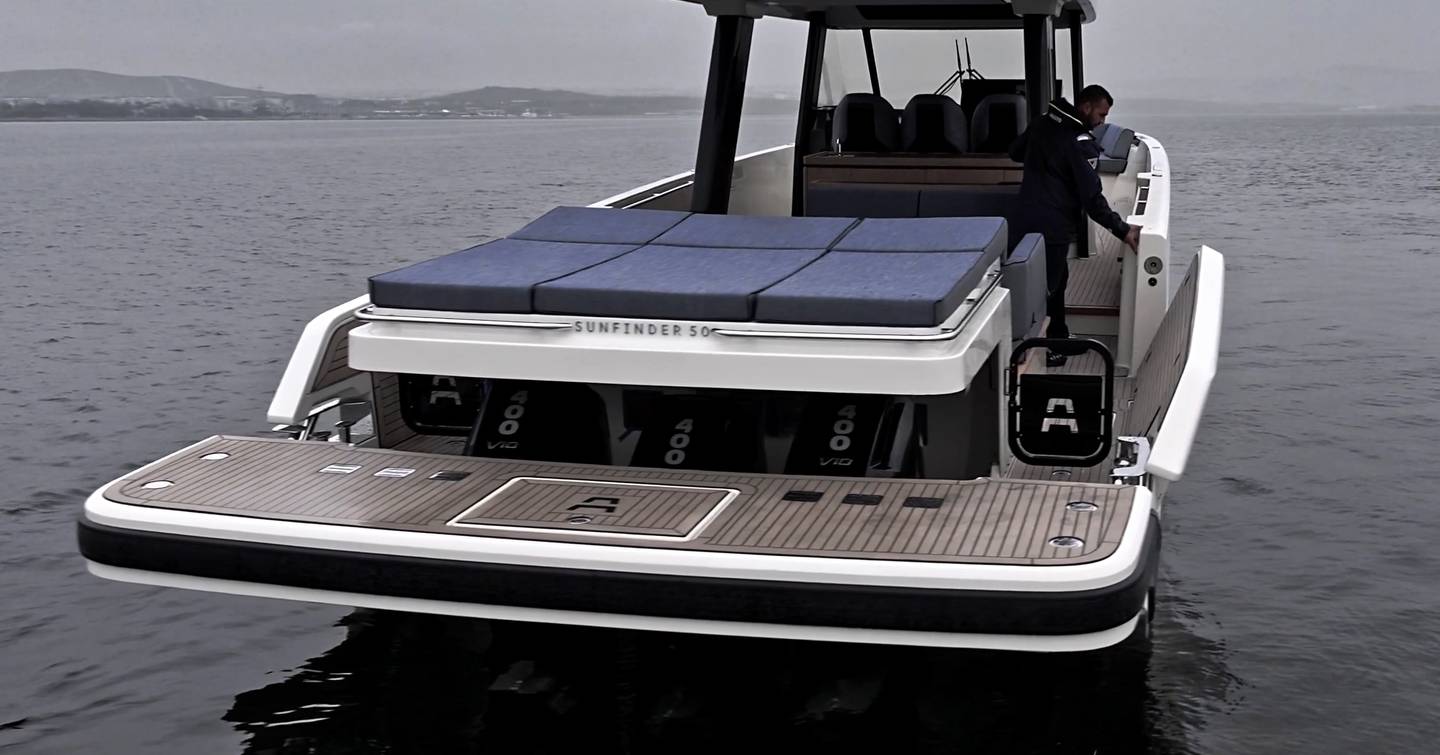
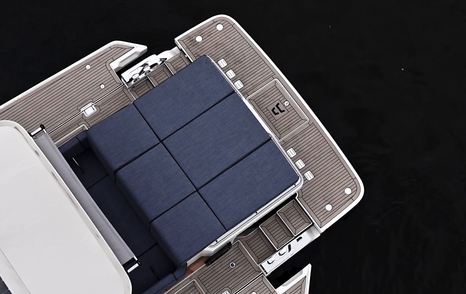
The sunbed sits directly over the engine well. It's fixed in place and wide enough to lie across without hanging over the edge. There’s enough depth to give proper back support, and the raised sides make it feel secure under way. The centre section drops away to give access to the engines and platform below. Unlike De Antonio’s full engine enclosures, Aiata’s design keeps the outboards visible but pushes the lounge far enough back that space is not lost.
Storage is built into the platform, with a dedicated locker for the carbon ladder and space for gear across the back edge. Engine linkages and technical gear are accessible through hatches beneath the sunbed and cockpit floor. All of it is simple to reach without moving furniture.
Cockpit
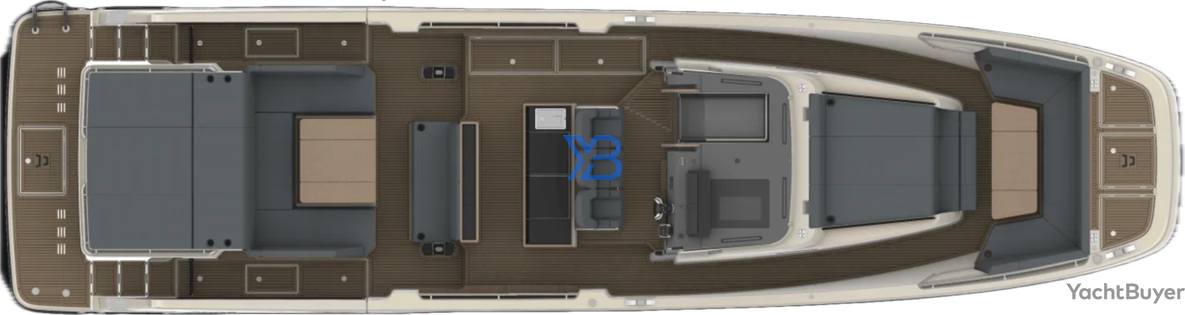
The cockpit is really the centre of the Sunfinder 50’s layout, fully open from side to side and covered by the fixed roof. The proportions help it feel bigger than expected for a boat of this length, and the layout allows people to move around easily while others are seated. It feels huge for its size.
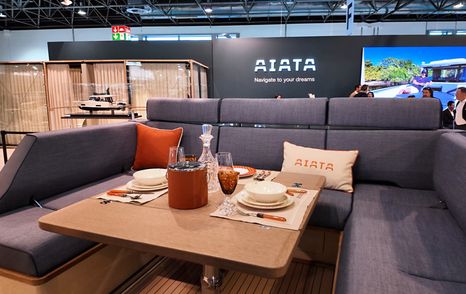
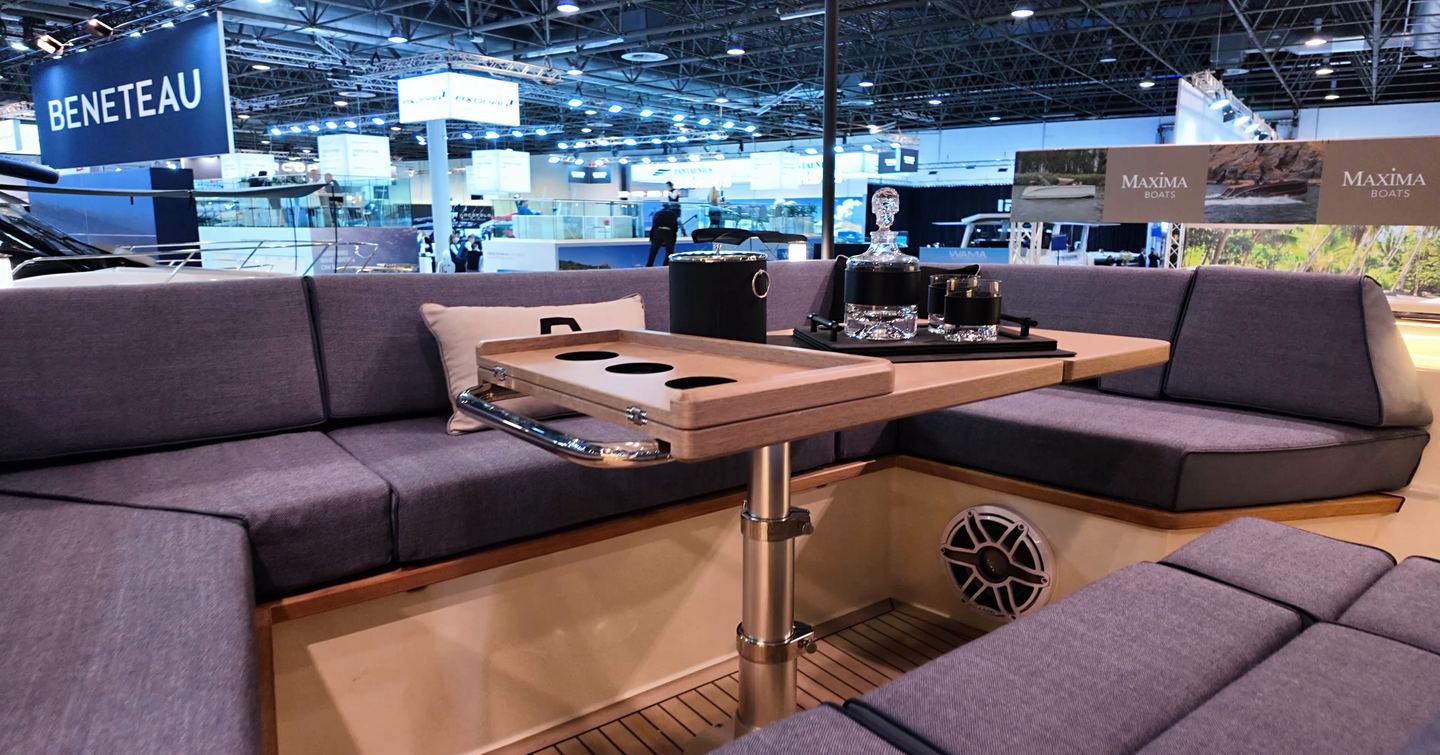
The main lounge wraps around the aft end of the cockpit in a wide U-shape. The table folds down and opens out, so it works for quick drinks or a full meal, and there’s room to seat six to eight around it without pulling up extra chairs. The backrests flip forward and aft, and the sunbed benches have fixed seats at the ends that can be used for dining or for watching the platform when it’s lowered.
The seating tracks aft on rails, so when the platform drops into the water, the backrests flip and the whole space turns into a forward-facing sofa over the water. The shift between dining and lounging takes seconds, and nothing needs to be removed or stowed.
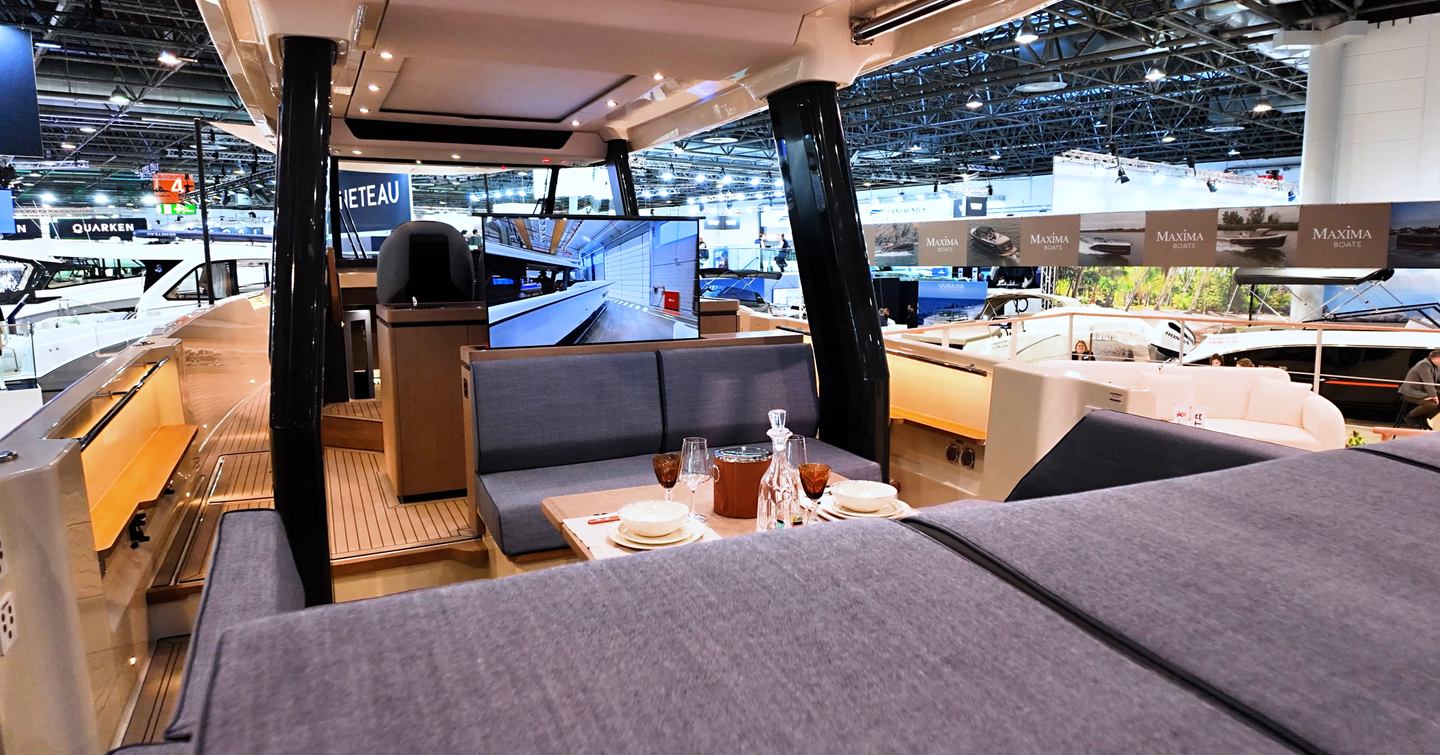
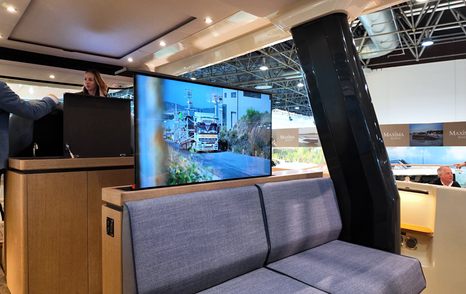
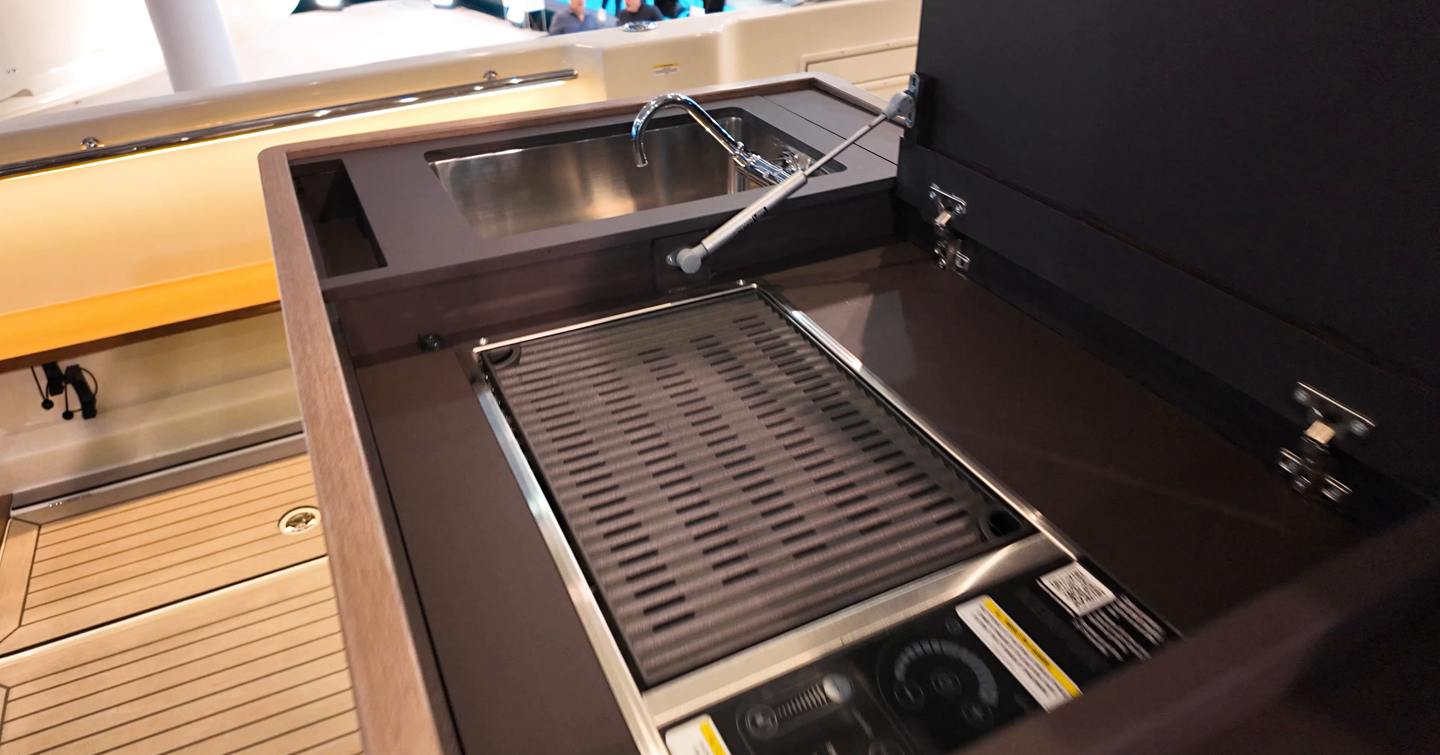
Ahead of the seating, under the hardtop, is the wet bar. It comes with a sink, grill and twin fridges as standard, while a ceramic cooktop is optional. The TV is tucked inside the cabinetry and pops up and down at the touch of a button.
The roof covers most of the cockpit, and a canopy stretches aft far enough to keep the seating shaded when needed. As well as the space in this area, the headroom within the hard top is really impressive and stands out in this sector.
Storage runs under the benches, and the floor lifts between the seats to reveal a technical bay with room for the generator and optional Seakeeper. The hatch opens wide and doesn’t interfere with the furniture, so access is easy. Grab rails are set low into the hardtop supports, and the deck lighting runs along the sides and under the rails.
Side Decks & Foredeck
There’s no step or drop along the side decks, so it’s easy to move forward. The decks are wide enough to walk comfortably, and the bulwarks rise high enough to feel secure, despite the lack of railings. Chunky pop-up cleats are a nice touch and are one of the many touch points that add an air of solidity.
The foredeck is built around a fixed sunpad. It’s wide, deep, and set low into the structure, with angled backrests that support both lounging and dining. This is where you really feel the benefit of that flared bow design.
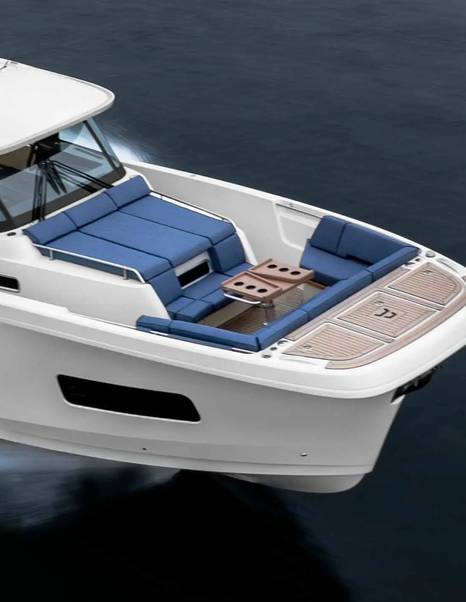
Between the cushions, an optional table slots into place. It folds out to cover the central section and is large enough to dine. When it isn’t needed, it folds away flat and turns the space into a large lounging area.
Storage runs port and starboard in lockers set into the side coamings. They’re deep enough to hold fenders and deck gear, with space to spare. In the centre, a flush hatch gives access to the anchor and windlass, which are both easy to reach.
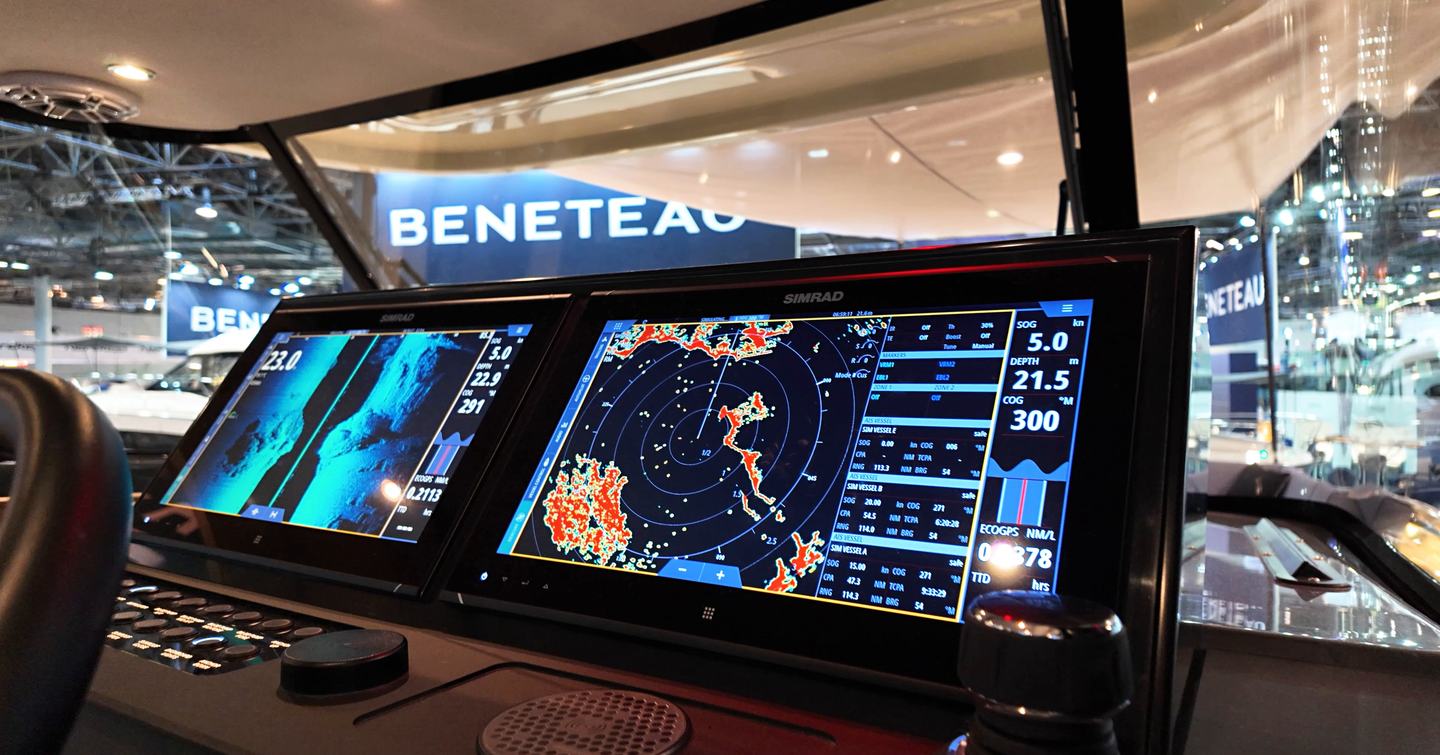
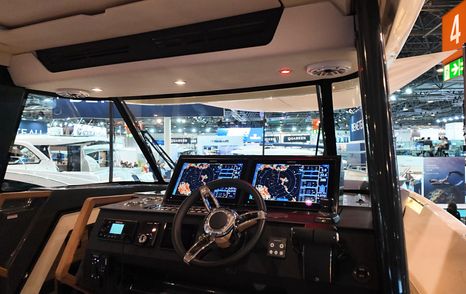
The helm has been designed for covering long distances at a decent lick. The windscreen wraps high around the front, so the driver and co-pilot are protected from the breeze and spray. On a boat that can run at 40 knots, having this area sheltered makes a difference.
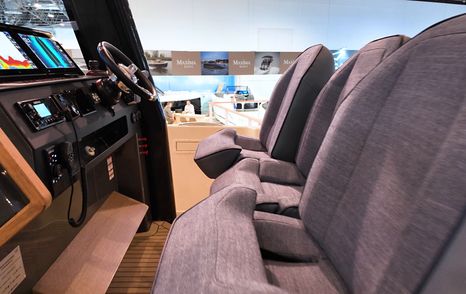
Unlike the 38, where the bench was shared, each seat here is separate, so the driver and both guests sit in their own space. The bolsters flip up, and the bases slide, so it’s easy to lean when standing or lock into place when seated. The wheel is adjustable, and there’s a solid footrest below, so the driving position works whether you’re standing, perched or sitting fully back.
Visibility ahead is clear across the bow, while the side decks are easy to glance along for close-quarters work. The dash layout is simple and focused, with twin 16-inch MFDs as standard and no clutter in the sightline. The dash is anti-glare but broken up with timber detailing that softens the otherwise grey palette. The throttles and joystick both fall to hand easily, too.
It feels well designed, but we won't know for sure until we sea trial the boat, hopefully later in the year.
Steps lead down from the helm into the lower deck, where the companionway opens between the two cabins. The transition is gentle, and the space opens up quickly once below. The owner's cabin is forward, with a second double cabin amidships and a generous bathroom in the middle.
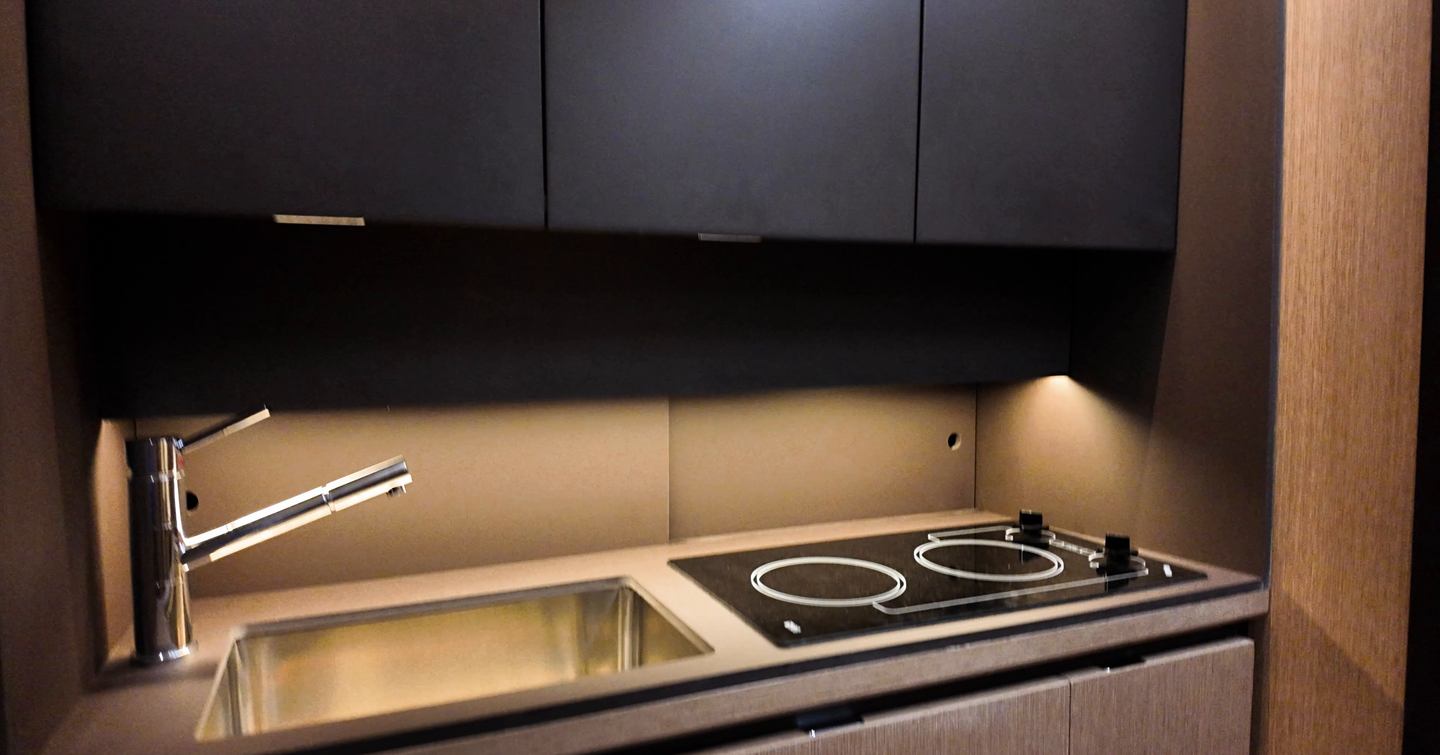
There are two layout options. One has two cabins and two bathrooms, with the head and shower split into separate compartments. The other replaces the second bathroom with a small galley, so the space can be used for light cooking or as a backup to the main deck setup. Both layouts use the same footprint, so the choice comes down to whether an extra head adds enough value on a boat of this size. For most owners, the deck galley will cover day-to-day use, and the lower galley will serve more as a convenience than a core feature.
The galley includes a sink, an induction hob, a microwave, and a run of low lockers. Fridge drawers sit under the steps, so they’re accessible from both deck levels, and there’s more storage in the furniture along the companionway.
Forward Cabin
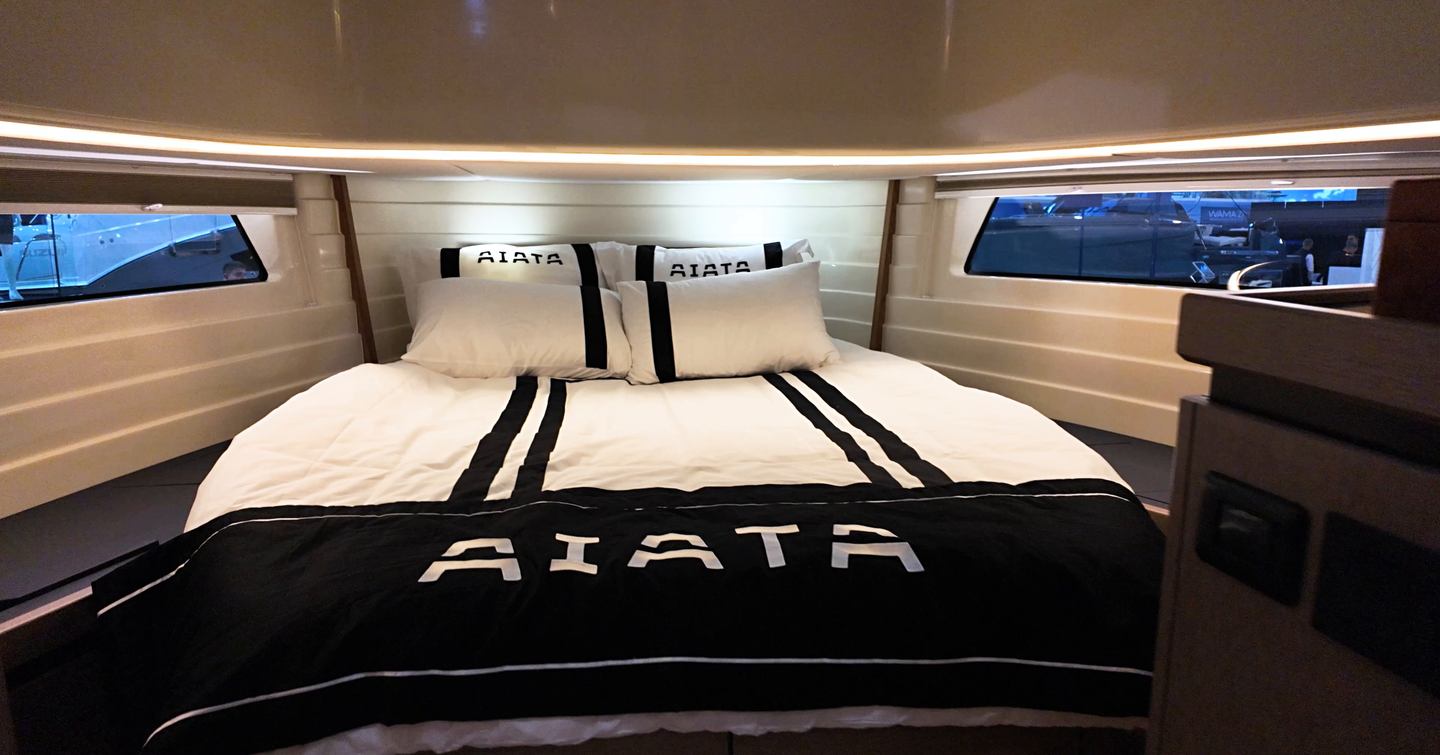
The forward cabin is ahead of the companionway and opens through a set of split doors. When left open, the space feels more connected to the rest of the interior, and the cabin gains light and volume from the central skylight above. This is smart: if you're on board as a family, you can leave it open-plan to enhance the space, or close the doors to improve privacy if you're on board with guests.
There’s good headroom through the centre of the space, with full standing height around the entrance and at the foot of the bed. The berth is mounted quite low, and headroom isn't great at the top of the berth, but that allows more room above deck.
Storage includes a hanging locker to starboard, cubbies on either side of the bed, and drawers set below. Long hull windows run down both sides, so there’s natural light during the day, and the overhead hatch adds both brightness and ventilation.
Amidships Cabin
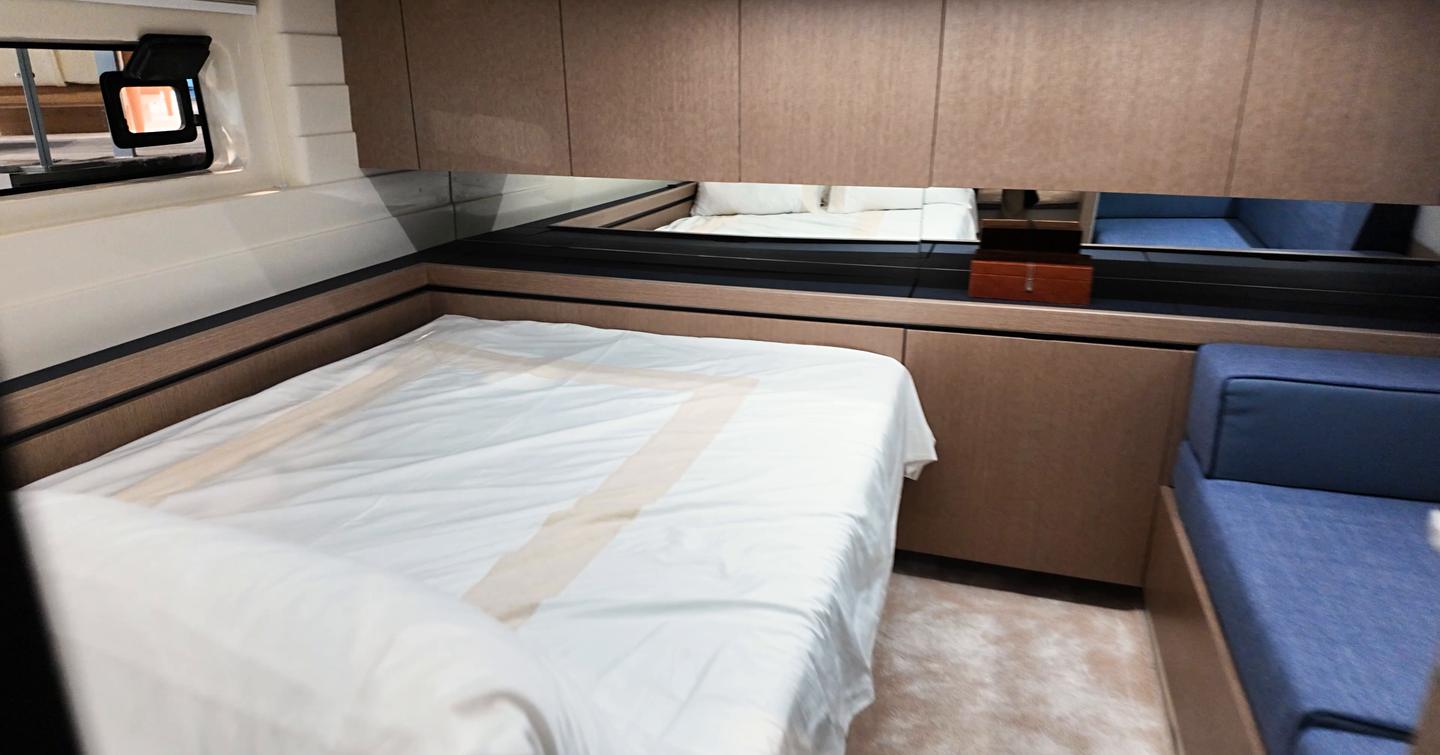
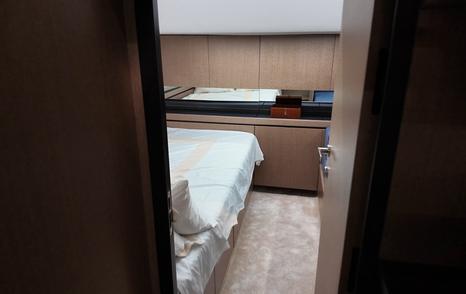
The mid cabin drops down two steps from the companionway on the port side. Headroom is limited on entry, but there’s a cut-out in the ceiling to stand close to the bed.
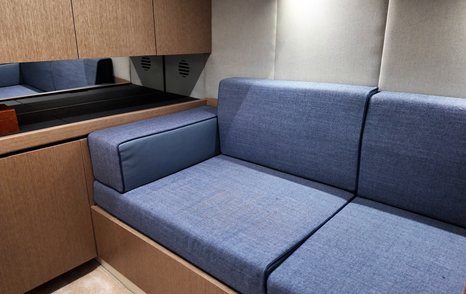
A full-width double bed runs under the cockpit. It’s wide and flat, though the person sleeping outboard will have to clamber over their partner in the night to get out. Opposite the bed, a sofa runs along the wall. It’s long enough for a child to sleep on, or to use as a daybed during longer stays. The mix works well for families or occasional guests.
There’s no full-height hanging locker, but storage is spread across lockers and drawers on both sides. A hull window brings in daylight, and an opening port gives airflow. Air conditioning is available, though natural ventilation may be enough for overnight use in cooler climates.
The accommodation feels pretty compromised compared to other genres of 50ft boat, but for this style of craft (which will mainly be used as a day boat/weekender), it works pretty well. Fit and finish sit somewhere between the smaller Saxdor 460GTC and the very well put together De Antonio D50.
The base price for the Sunfinder 50 is €850,000 ex VAT (correct at the time of writing), so you're likely looking at the best part of €1,000,000 by the time you've added options and tax. A fair bit of money, especially for an unproven marque that is likely to depreciate more than established names in the sector.
The good news is that there isn't an endless list of optional extras to chuck your cash at as the 50 comes pretty well specified in base spec, including things like: 2 x Honda V8 350hp, aft platform, balconies, Flexiteek, bow thruster, joystick, Zipwake, twin 16in MFDs, electric toilet, electric windlass, and an Ultra anchor.
The main things to consider would be the lower deck layout (we'd go for two bathrooms for better privacy) and the addition of a generator and gyro stabiliser for improved comfort at anchor.
Our Verdict
The Sunfinder 50 is a statement of intent. Aiata is a new brand, but it is well backed and serious about growing into this space, and this boat makes that clear. It arrives fully formed, with proper performance, a clear layout, and a high standard spec that includes what most owners would otherwise have to add.
There is clever thinking on board. The way the aft seating converts, the position of the sunbed over the engines, and the decision to include features like balconies and a hydraulic platform all suggest a team that has looked closely at what rivals are doing and worked to improve it. That thinking carries through, but so do a few first-build rough edges. Some seams could be tighter, and the finish will likely improve as production settles. And also, we have not yet sea trialed this boat, so full judgment will follow once we test it on the water.
It does feel like boat number one in places, and Aiata will want to sharpen the finish at this price point, but the start is strong. This is a capable design, and if the next models follow the same path, the brand will not stay quiet for long.
Reasons to Buy
- Feels big for its size
- Balconies and platform included
- Two-cabin setup
Things to Consider
- Cabin headroom tight
- Galley unlikely to see use
Looking to own a AIATA Sunfinder 50 ? Use YachtBuyer’s Market Watch to compare all new and used AIATA Sunfinder 50 Boats for sale worldwide. You can also order a new AIATA Sunfinder 50 , customized to your exact specifications, with options for engine choice and layout configuration. Alternatively, explore our global listings of new and used boats for sale and find your perfect boat today!
Rivals to Consider
The Axopar 45 Cross Top is shorter at 13.9m (45.6ft) and narrower at 4.11m (13.5ft), but it uses that space well. It runs triple 300hp outboards and reaches around 45 knots, while its stepped hull and long-range fuel efficiency suit owners who want to cover ground without burning through a tank. The layout is modular, with options for two cabins, and the gullwing doors and fold-out balconies help open the boat up when the weather allows. The helm is enclosed, so it suits northern waters or year-round use, while the Sunfinder 50 leans more towards warm-weather comfort with broader decks and more fixed lounging space.
The Pardo P50 stretches to 16m (52.5ft) with a beam of 4.96m (16.3ft), so it offers more interior volume and a loft-style fit-out below. It runs on twin Volvo IPS inboards and tops out around 35 knots, so it trades performance for refinement, and its one-level deck and wide sunpads suit dockside entertaining as much as cruising. The build is smart, the design is clean, and the helm setup is simple, but it comes at a higher price, and with less pace. The Sunfinder runs faster and feels more focused on driving, while still offering enough space for guests to stay aboard in comfort.
The Saxdor 460 GTC is a different proposition. It measures 14m (45.9ft) with a beam of 3.6m (11.8ft), and the standout is its full-beam pilothouse, which opens on both sides and at the rear to create a terrace-style space. It can take twin or triple outboards and reach close to 50 knots, so the performance is there, and the layout is flexible, with a bow lounge, optional third cabin, and fold-down terraces. It feels more enclosed and gadget-led than the Aiata.
The wallypower50X is longer at 14.6m (47.9ft) and runs on four Mercury Racing 500 hp outboards, so it has the numbers, and it looks the part too. Styling dominates, with a minimal deck layout, open-plan cabin, and fold-down bulwarks that give more cockpit width when needed. There is only one cabin, and it’s mostly for changing or cooling off, so this is a boat built for day use and visual impact.
The De Antonio D50 Open is the closest direct rival. It matches the Sunfinder’s length at 15m (49.2ft) and has up to four 400hp outboards, hidden beneath a raised sunpad. The hull is deep and spacious, with the option for two or three cabins, and one or two heads, so there’s flexibility in how it’s used. The design is sharp, and the deck layout is clean, while the interior can be built to suit different owners. The Sunfinder is more upright and open in its design language, and it doesn’t hide the engines, but the performance figures and layout goals are close. An owner comparing them will need to choose between style, access and the kind of layout that works best for how they boat.
Considering a new boat? Explore AIATA's entire current range to find the model that best suits your needs, and compare it with alternatives from competitors to ensure you make the perfect choice.
Specifications
- Builder AIATA
- Range Sunfinder
- Model Sunfinder 50
- Length Overall 15.35m
- Beam 4m
- Draft 0.84m
- Hull GRP
- Cabins 2
- Yacht Type (Primary) Centre Console
- Use Type (Primary) Dayboating
- Cruising Speed
- Max Speed
- Fuel Capacity 1,600 Litres
- Fresh Water Capacity 360 Litres
- Engine Model 3x Mercury Verado V10 5.7L 400hp
- Engine HP 6400
Interested in a Sunfinder 50?
NEW Build
Find your local dealer for a personalised, no-cost consultation
or just request
Brochures & Pricing
Used & In Stock
Looking for a ready-to-go Sunfinder 50 or pre-owned options? Explore all inventory of the Sunfinder 50 available worldwide