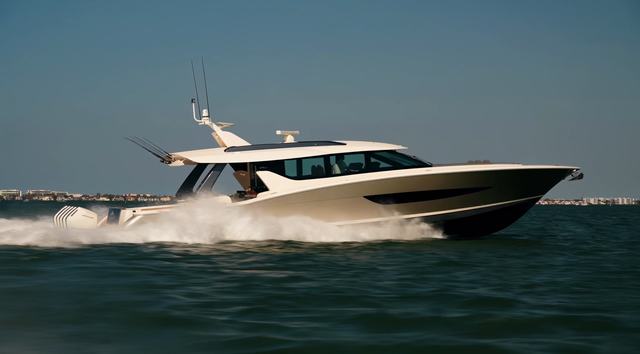
At 18.5m (60ft), the D60 sits as the flagship of the De Antonio range, and it builds on the brand’s core idea of hiding the outboards beneath the aft deck so you don’t lose usable space.
This allows for a clean stern, a large sun pad and a full walkaround layout that feels closer to an inboard coupé than a typical outboard boat. So, beyond the clever packaging, how well does it actually work in practice? In this review, we take a detailed look at the design, layout and onboard spaces to see what makes the De Antonio D60 different.
Review Video
This is a 60-footer that feels a bit different from the usual outboard crowd. The starting point is the engines (4 x Mercury Verado outboards, either 400s or 600s), because outboards on a boat this size usually mean you give up a lot of usable deck space, and that is exactly what they have avoided here by hiding up to four engines under the aft structure. So what you get instead is an inboard-style stern with a proper sun pad and swim platform, and that one decision drives a lot of what follows on the rest of the boat.
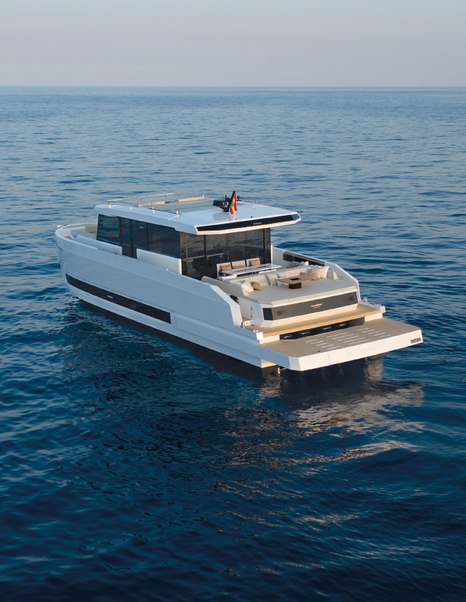
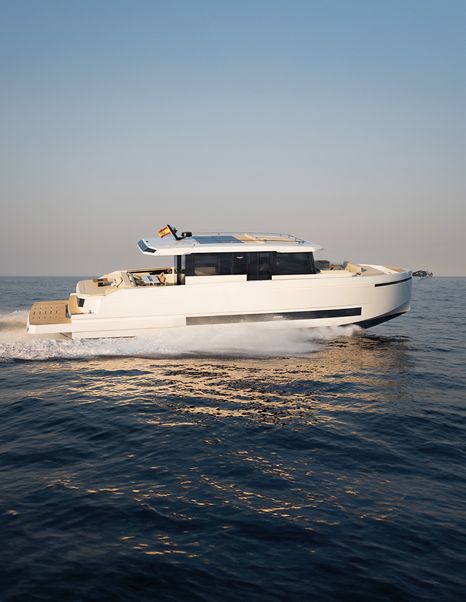
It also explains the shape, because the profile is quite slab-sided and there is no real attempt to disguise that. Still, that extra height gives you wide side decks, deep bulwarks and the internal volume needed to support a large, glass-heavy deckhouse, so while it is not the most elegant form in this sector, the space it creates is rather astonishing.
That focus on space carries straight into the layout, where the walkaround concept has been taken further than usual, with clear movement around the deck and access down into the accommodation on both sides of the helm, so you are not funnelling everyone through a single point, and that makes a difference when the boat is in use with a full group on board.
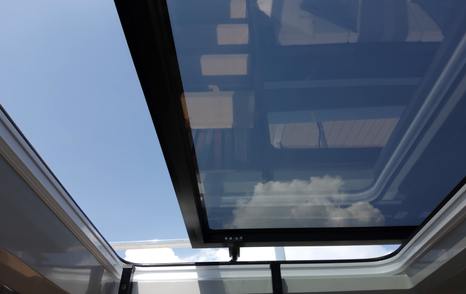
The same thinking shows in the structure above, where the saloon is wrapped in glass with drop-down side windows, opening aft doors and a sliding roof, so you can close it up when needed or open the whole area out and rely on airflow, rather than the air-conditioning.
From a build point of view, the design and engineering come out of Barcelona, while production sits within a Polish OEM network that also builds for established Northern European brands, so this is not a low-volume or experimental platform; it is coming out of a well-developed composite build environment.
The hull reflects that, built in vacuum-infused GRP with carbon reinforcement and shaped with steps to reduce drag, which allows the D60 to carry its volume and still run up to around 46 knots with the right engine package, and that balance between weight, stiffness and speed is central to how the boat performs.
What that leaves you with is an 18.5m (60ft) stepped, infused hull built around four hidden outboards and a walkaround deck plan that is in a class of its own in this sector.
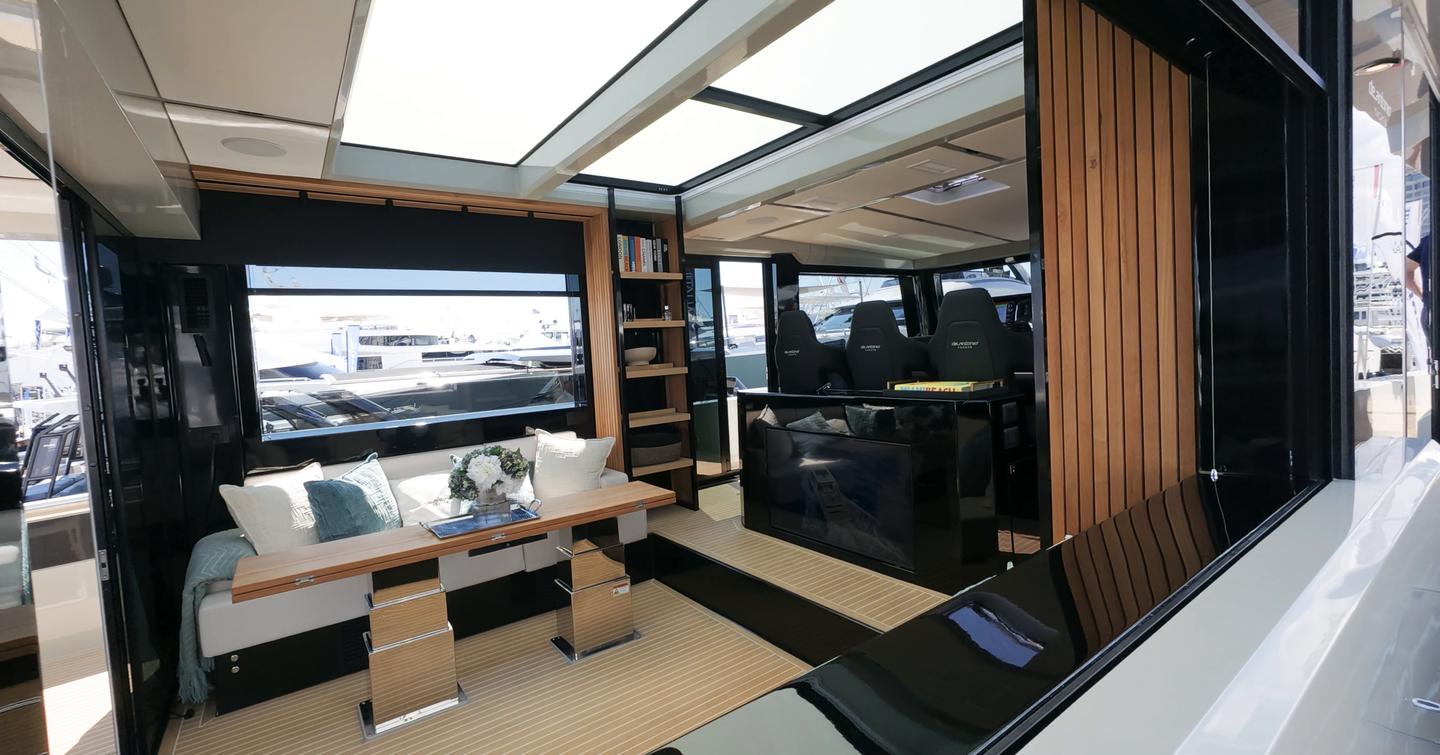
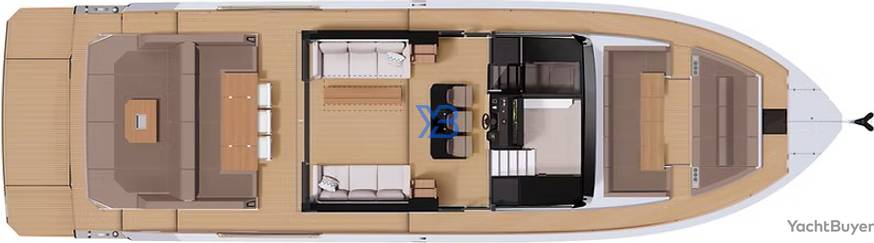
In the saloon, this is where they have really taken that inside-outside idea to the max, because you’ve got glass all the way around, and it makes the space feel really open and bright.
It’s not just about the glass being there either, because it all works, with the side windows dropped, the doors open, and the roof sliding back, so in the right conditions, you could get away with not having to run the air conditioning and just use the breeze.
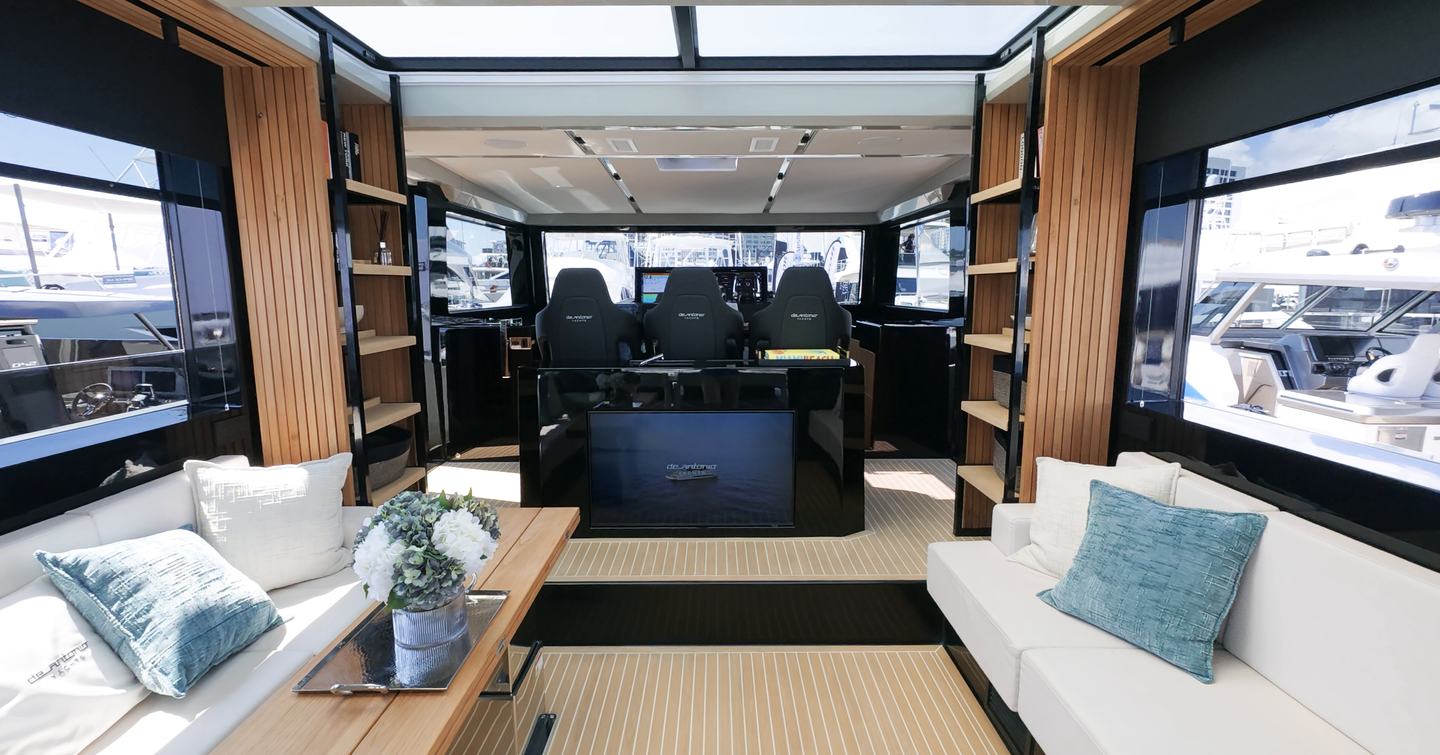
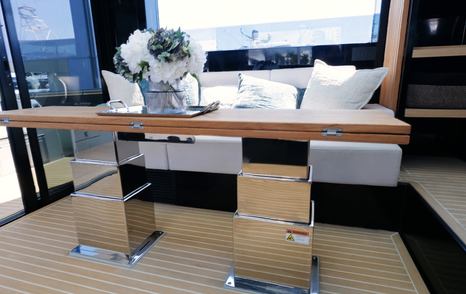
There’s a nice dining setup in here as well, with a table that adjusts up and down, opens out if you want to dine, or drops down to create a daybed. Useful if you want to be able to sleep some extra guests occasionally.
They’ve kept the upper deck functions simple, with just a sink unit here and the main galley down below, and even the TV is tucked neatly into the back of that unit, so it doesn’t dominate the space.
Movement through this area is just as well thought through, because you can head down into the accommodation on either side of the helm, which ties back into that walkaround thinking.
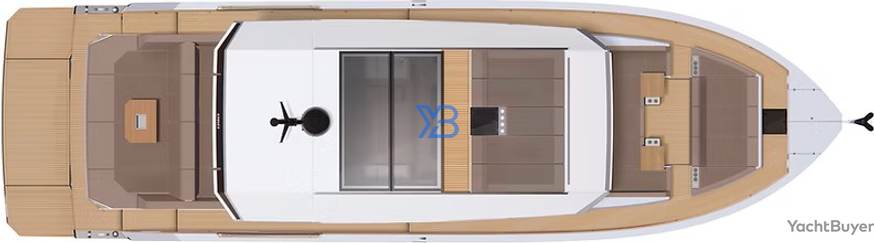
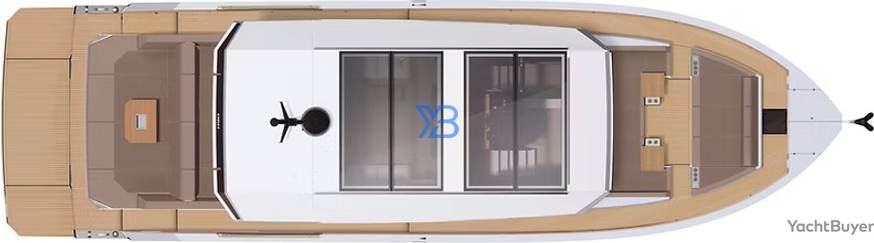
Then above you’ve got the sunroof, which slides back, and ladders on either side that take you up to the sun terrace, and the glass itself is quite clever because you can press a button and it provides shade, so you’re not stuck under full sun even with all that glazing. No doubt it could still get pretty warm in the height of the summer.
Lower Deck - Galley
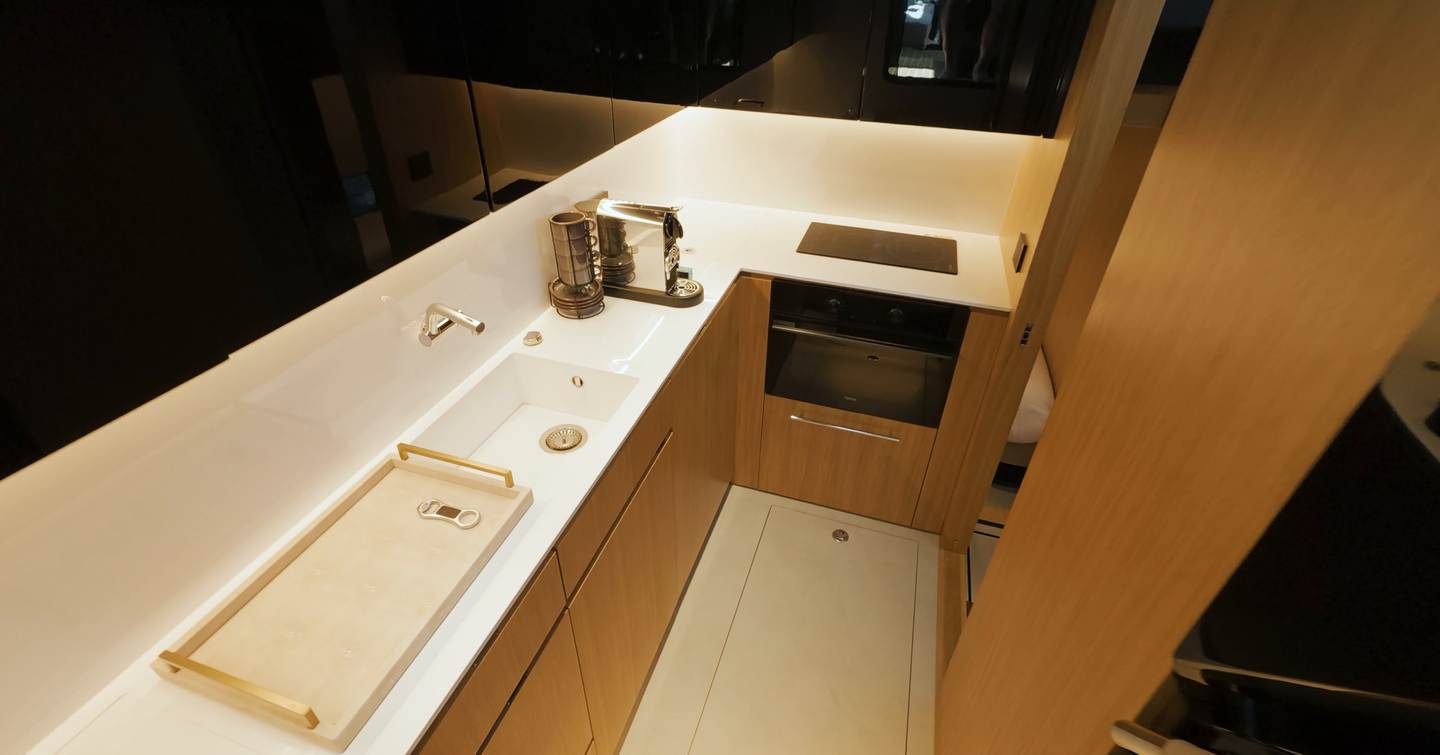
Drop down to the port of the helm, and you arrive straight into the galley, and they fully admit this is not a boat where the owner is going to be cooking on board, so the focus here is on giving you some basic facilities rather than turning it into a full cooking space.
It’s set up for exactly that, with a hob, a sink, storage below and overhead, and it is really about being able to make a coffee or a snack rather than anything more involved, which fits with how the boat is meant to be used.
It is very simple, but it doesn’t feel too hemmed in down here because you’ve still got glass bringing light in, and that makes a difference when you step below.
Life is designed to be spent on deck on a boat like this, and the galley reflects that, sitting here as a practical support space before the main accommodation opens up beyond.
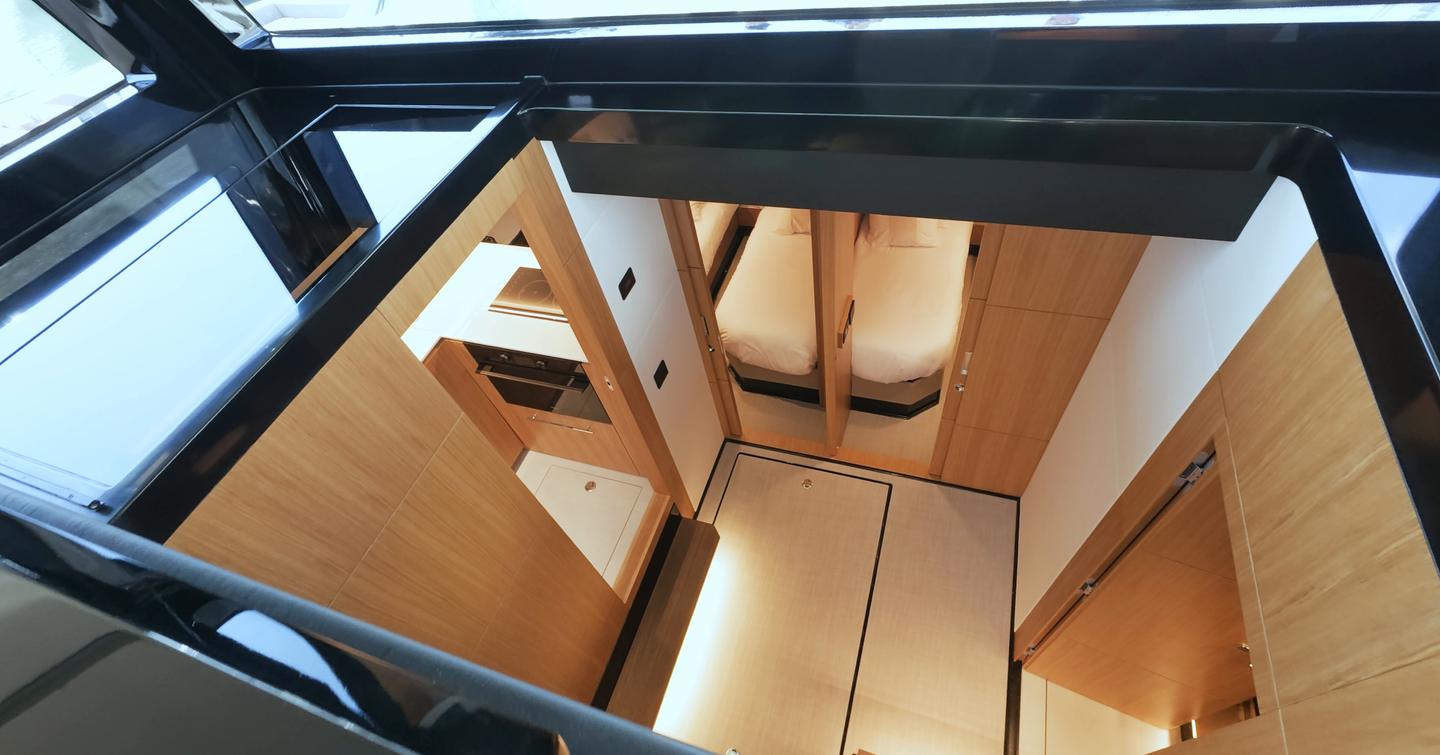
Move past the galley, and this is where the boat changes quite a lot, because you step into this central space, and the atrium effect is absolutely amazing, with light coming down, and it being so bright down here that it makes it feel much bigger than the boat actually is.
That brightness carries the whole lower deck, and it stops it from feeling like you’ve gone below in the usual sense, because you still get that sense of openness rather than being tucked away.
Owner's Cabin
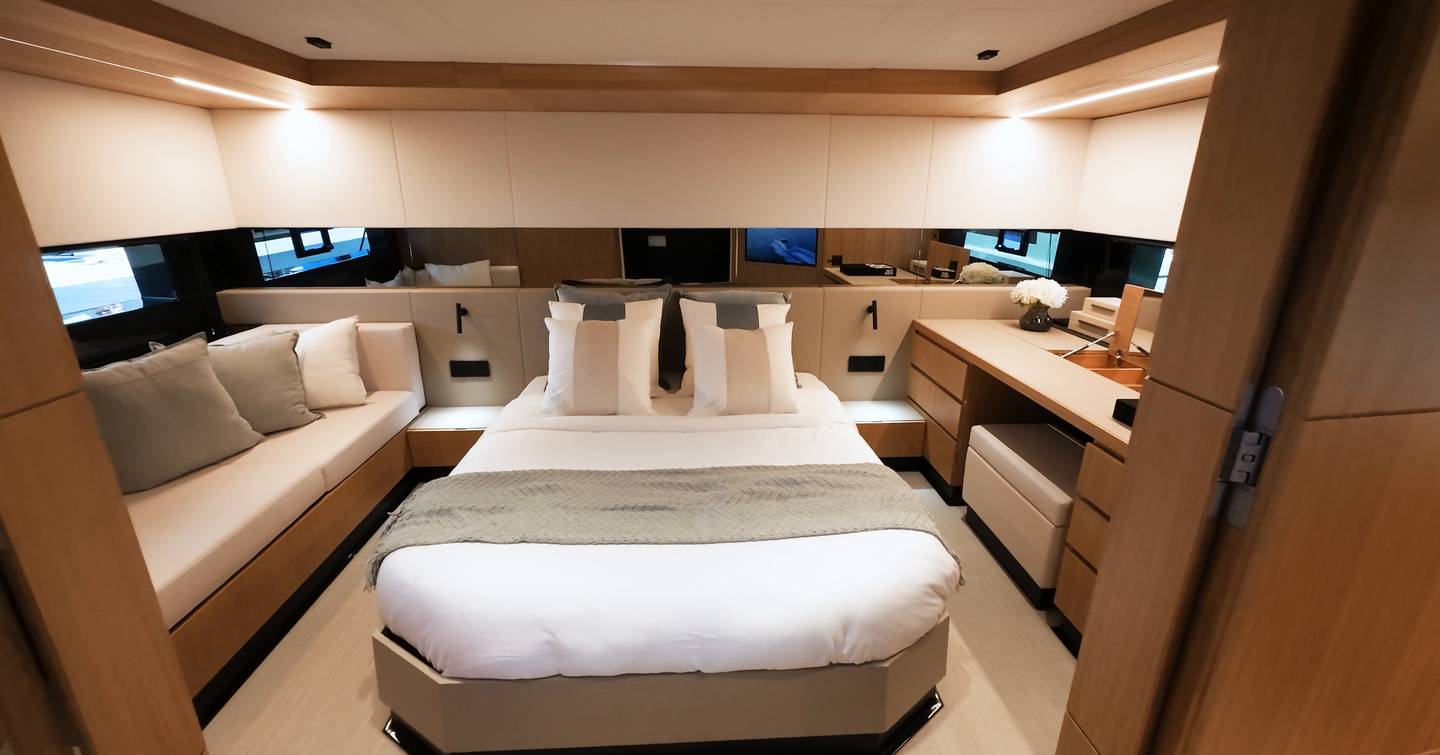
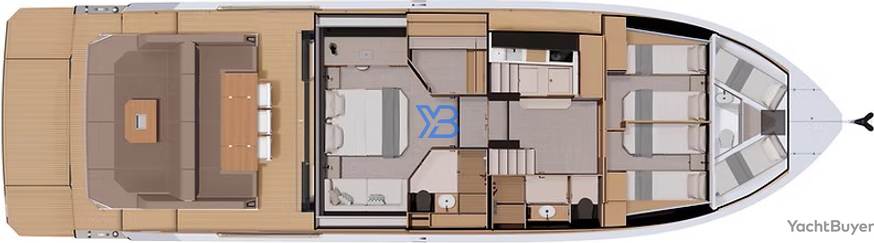
Amiships, you come into the owner’s cabin, and this is another really nicely designed space, where the headroom drops slightly over the bed, but even at around 6ft (1.83m), you can stand up comfortably, so it doesn’t feel tight.
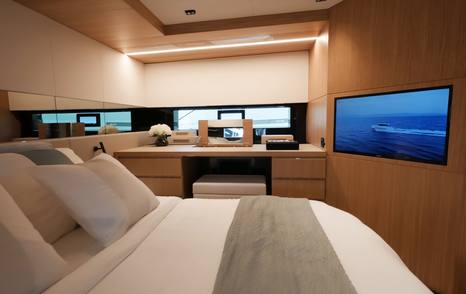
The layout is straightforward, with a big double bed, a bureau to one side, a sofa and a TV mounted on the wall. The standout feature is the walk-in wardrobe, which is something you just don’t often see on a boat this style, even at this size, and it makes a real difference if you are staying on board for longer.
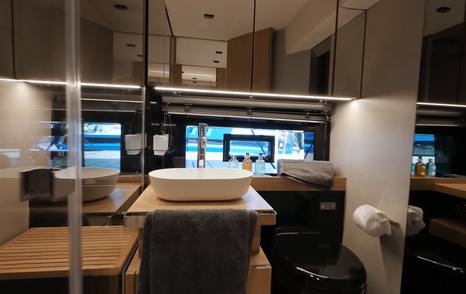
Opposite sits the bathroom, and again the finish jumps out, with wood detailing carried through into the shower, a rainfall head, decent storage and good headroom.
Guest Accommodation
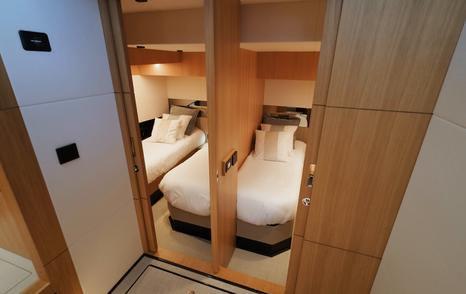
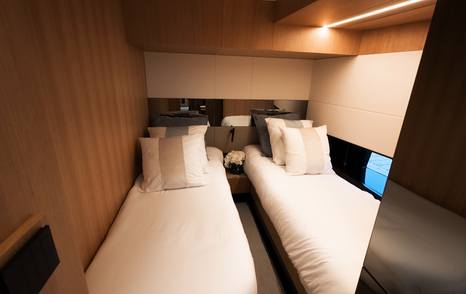
Opposite the day head sit the two guest cabins, and they are quite a nice arrangement because you can have them as twins or turn them into one big double, so if you’ve got occasional guests, they get a really decent cabin, or if you need more berths, you can sleep four down here, all using that same bathroom.
There are also some clever touches in here, like the split door, which means it doesn’t gobble up loads of space when you open it, and it allows you to open the area up if you’re on board as a family, so the spaces connect rather than feeling closed off.
Crew Accommodation
Up on the foredeck, there is access down into a crew cabin, and it’s quite tucked away, which makes sense on a boat like this, where crew isn’t really the focus.
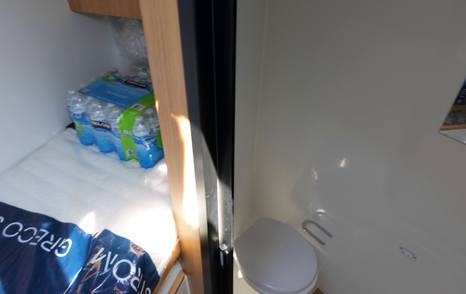
The layout is simple, with two berths and a separate bathroom, and it is air-conditioned, so it will be comfortable enough for short stays, but it is not particularly luxurious, and it is not set up for extended time on board.
This feels more like a support space for a few days out rather than something you would rely on for a full-time crew, and that lines up with how the boat is likely to be used.
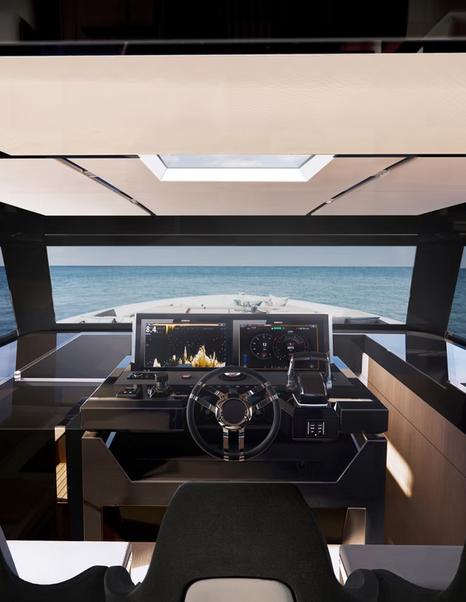
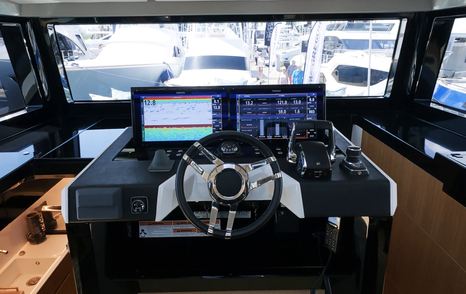
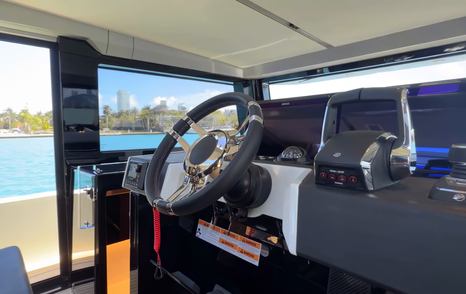
The helm hovers above the atrium, so you’re driving from inside, but you don’t feel cut off from what’s going on outside, and that comes down to all that glass and the way the space is set up around you.
As an owner-operator setup, it has what you want straight away, because the joystick is here and that takes a lot of the pressure out of close-quarters work, which is usually the hardest part of handling a boat this size, and it’s backed up by Skyhook, so you can hold position while you get fenders and lines ready.
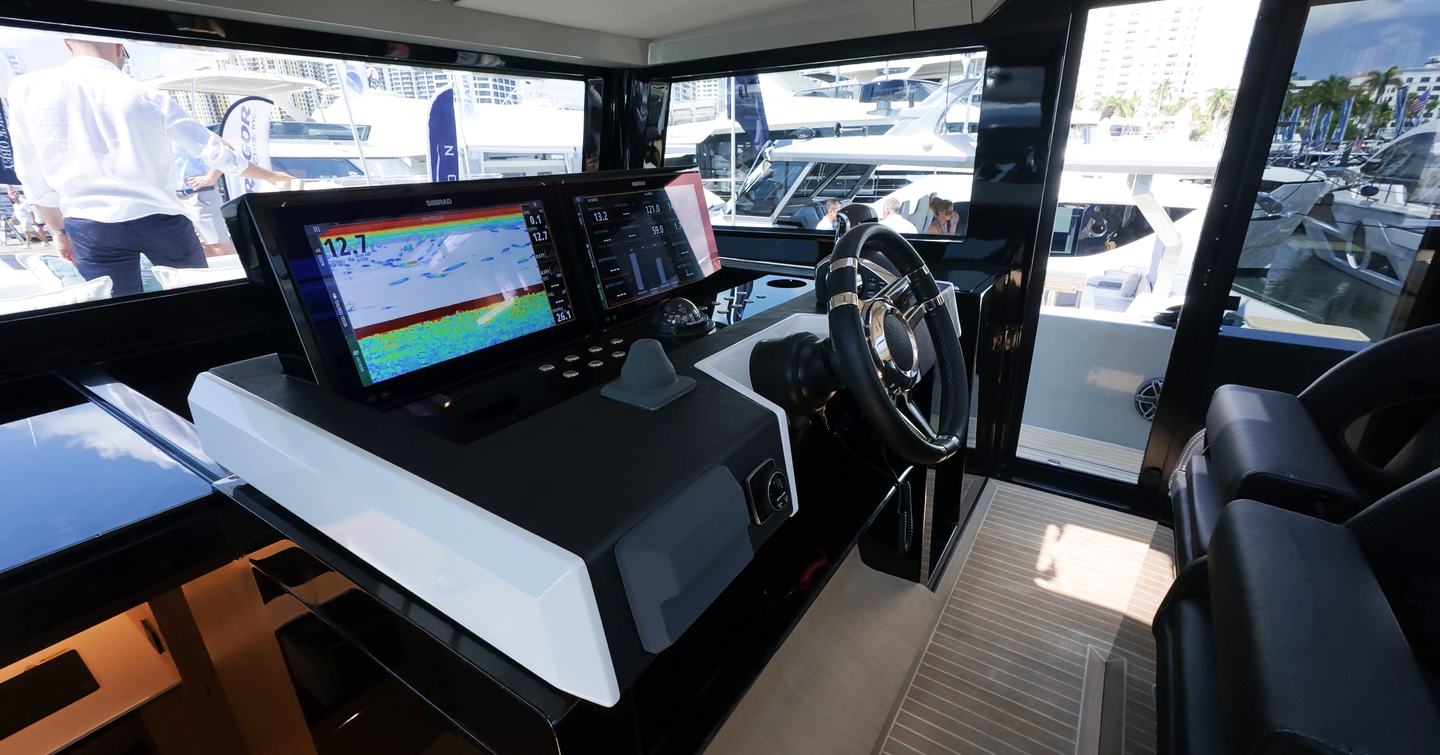
The driving position itself is well sorted, with a seat that flips to become a leaning post, the wheel set high and everything close to hand, so you can brace yourself. The visibility works better than you might expect, because although the mullions are quite thick, all that surrounding glass means you can still see the extremities of the boat without having to move around too much.
Controls are simple, with a pair of MFDs, a clean switch layout and those large Mercury throttles that make it very easy for you to brace your throttle hand at higher speeds. There is a lot of power and performance on tap, but the design of the helm and systems should make it all feel manageable.
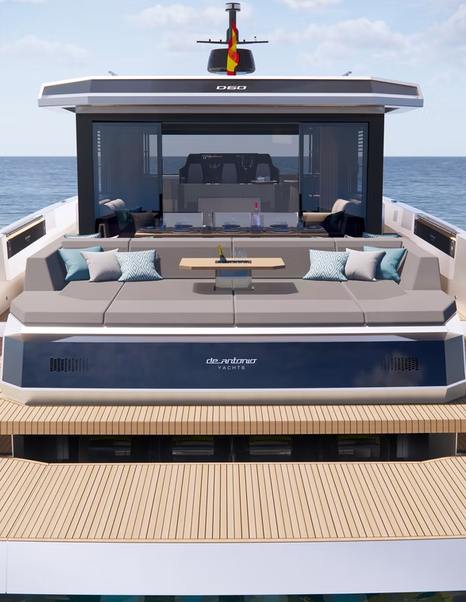
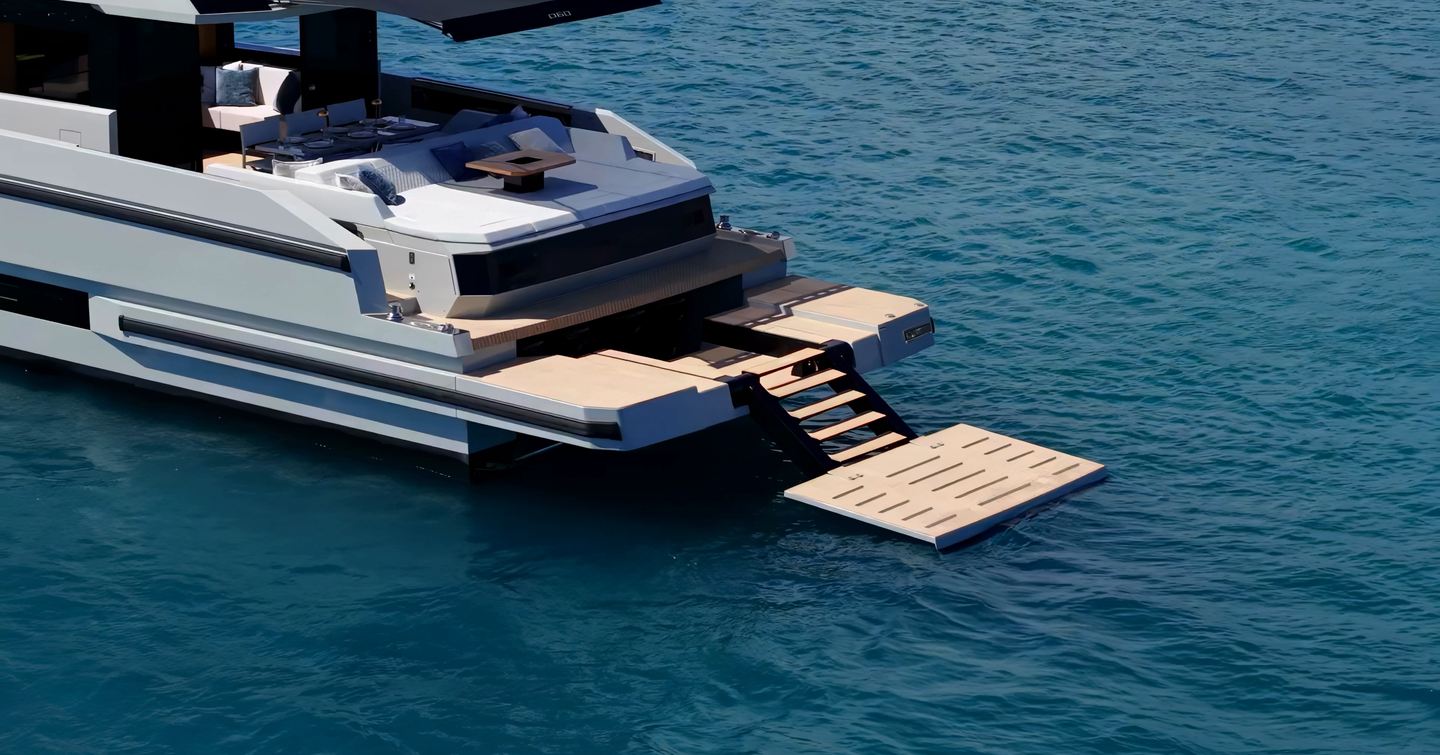
Some of the cleverest stuff aboard the D60 is at the stern, because this is an outboard boat that doesn’t look like one, and the reason is simple: the engines are hidden away beneath this aft structure.
On a typical outboard setup, you lose a big chunk of usable space to the engines themselves, but here they sit under a lifting section, so what you get instead is a clean, inboard-style layout with a full-width sun pad and proper swim platform. There is absolutely no compromise for having outboards here.
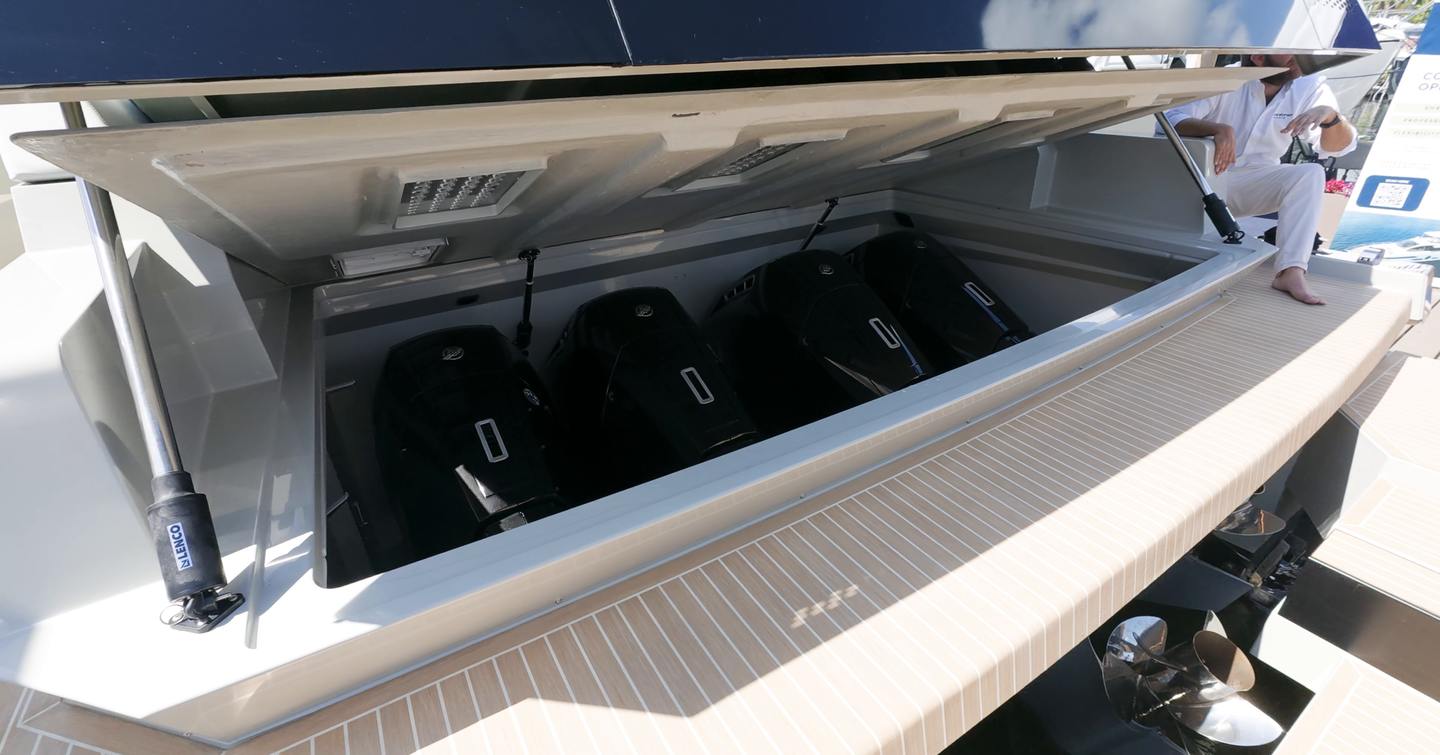
That structure does more than just hide the engines. The upper section lifts to reveal a shallow tender garage, sized around a bespoke jet tender, while a second section gives access down to the outboards for servicing, so you keep the practical benefits of the setup without exposing it visually.
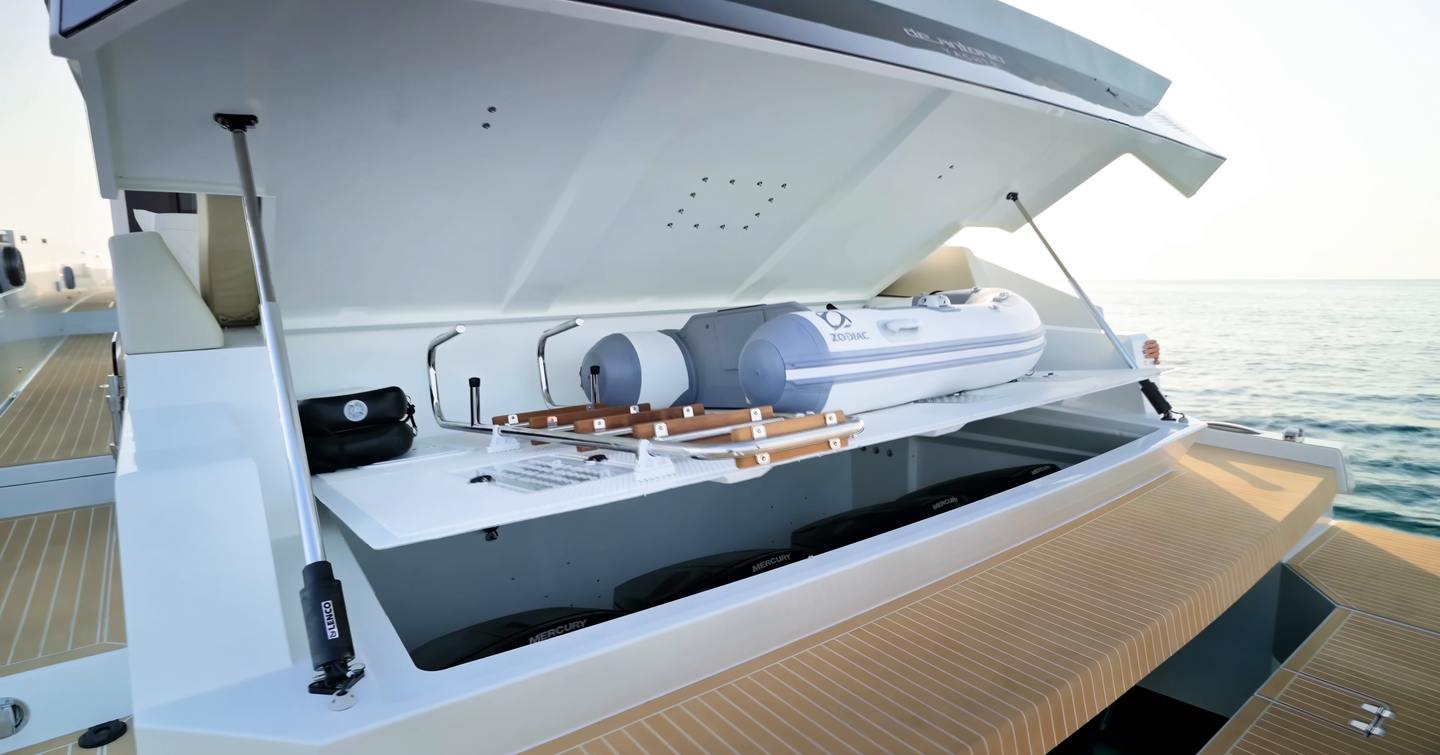
There is more packed into this area as well, with a transformer platform mounted at the transom, and placing it here works well because it can link up to a high quay, sit flush with the deck when not in use, or drop right down to the water to act as a wide, shallow stair, while also doubling as a launch point for water toys thanks to its lift capacity.
Cockpit
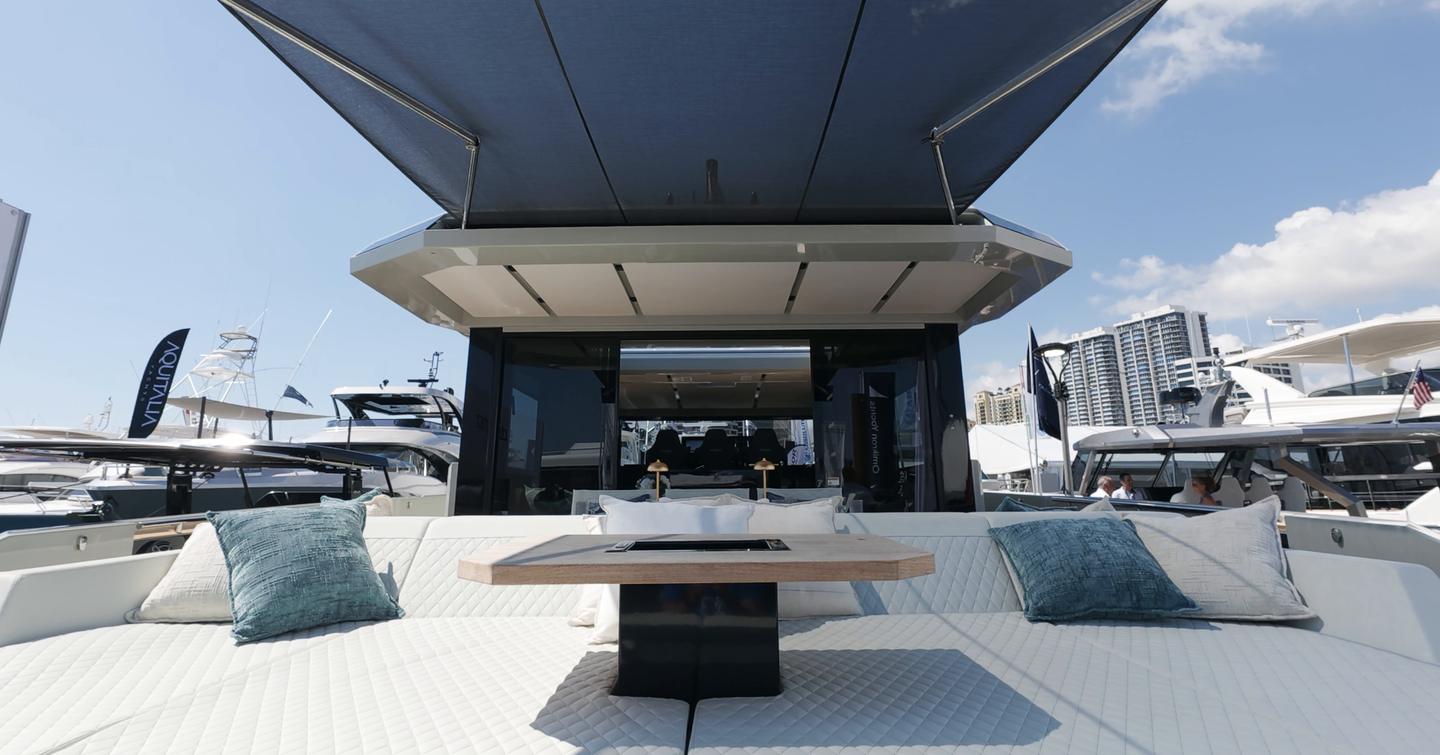
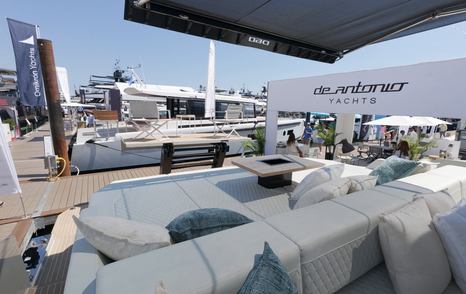
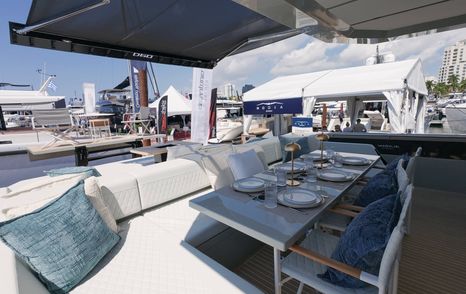
Move forward off that huge sun pad, and you arrive at the main cockpit and outdoor dining area. It feels like a much more usable space if you don’t want to be out in the full sun all the time.
It’s a nice central dining space, with the table set right in the middle and seating around it, so this is where you’re going to be spending time eating and socialising with lovely views out over the aft terrace.
That protection is important because the sun pad behind is completely open, and here you’ve got cover, and there’s even a separate shade that can extend back over that area if you want a bit more shelter.
It also sits right between everything, open to the sun pad aft and then leading straight into the interior, so the whole thing flows together really well.
Side Decks & Foredeck
Moving forward is easy enough because you’ve got access down both sides, and that ties back into that walk-around thinking, you can move straight up to the bow without any fuss.
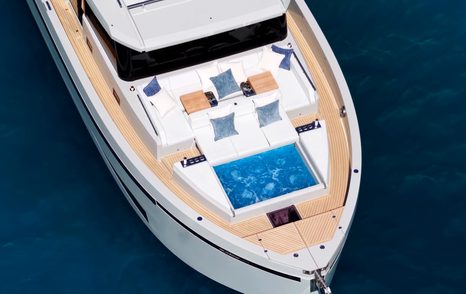
When you get here, it looks like a fairly typical setup, with a sun pad forward and a seating area behind it, so you can sit, stretch out, and spend time at anchor.
That seating is flexible as well, because the backrests slide, so you can turn it into more of a dinette or push it back into a larger sun pad, which makes the space work in a couple of different ways depending on how you’re using it.
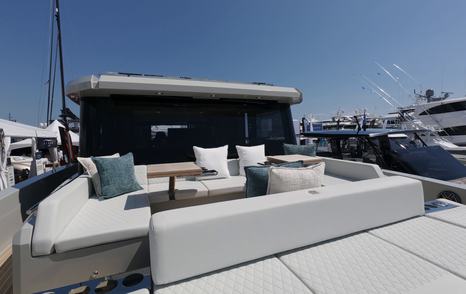
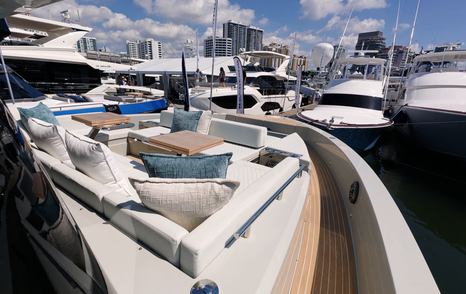
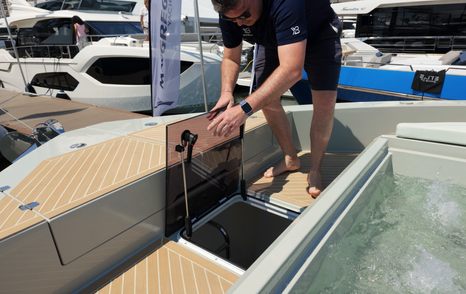
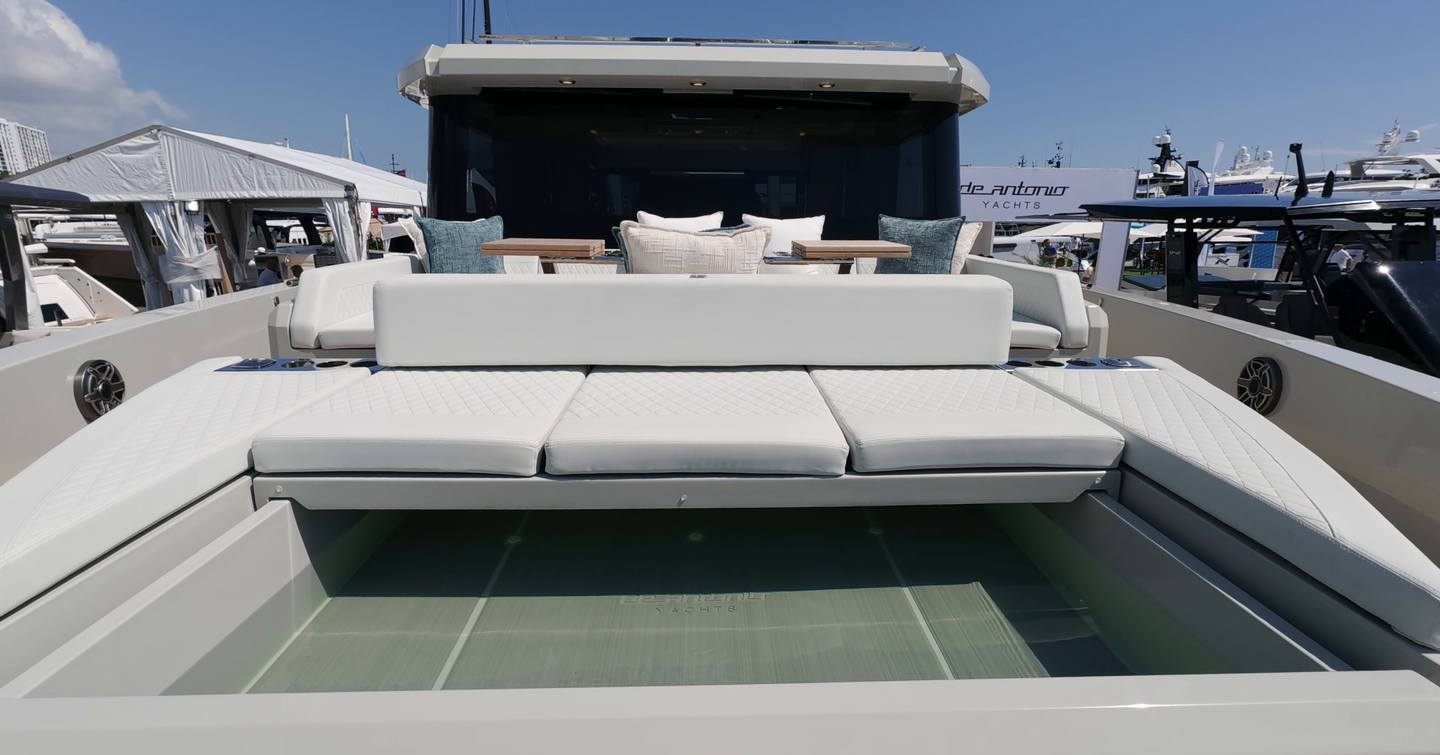
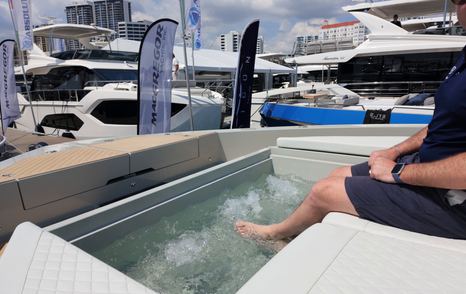
Then you get to the part that sets it apart, because lift the panels and there’s a jacuzzi hidden underneath, and that is not something you expect to find on a 60ft boat like this.
It’s a saltwater system, and it’s not heated, but in the right conditions, that doesn’t really matter, and it turns this area into something completely different, especially for day use, where it becomes a proper focal point and a lovely place to cool off with your feet dangling in the pool.
This is an area that truly sets the D60 apart.
Lazarette
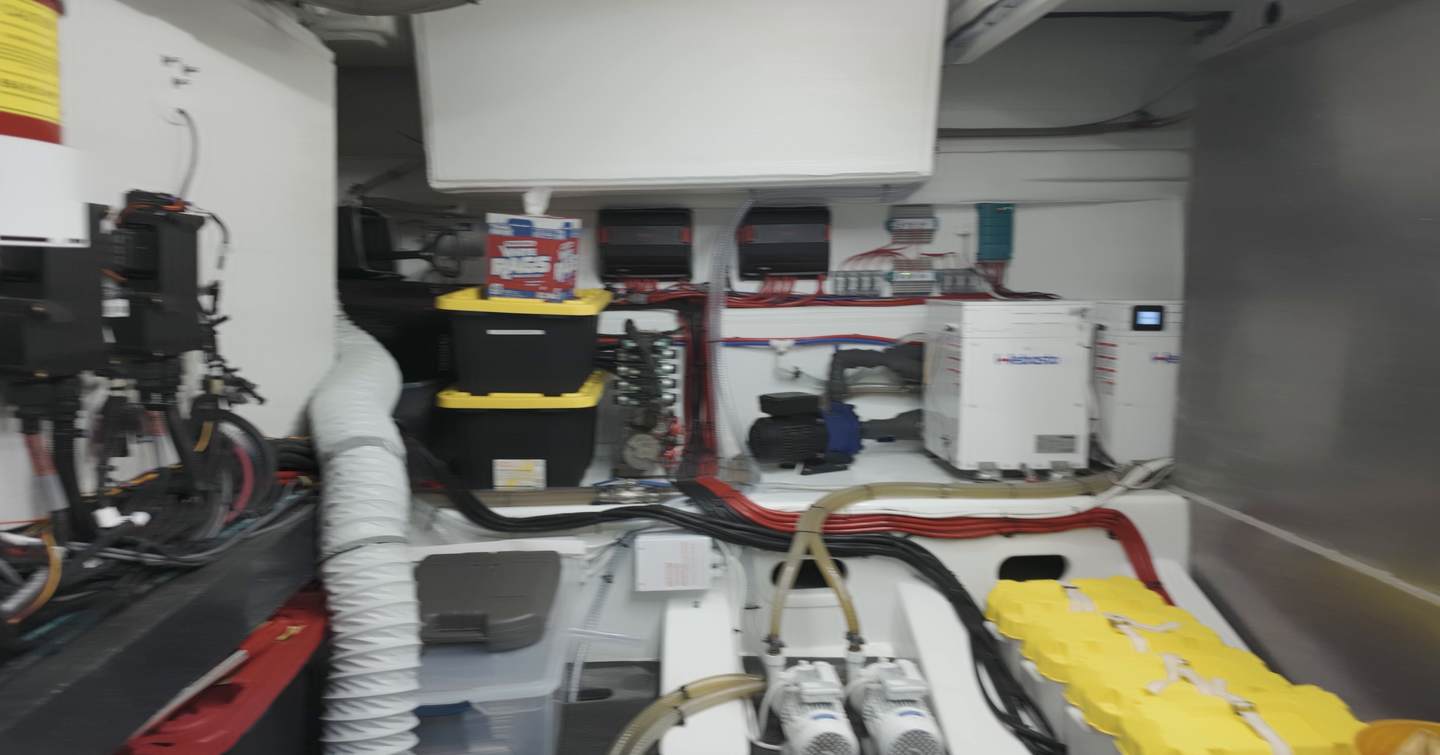
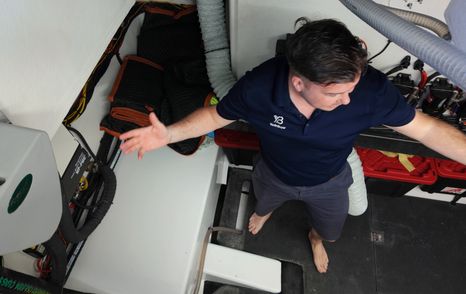
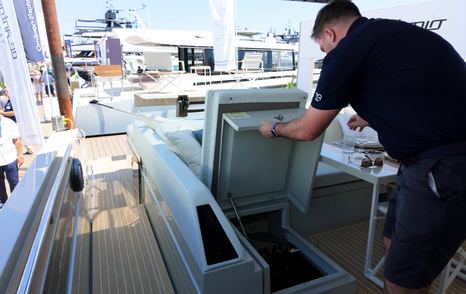
That question about where all the space goes if you don’t have inboard engines gets answered when you lift the hatch and drop down into the lazarette, which is truly enormous.
It is a long way down, and straight away you get a proper sense of the boat’s freeboard, because you’re standing in a space with full headroom, and it feels much larger than you would expect on something that is, on the face of it, a day-focused 60-footer.
The scale of it is the standout point, because this is not a token storage locker, it is a proper usable area, and it can be set up in different ways depending on how the boat is specified, with enough room for storage, technical systems or even more bespoke uses such as a workout space.
At the moment, it houses the core systems, with fuel tanks, generator and associated equipment all set down here, and having that concentrated in one accessible space makes sense from a practical point of view.
It also brings up the question of stabilisation, because the Seakeeper unit sits further forward in the boat, and while that helps with weight distribution, it does make access more complicated if you ever need to remove it for major servicing, whereas a space like this would be far easier to work with.
More than anything, this area shows what the hidden outboard layout gives you, because by moving the engines out of the traditional engine room position, it frees up a large internal volume that can then be used in a much more flexible way.
The boat we saw at the Palm Beach Boat Show (2026) came in at €2,200,000 ex VAT, which, when you consider the power, performance and innovation on display, seems reasonable value for money. Do keep running costs in mind, though, you'll be fueling and servicing four V12 outboards...
The base boat costs €1,970,000 ex VAT with triple 400hp Mercury V10 outboards, and the standard equipment includes some attractive items such as: pop-out bimini shade, Transformer platform, bow thruster, 2 x Simrad MFD (19in), 19kW generator, 108,000BTU air-con, electric side windows and the crew cabin.
To upgrade to the 4 x 600hp V12s with the joystick, it costs €110,240, but this is a big boat with a lot of heavy kit, so we think that extra power is worth considering. It's €15,000 to add the three cabin layout (which most people will want), and the pool on deck (another must-have in our opinion) is €20,500.
For the owner/operator, the Zipwake system will handle the boat's trim at speed (for €13,500), and for a boat that is going to spend its life in anchorages and on sand bars, the Seakeeper is worth it... even at a punchy €149,000 ex VAT.
Our Verdict
It is not easy to do something different in this part of the market, because there are a lot of very good outboard-powered boats around this size, but the D60 does manage it, and it comes down to how that hidden outboard layout changes everything else.
You get the benefits of outboards, speed, access and simplicity, without giving away the deck space, and that feeds into a layout that works well right the way through, from the stern setup to the cockpit, into a saloon that feels genuinely open, and down into accommodation that makes good use of the volume.
The exterior might divide opinion, the galley is basic because the focus is on being outside, and the placement of the stabilisation unit could make access more difficult, but none of those feel out of step with the overall brief. At around €2.2 million excluding VAT, it is a serious investment, but there is a lot of boat here, and more importantly it offers something that you don’t see very often at this size.
Reasons to Buy
- Hidden outboards free deck space
- Bright lower deck atrium
- Foredeck jacuzzi is unique
- Quality feels good
Things to Consider
- Slab-sided exterior styling
- Seakeeper access not ideal
Looking to own a De Antonio D60 ? Use YachtBuyer’s Market Watch to compare all new and used De Antonio D60 Boats for sale worldwide. You can also order a new De Antonio D60 , customized to your exact specifications, with options for engine choice and layout configuration. Alternatively, explore our global listings of new and used boats for sale and find your perfect boat today!
Rivals to Consider
The Tiara EX60 takes a more traditional inboard route, with twin Volvo Penta IPS drives rated at up to 1,000hp each, and that shows in the numbers, with a top speed of 31.8 knots and a cruising speed of 25.1 knots, alongside a 281Nm range at that pace, so it is set up for steady, longer-distance cruising rather than outright speed. At 18.36m (60ft) with a 5.16m (17ft) beam, it sits very close to the D60 in size, yet the layout leans heavily on a modular cockpit and enclosed aft deck, which makes it feel more like a traditional cruising yacht, while the D60 trades that for quad outboards, a 45-knot top end and a shallower 1.01m (3ft) draft, shifting the focus towards speed, access and a more open, reworked deck layout.
The Scout 670 LXS pushes the scale and performance much further, at 20.35m (67ft) with up to five Mercury V12 outboards delivering around 3,000hp, and that translates into a top speed of 58 knots, a 35-knot cruise and a quoted 500Nm range, so it sits in a different league for pace and offshore reach. It also carries three cabins and a broader brief that mixes luxury cruising with serious sportfishing capability, which sets it apart from the D60’s more focused social and design-led layout, because while the Scout offers more power, range and outright size, the De Antonio keeps a tighter footprint at 18.5m (60ft) with a wider 5.2m (17ft) beam, and uses that space in a very different way, with hidden machinery, a more enclosed saloon and features like the foredeck jacuzzi shaping how the boat is used day to day.
Considering a new boat? Explore De Antonio's entire current range to find the model that best suits your needs, and compare it with alternatives from competitors to ensure you make the perfect choice.
Specifications
- Builder De Antonio
- Model D60
- Length Overall 18.5m
- Beam 5.2m
- Draft(full load) 1.01m
- Hull GRP
- Cabins 3
- Berths 6
- Crew 2
- Max Speed 45 knots
- Fuel Capacity 3,700 Litres
- Fresh Water Capacity 680 Litres
- Engine Model 4x Mercury Verado V12 7.6L 600hp
- Engine HP 6400
De Antonio D60 Layout
-
Sun Deck
-
Bow hard top sun deck
![Sun Deck De Antonio D60]()
This version shows the sun deck atop the wheelhouse
-
Bow hard top sliding glass roof
![Sun Deck De Antonio D60]()
Or you can have twin sunroofs
-
Main Deck
-
![Main Deck De Antonio D60]()
The main deck is packed with seating and sunbathing space
-
Lower Deck
-
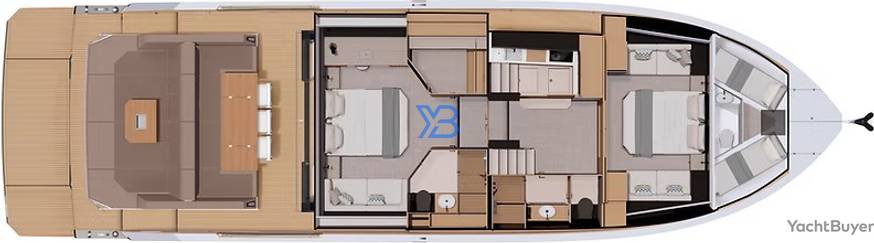
Standard 3 cabin layout
![Lower Deck De Antonio D60]()
The standard three-cabin arrangement with two twins forward
-
Optional 2 cabin layout
![Lower Deck De Antonio D60]()
As an option, you can have two very luxurious cabins
Interested in a D60?
NEW Build
Find your local dealer for a personalised, no-cost consultation
or just request
Brochures & Pricing
Used & In Stock
Looking for a ready-to-go D60 or pre-owned options? Explore all inventory of the D60 available worldwide