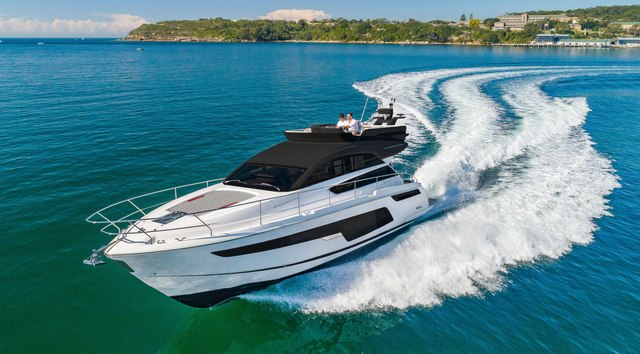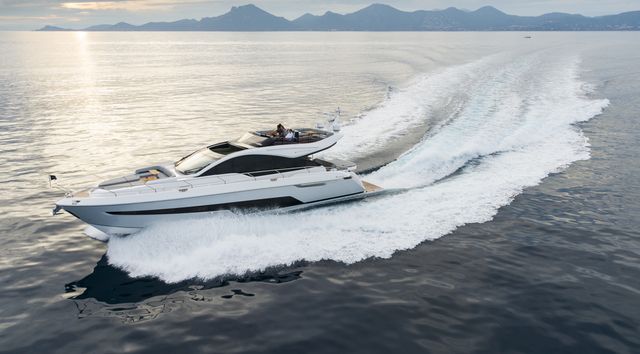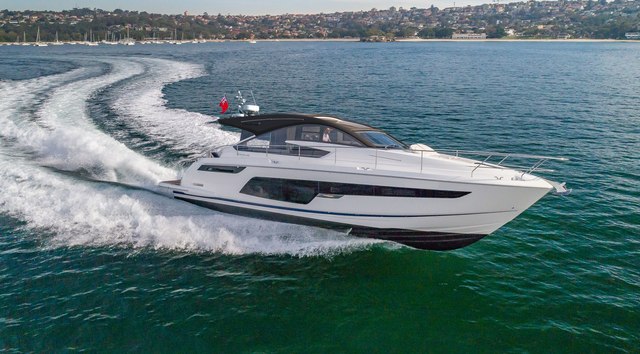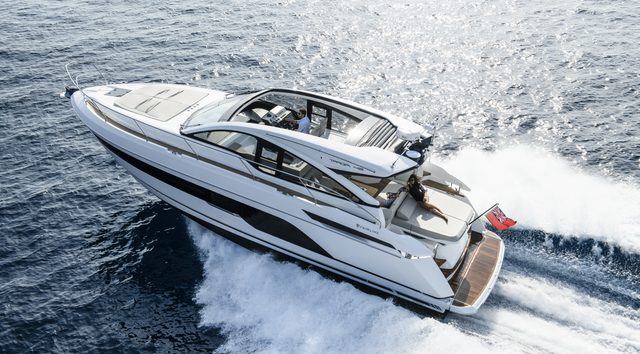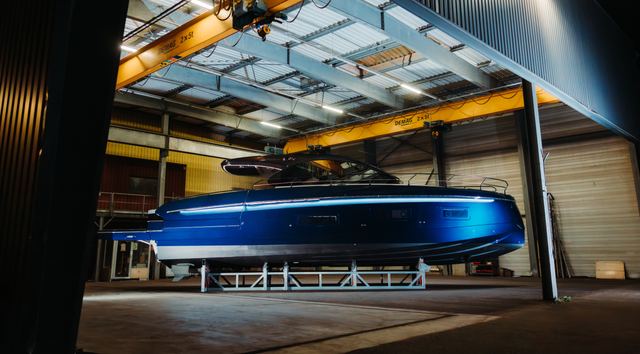
Improving an already successful formula is one of the toughest jobs in yacht design, and that's exactly what Fairline has taken on with the Targa 47 GT. It builds on the Targa 45 GT, a boat that had already proved itself as a capable, well-rounded sports cruiser, so there was always going to be a fine line between improving it and changing it for the sake of it.
Has Fairline done enough, or do buyers in this part of the market now expect more innovation and more clever ideas? To find out, we spent a day with the Targa 47 GT on the Solent, putting it through a full sea trial off the Needles, touring every part of the boat from the bathing platform to the engine room and finishing with some close-quarters manoeuvring in Ocean Village Marina.
Fairline Targa 47 GT (Mk2) Key Facts
- LOA 14.73m
- Model Year 2026
- Cabins 2
- Max Speed 32 knots
- Status In Production
- Generations 2
- Yacht Type Sportsboat
- Use Type Cruising
Test & Review Video
At Sea
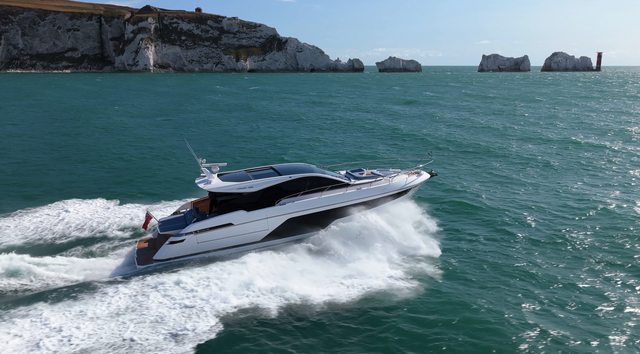
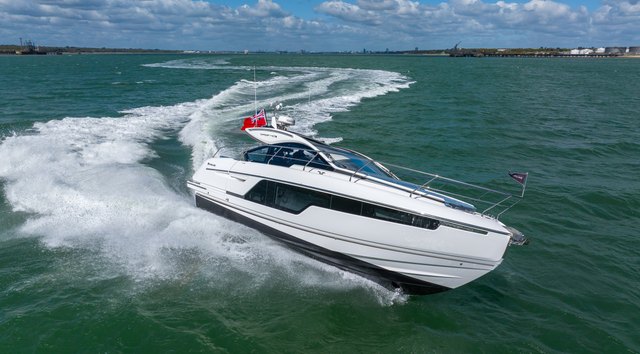
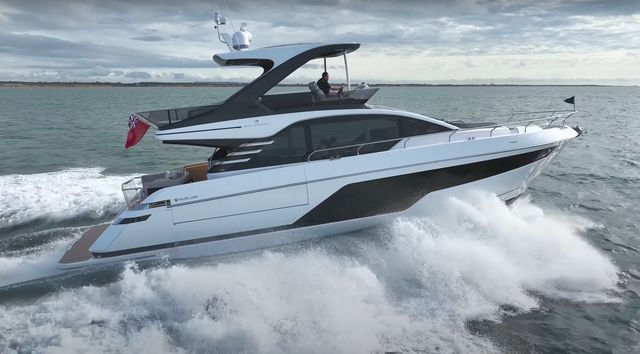
Getting onto the plane is completely straightforward. Twin Volvo Penta IPS650s, producing 480hp each, push the Targa through the hump at around 16 knots, while the Humphree interceptors work automatically in the background to keep the boat running at the right attitude.
From the helm, there's very little to think about beyond the throttles. In the conditions off The Needles, 25 knots quickly felt like the right place to leave it. The boat settled into that speed very naturally and, with only a slight chop on the water, felt happy to sit there all day.
At this speed, fuel burn settles at around 150L/hr across both engines, which works out at roughly 6L per nautical mile. That's about what you'd expect from a sports cruiser of this size. Open the throttles fully, and the Targa reached an indicated 31 knots during the test with around 75% fuel on board and some tide under the hull. Fairline quotes 32 knots, and that looks entirely realistic in better conditions.
Buyers looking for longer offshore passages will still find boats like the Riviera 465 SUV offer greater range thanks to their larger fuel tanks, but the Fairline feels very much in the middle of the pack for performance and economy.
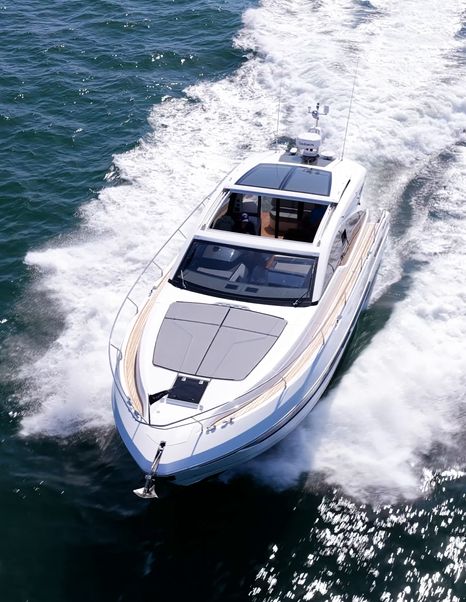
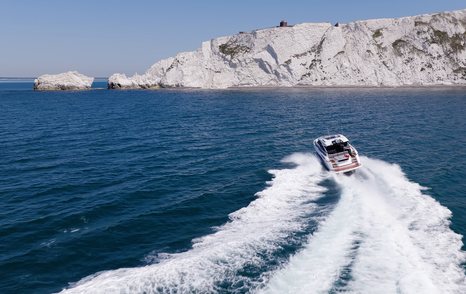
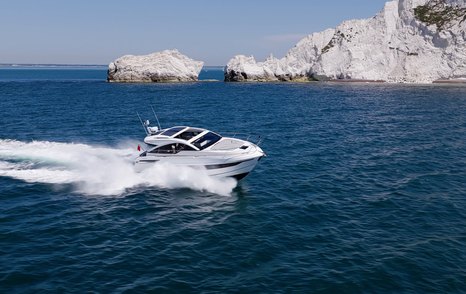
More than the numbers was the way the boat behaved. The IPS steering is nice and light, but not so light that it loses feel. Some modern Fairlines can feel a little over-assisted. This one doesn't. There is enough weight in the wheel to know what the hull is doing, yet it still changes direction with very little effort.
Add more lock, and it comes round cleanly, which is far more useful in a following sea than on a calm day. Once settled on course, the boat tracks nicely too. Very little wheel input is needed, so long passages should prove pretty relaxing behind the helm.
There was one issue during the test. Without a little extra trim, the spray was being dragged back into the cockpit, making the aft seating less comfortable than it should have been. A little more interceptor blade largely cured it.
After the trial, Fairline explained that the Humphree interceptors had been running with incorrect deployment mapping, affecting the trim angle at certain speeds. The company expected that to be a straightforward fix through software. Assuming that's the case, it removes the only real criticism of what is otherwise a very enjoyable boat to drive.
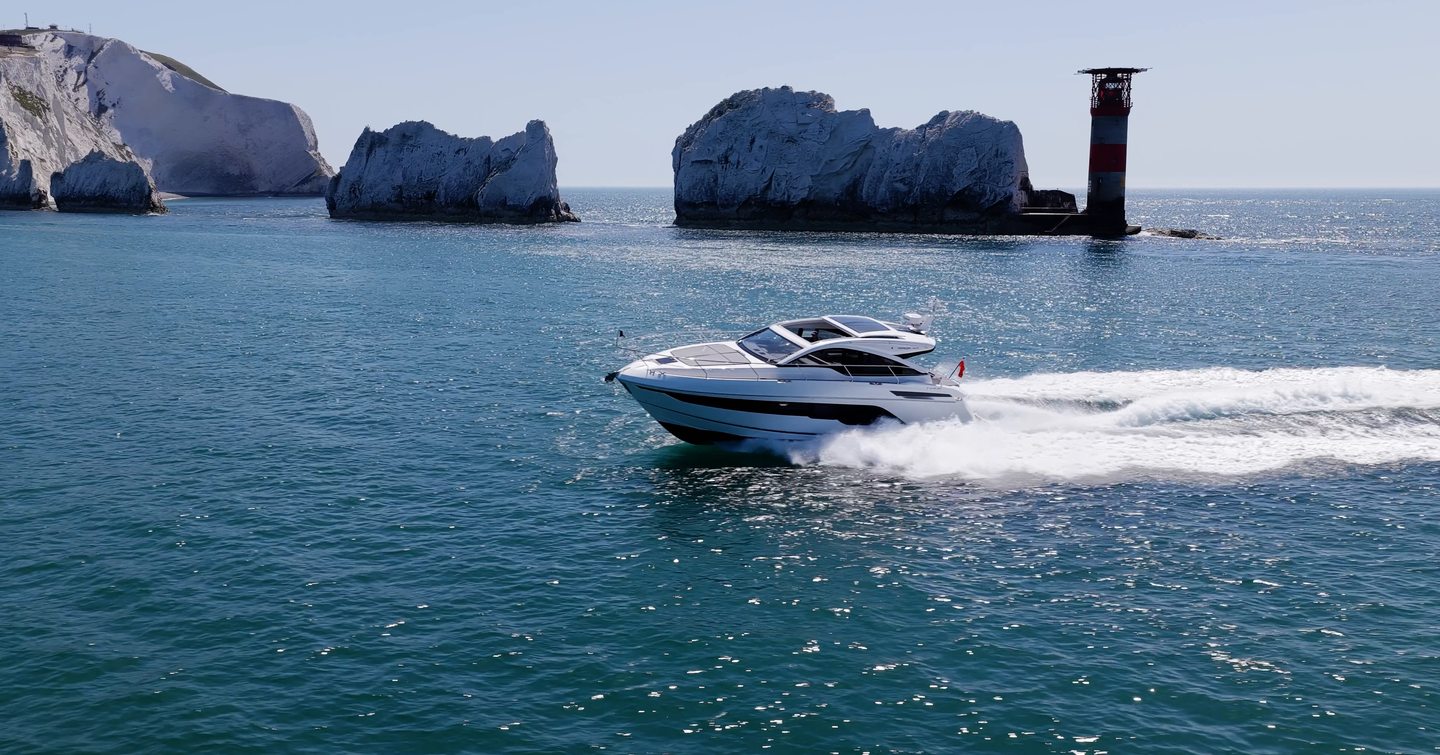
Around the Marina
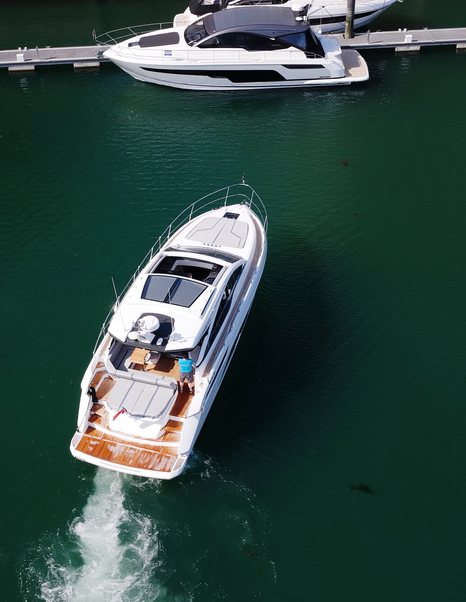
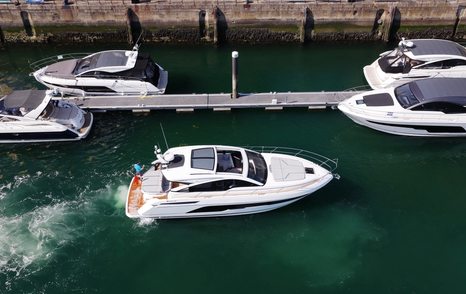
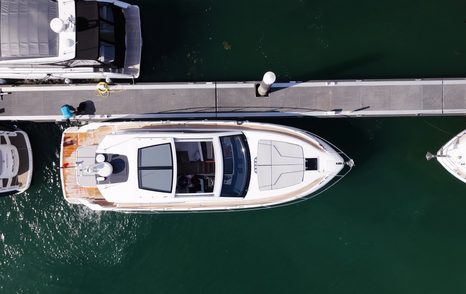
The nice thing is how little there is to think about. Line the boat up, bring it to a stop, push the joystick sideways, and the Targa simply starts moving across. Twist the joystick, and it rotates at the same time. With conventional shafts, you'd be splitting the throttles, juggling the bow thruster and trying to keep everything balanced.
Here it's all done with one control, and because the joystick is proportional, you can be really quite gentle with the inputs. That makes it much easier to judge the last few feet as you come alongside, rather than constantly correcting because you've asked too much of the boat.
The bow thruster stays separate from the joystick, and that's something Fairline has got right. There are times when all that's needed is a little nudge on the bow without affecting the stern, particularly once the boat is lined up. That's exactly what happened here. A quick touch on the thruster will keep the bow clear of the pontoon without upsetting everything the pods were already doing - useful to have that extra level of control.
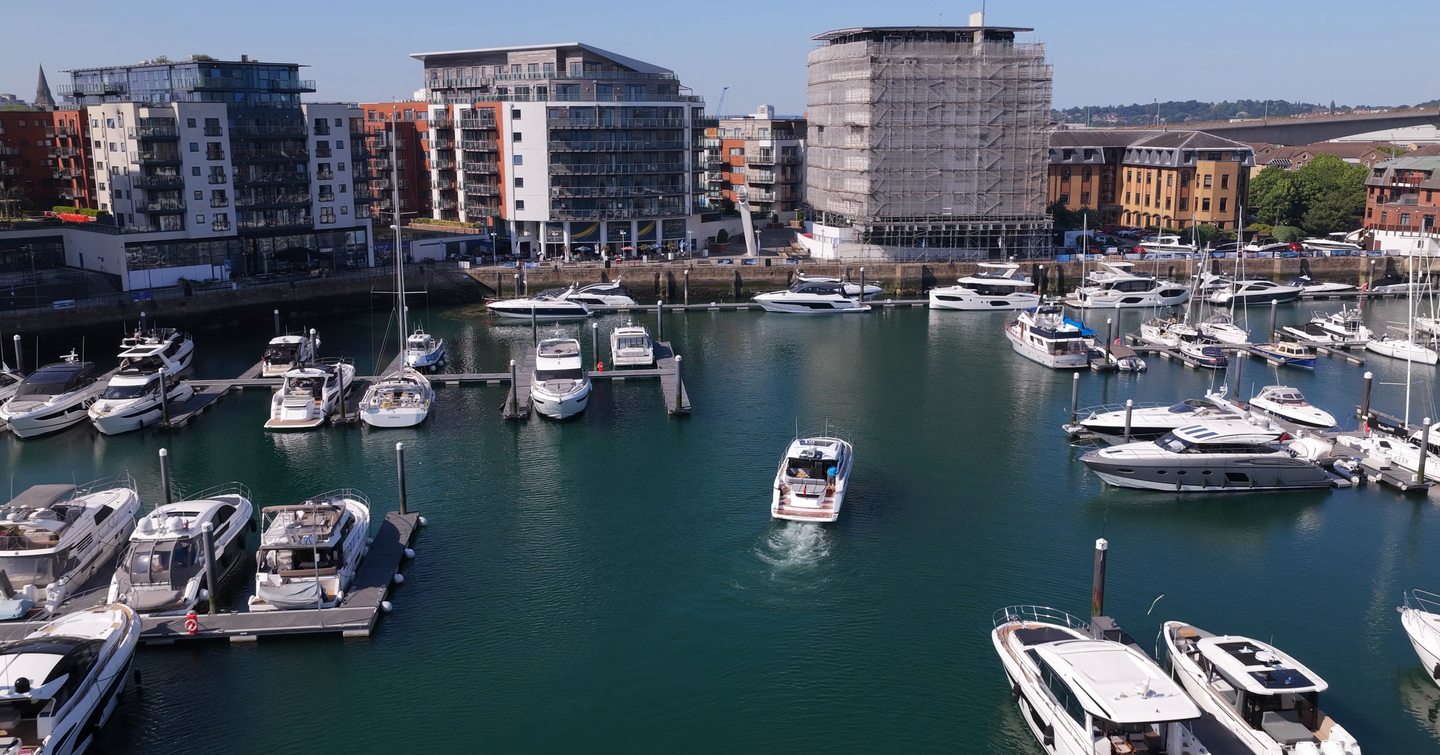
Keeping the roof open helps too. It isn't just about letting the sunshine in. It means you can hear the crew walking around the side decks, talk to them without shouting and keep track of what's happening as the boat comes alongside. There isn't a side helm door, but it never really feels like one is missing.
Visibility actually works better here than it did out at sea. The camera over the bathing platform gives a clear view of the stern, and once the boat is lined up, everything is easy enough to judge from the helm.
Granted, it wasn't particularly breezy, and the wind was actually helping a little, so this wasn't the toughest berthing exercise a Targa 47 GT will ever face. Even so, it demonstrated exactly what most owners will want to know.
It is worth understanding the challenge Fairline set itself because designing an all-new sports cruiser is difficult enough, but evolving one of your strongest recent platforms can be even harder - particularly in the fiercely contested 45 to 50-foot sports cruiser market. Buyers expect meaningful improvements, but they are rarely willing to sacrifice the qualities that made the previous model so successful.
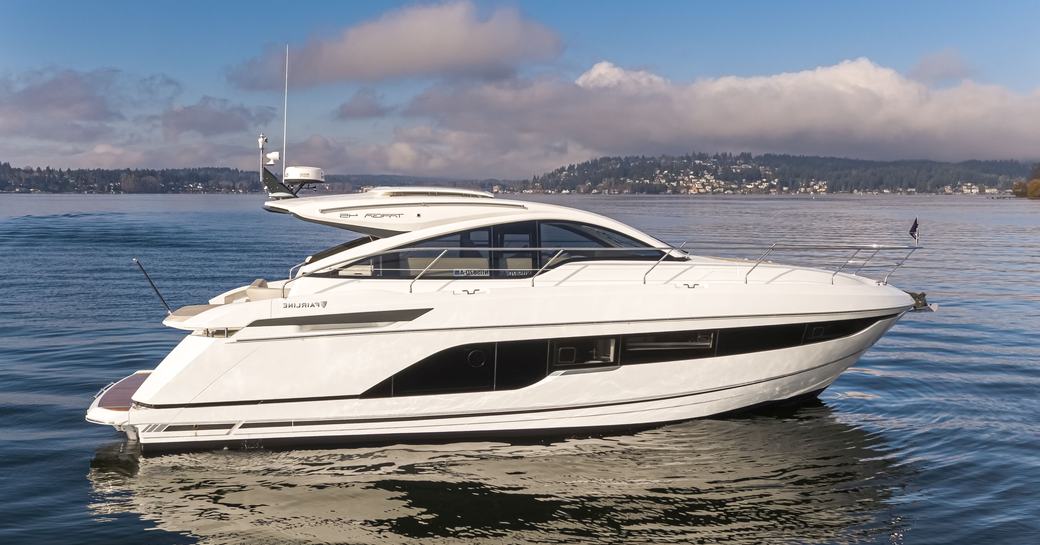
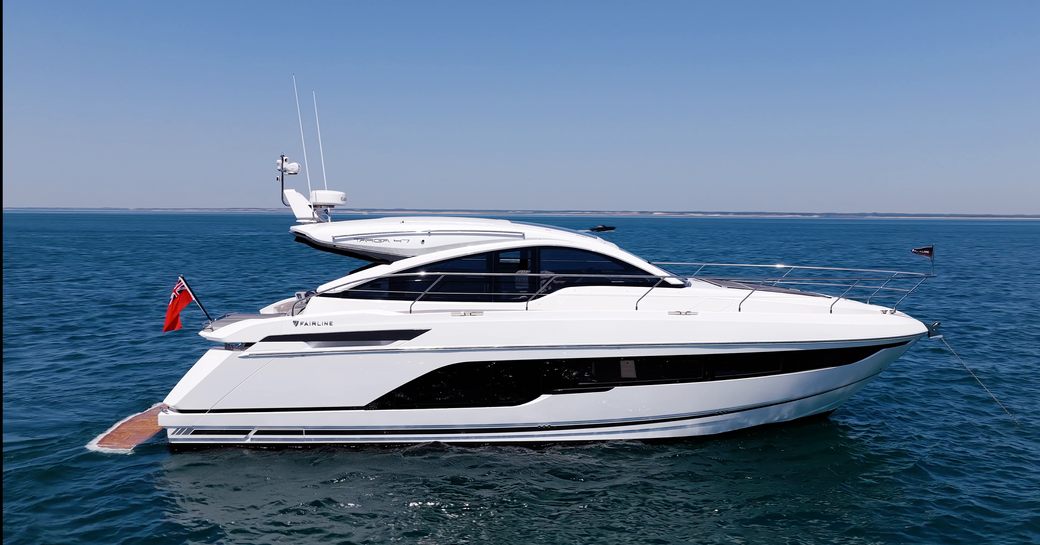
Explore the full Targa 45 GT vs Targa 47 GT side-by-side comparison
The Targa 45 GT had already proved itself since its launch in 2019, becoming one of Fairline's strongest recent success stories with almost 100 GT and Open models built. Rather than replacing it, Fairline chose to develop the platform further. The Targa 45 GT remains in production, while the Targa 47 GT sits above it as a more highly specified evolution. Despite reviving the Targa 47 name, this boat has much more in common with the Targa 45 GT than it ever does with the original Bernard Olesinski-designed Targa 47 that left production in 2012.
You can see where the development work has gone. The hull construction, 4.32m (14ft 2in) beam, draft and twin Volvo Penta D11 IPS650 installation are all familiar, while the extra 250mm (10in) of overall length has largely gone into a longer hydraulic bathing platform. Above deck, though, there are plenty of changes. The helm adopts the latest dashboard first seen on the Targa 40, the cockpit seating has been redesigned to create a more sociable entertaining area, the hardtop now carries much larger glazed panels and the interior borrows heavily from the latest Targa 40 and Squadron range.
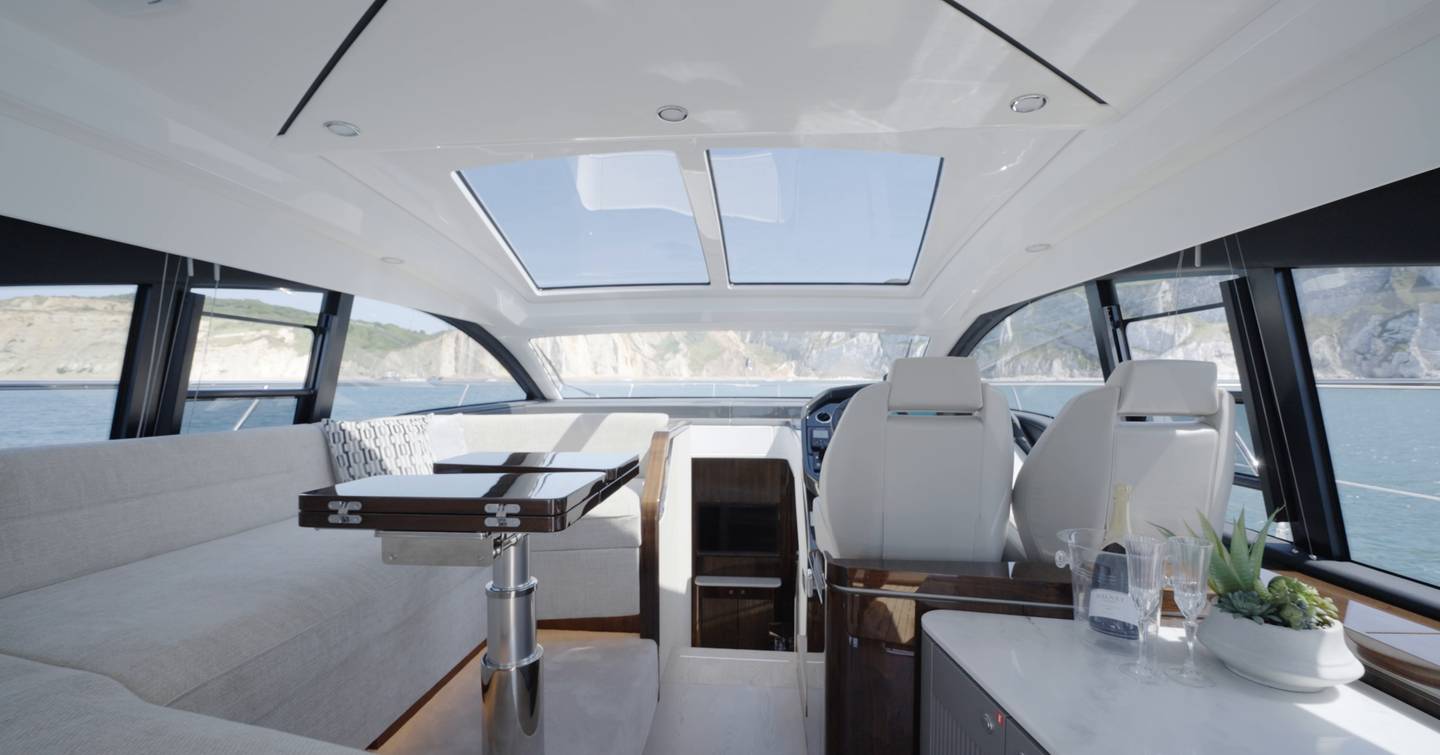
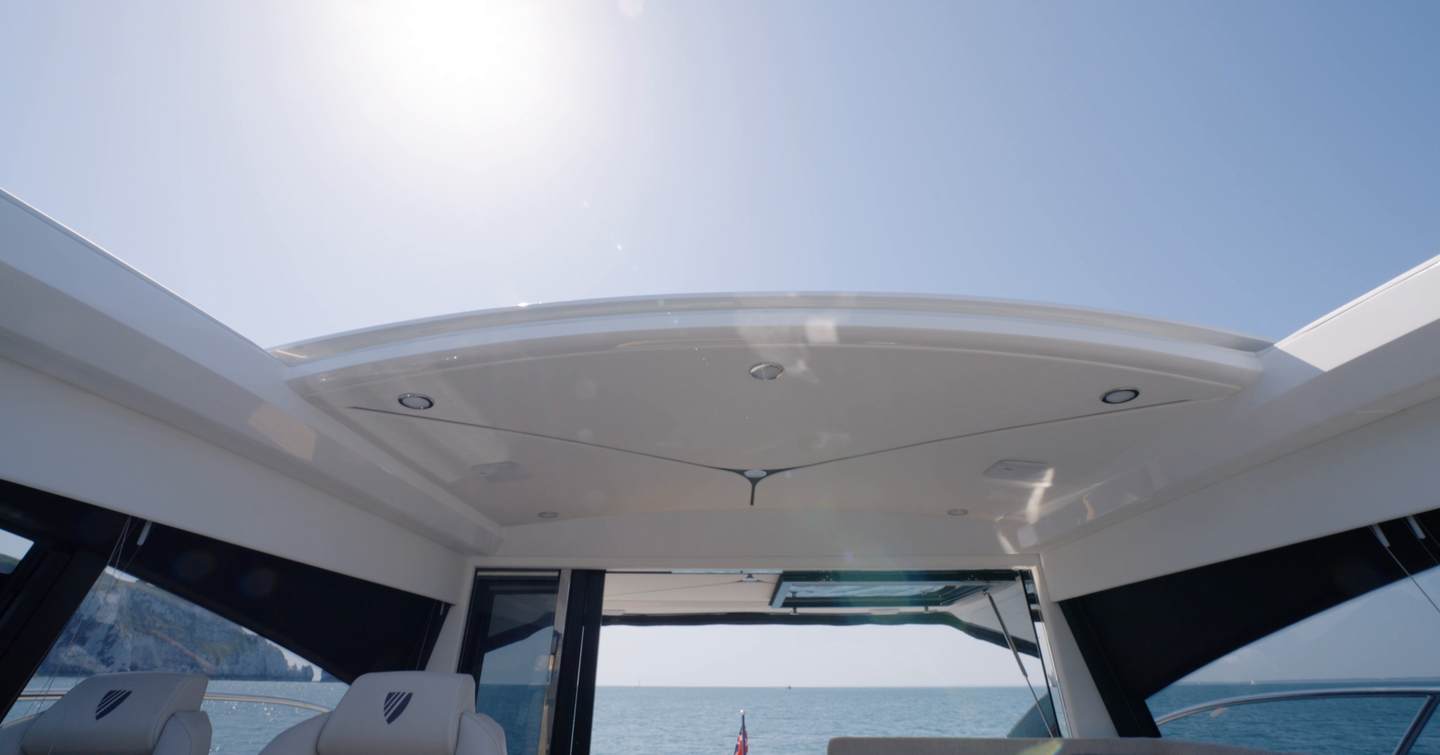
Plus there are things that Fairline hasn't done. There are no fold-out balconies, transforming cockpits or headline-grabbing party tricks here, and some rivals from Riviera, Galeon and Jeanneau certainly offer more innovation in that respect. Fairline has spent its time refining the parts of the boat owners actually use every weekend - improving visibility, bringing much more natural light into the saloon, making the cockpit more comfortable and updating the accommodation. The larger glazed roof is probably the best example. It keeps all the security and weather protection of a hardtop while making the saloon feel noticeably brighter when it's closed.
Alberto Mancini's influence remains obvious in the low, clean profile, while Fairline Design Studio and lead designer Christian Gott have concentrated on developing the platform rather than reinventing it. That philosophy extends below the surface too. The Targa 47 GT continues with a resin-infused hull, deck, liner and superstructure, polyurethane foam-cored deck construction, integrally moulded engine bearers and a network of longitudinal and transverse strengthening stringers. Every boat is still built in Britain before commissioning and sea trials ahead of delivery, and those are very reassuring facts on paper.
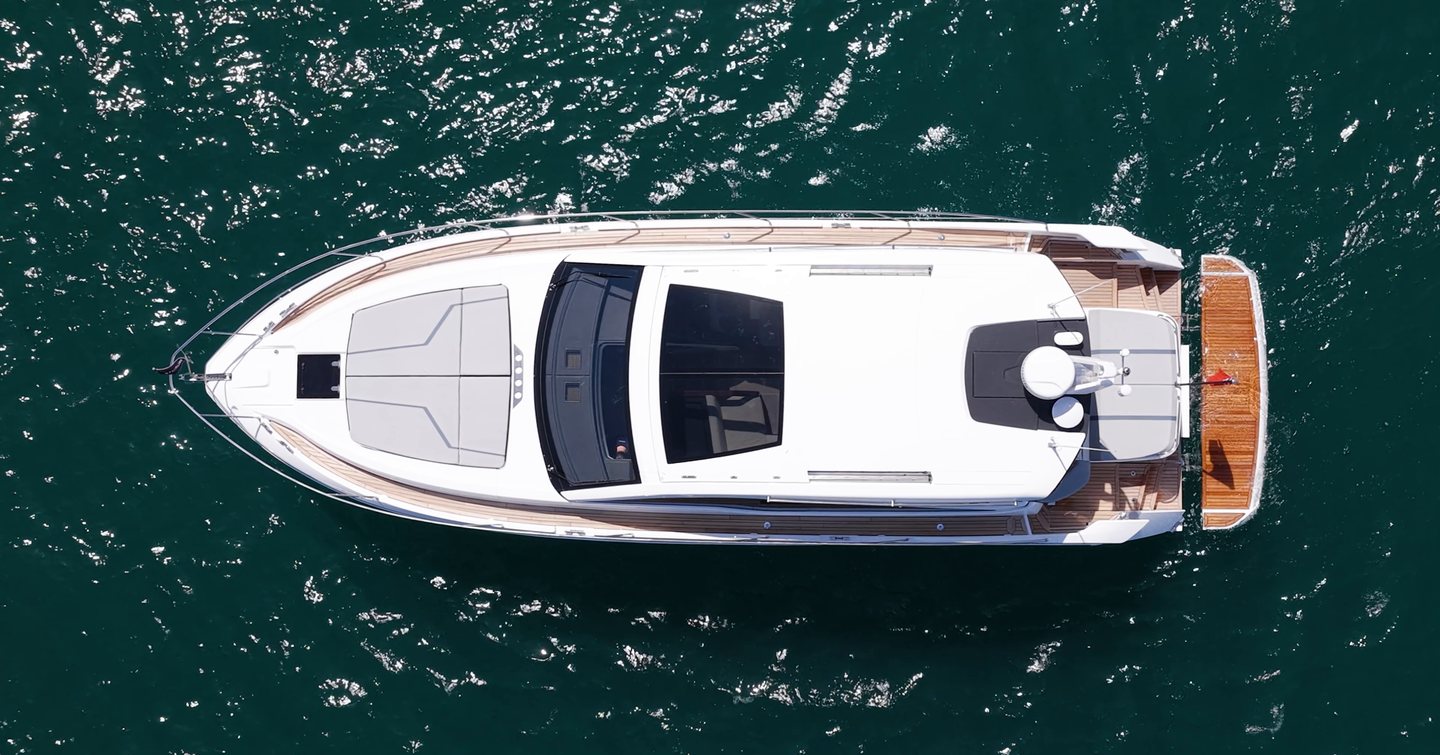
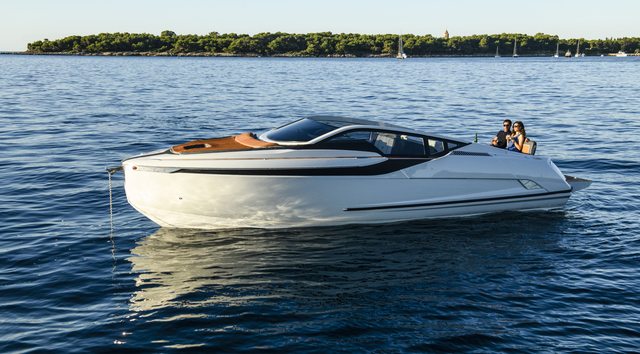
It's not difficult to see why the GT proved so popular on the Targa 45, and I suspect it'll be the same story with the 47. It just gives you so much flexibility. On a day like this, you slide the doors open, drop the side windows, roll the roof back, and the whole saloon fills with fresh air.
If the weather turns, and it only takes a few seconds sometimes, everything closes up again just as quickly. Suddenly, you've got a completely enclosed wheelhouse that's just as happy on a chilly spring morning as it is in the middle of summer. That's really the beauty of this layout, and it's why Fairline hasn't felt the need to move too far away from it.
You do lose a bit of cockpit space compared with the Open because some of the main deck now belongs to the saloon. In reality, it doesn't feel like much of a sacrifice. The dinette is a good size, the seats are lovely and comfortable, and because you're only separated from the cockpit by the sliding doors and opening window, you never really feel like you're sitting inside while everyone else is outside.
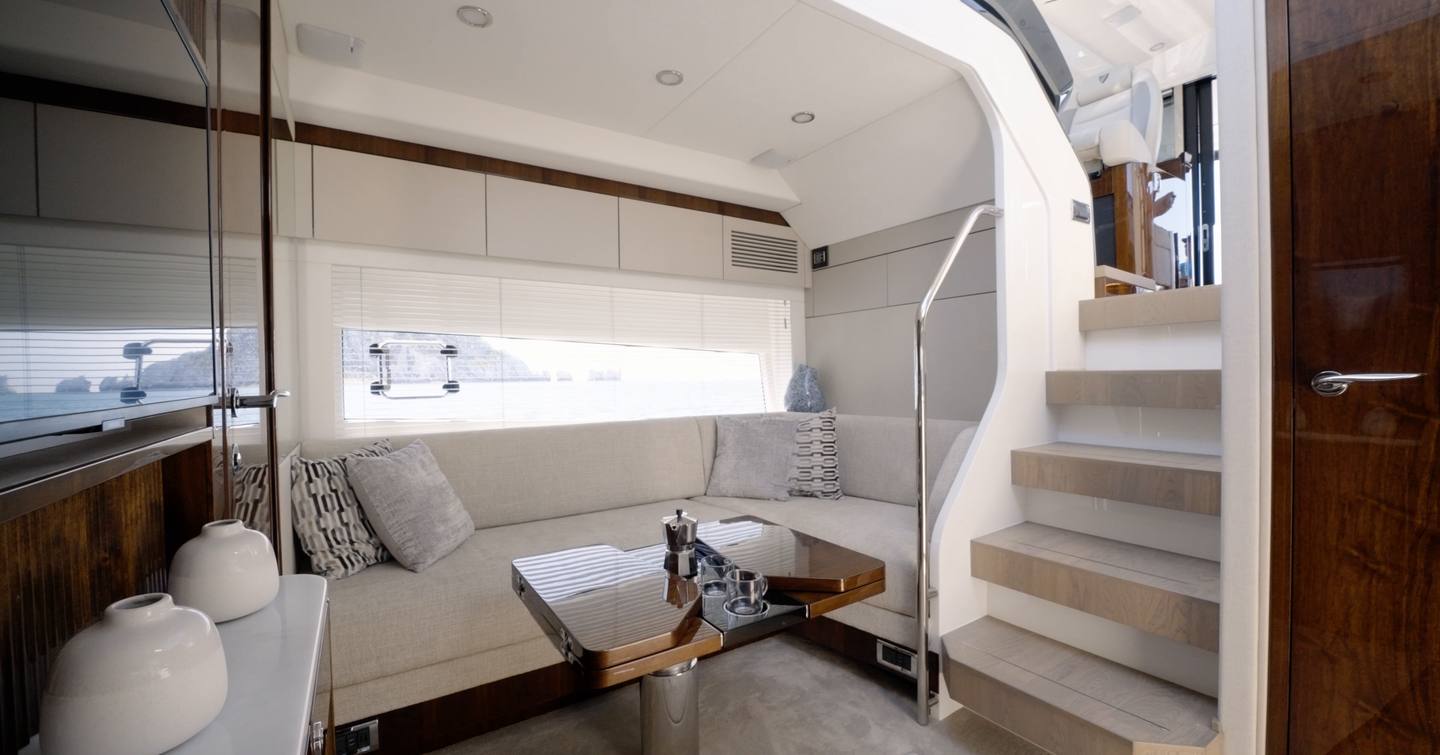
If lunch ends up happening in here because the weather isn't playing ball, that's absolutely fine too. The table folds out to a decent size, it drops up and down electrically and, most of the time, it'll probably stay folded away while you sit back and watch the television pop up from the cabinet opposite.
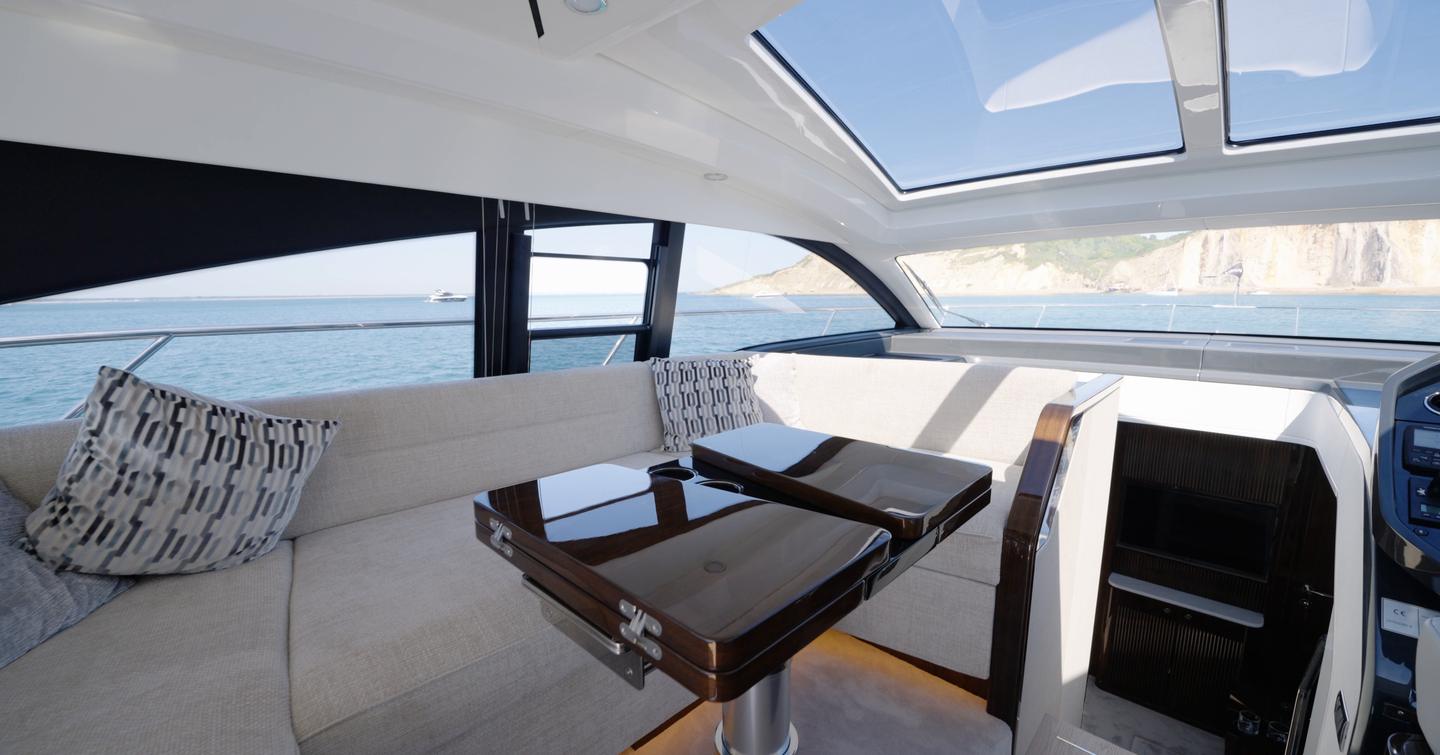
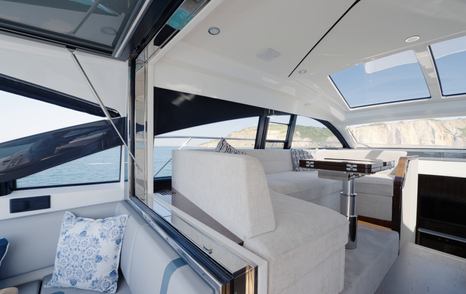
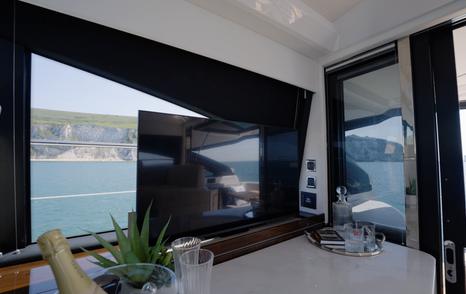
This is also where the Fairline quality starts to come through. Even the stainless steel support for the table feels beautifully made. The gloss timber is all grain matched, the finish is lovely and, if anything, it's almost a bit too nice. You'd probably want a tablecloth before sitting everyone down for lunch. Little details like that have always been one of Fairline's strengths, and it's nice to see they haven't disappeared.
Because the galley lives downstairs, this area doesn't need to do everything. Instead, you've got another fridge tucked away beside the seating, which is exactly where you'd want it when people are sitting in the cockpit, plus a bit more storage for the sort of things that never seem to have a home on a boat.
There's one small shelf that could probably do with a raised edge because it's the obvious place for ornaments and they'll only slide off once you get underway. During the test, there was also a bit of movement at anchor because this particular boat wasn't fitted with the optional stabiliser, although air conditioning kept the saloon nice and cool despite all the glass overhead.
The roof is probably the best example of why this design still works. It opens and closes really quickly and, because the glazing is now standard, shutting everything up doesn't suddenly make the saloon feel dark. Yes, there is a lot of glass up there, and on a hot day it will warm up more than a solid GRP roof, but you've still got the drop-down side windows to pull a cross breeze through if you don't want the air conditioning running.
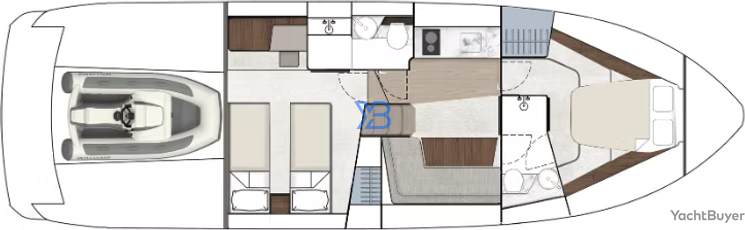
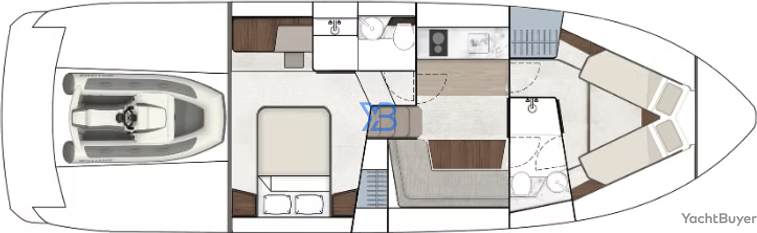
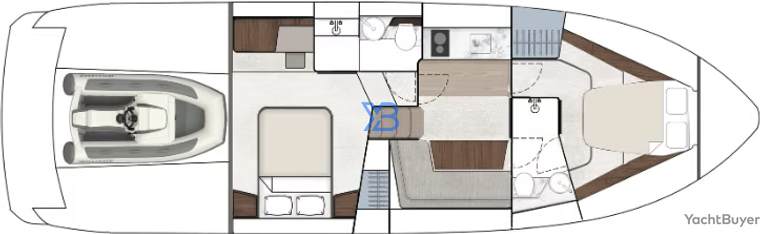
There are two layout options downstairs. The test boat has the two-cabin, two-bathroom arrangement with this seating area in the middle, but if you need more permanent sleeping space, Fairline will replace it with a pair of bunks. Unless you've got a family big enough that you genuinely need them, though, this is probably the layout to go for. It just makes the lower deck feel much nicer.
Rather than coming downstairs and finding another cabin, you've got somewhere private to sit, cool off and spend a bit of time away from the main deck. Up in the saloon, you're quite on show, particularly in a marina. Down here you can properly relax, watch the TV or, if guests stay over, drop the table at the touch of a button and turn it into an occasional double berth.
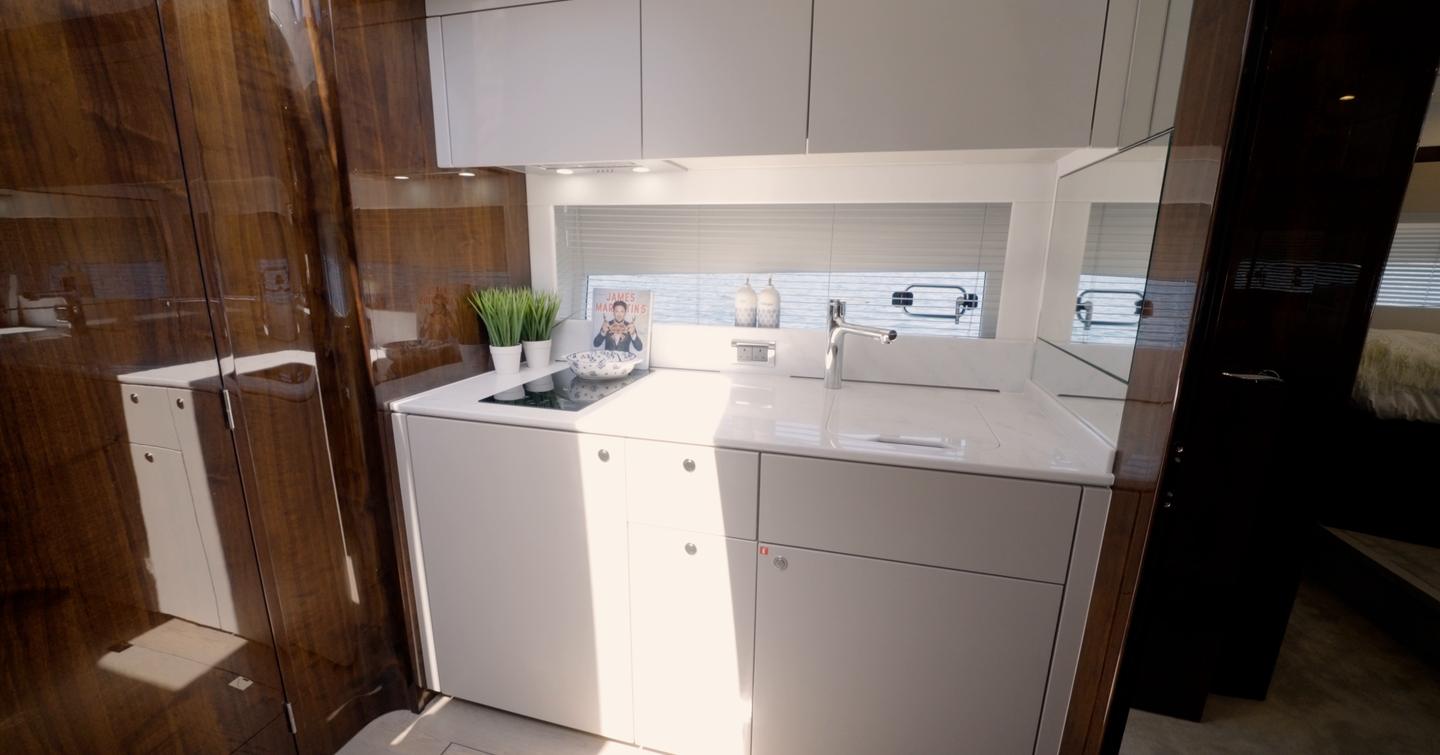
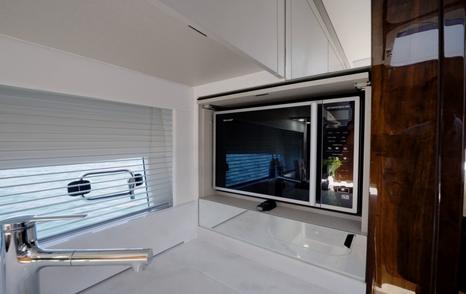
Opposite sits the galley and, while it isn't enormous, it doesn't really need to be. This isn't a boat where you're cooking for ten people every night. There's enough worktop, a two-burner induction hob, and everything is where you'd expect it to be.
The only area that feels a little bit tight is the fridge. It's under the counter with a small freezer compartment and, if you're spending a couple of weeks aboard, it's probably going to be working quite hard. That's exactly why the extra fridge upstairs is such a useful addition. Storage, though, is really good. Fairline has found somewhere for just about everything.
The crockery has its own locker, the stemware is held securely in place, there are deep drawers for pots and pans and even the floor lockers are lined, making them ideal for dry stores or, perhaps more realistically, somewhere to keep the drinks. It's also another place where the little details stand out - open the glass cabinet, and the lights come on automatically.
Owner's Cabin
The owner's cabin sits amidships, and on the way in, you've got a really good-sized en suite. Separate shower, plenty of room and completely private, exactly what you'd expect on a boat this size. Then it's down a couple of steps into the cabin itself.
That's actually no bad thing because it gives you much better headroom. At the end of the cabin, there's plenty of space to stand and get changed. It's only right down at the foot of the bed that anyone much over 6ft is going to start stooping a little. If that's you, sleep this side. You're a bit closer to the bathroom as well, which, as men of a certain age know, isn't a bad thing.
Storage is all where you'd want it. There's a run of drawers, a proper hanging locker, and, once again, it's the little details Fairline seems to enjoy. The hanging rail lights up when you open the wardrobe, there's a mirror built into the door, and the gloss timber is every bit as good down here as it is upstairs. The fluted panelling carries through as well, along with the grey felt around the bed, the reading lights and the sockets tucked neatly down beside you. It's all very thoughtfully done without feeling like it's trying too hard.
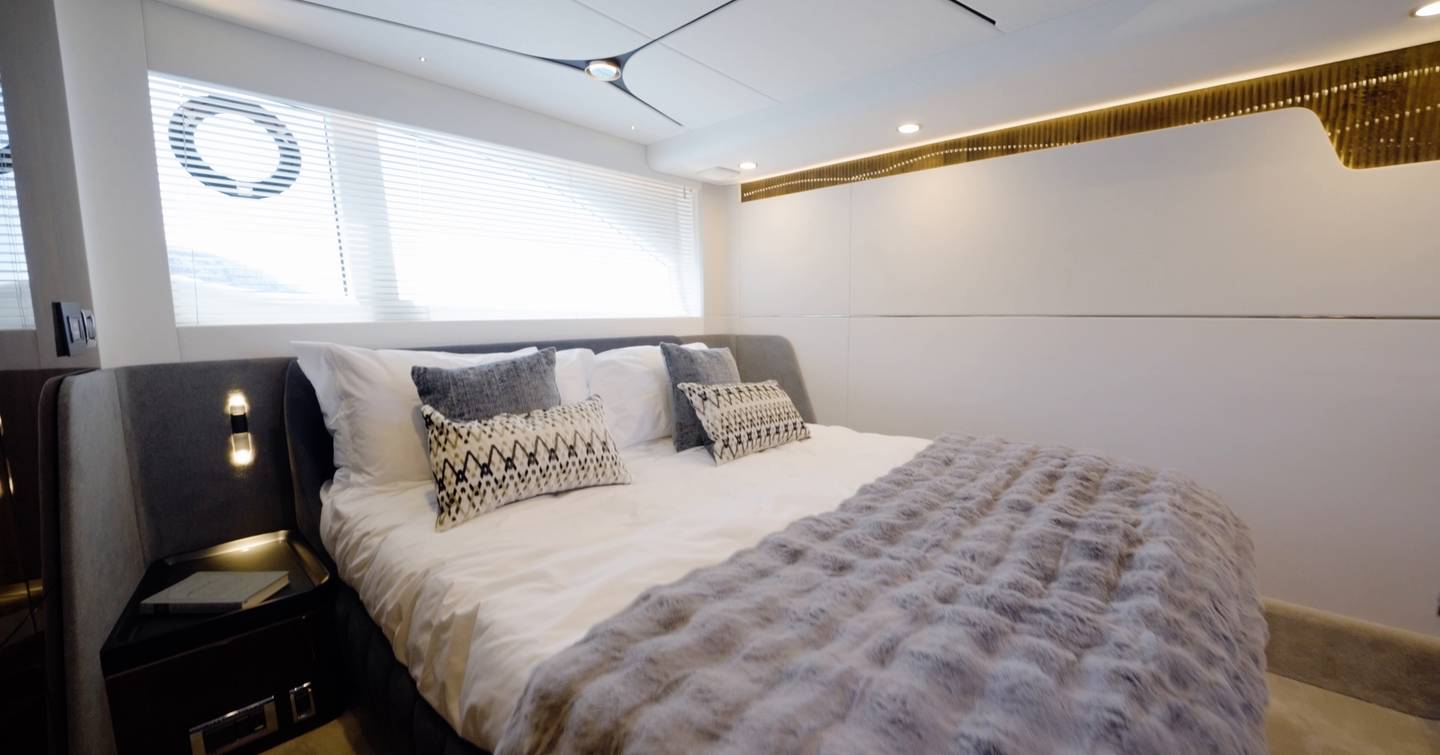
The bed itself is probably the biggest surprise. Normally, on a boat this size, you'd expect it to sit across the boat, but Fairline has turned it round and, for me, that's the right decision. You get much more space over on this side to move around, there's more room to get changed and, perhaps more importantly, when you're lying in bed, you're actually looking straight out through the hull windows.
Surely that's the whole point. You're down at water level and, whether you're tucked into a quiet anchorage or sitting in a marina, you can actually enjoy the view. The windows themselves are now one large piece of glass compared with the Targa 45 GT, but Fairline has kept opening sections as well, so if you'd rather have fresh air than air conditioning overnight, that's easy enough.
It's just a really effective cabin. It feels bigger than you'd expect, there's plenty of room to move around, and nothing really feels like it's been squeezed in just to make the brochure look better. If you go for the two-cabin layout, the owners get a really lovely space and, actually, the guests don't do too badly either.
Guest Accommodation
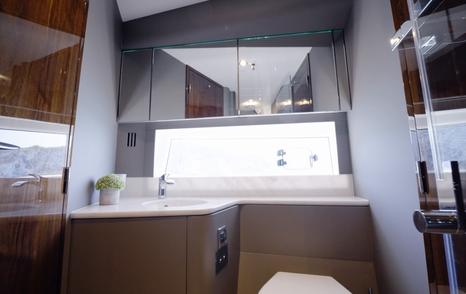
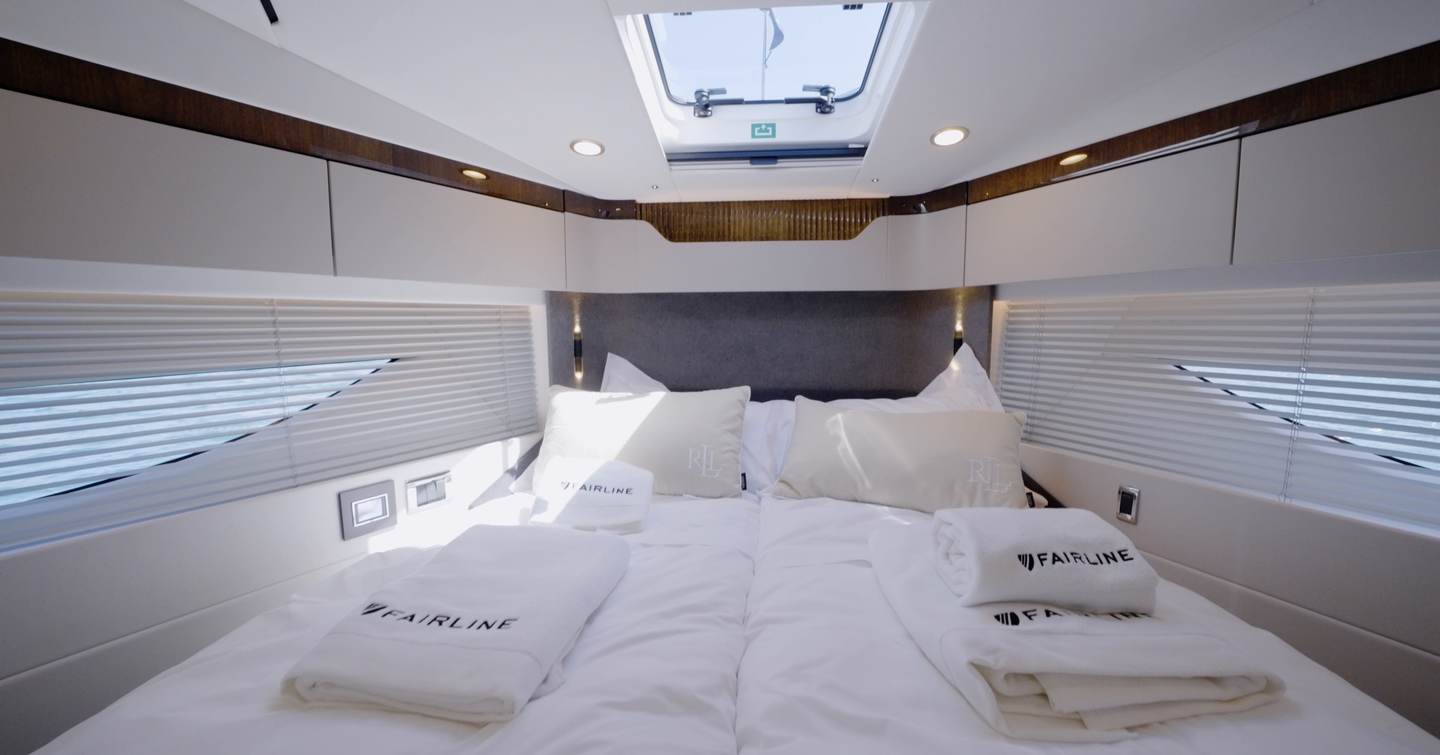
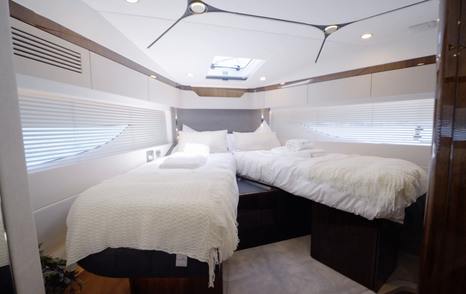
The VIP cabin picks up a few changes over the Targa 45 GT, and the first one is pretty obvious. This wall of mirrors isn't just somewhere to get ready in the morning. It throws light all around the cabin and, when you first walk in, you genuinely feel like you've got more space than you actually have.
The beds are another good example. They're scissor berths, so within a few seconds you can go from two singles to a double, and it's all completely manual. It's nice when things don't have to whirr into life every time you want to change the layout.
If the kids are sharing the cabin and driving each other mad, push them together. If two friends are staying on board, split them apart again. It's really quick, there's very little to go wrong, and Fairline has thought about both layouts. With the beds apart, you've got a handy tray between them that's ridged so your phone or glasses aren't sliding around, and when they're together, you still end up with proper bedside tables. It's just a really clever bit of design.
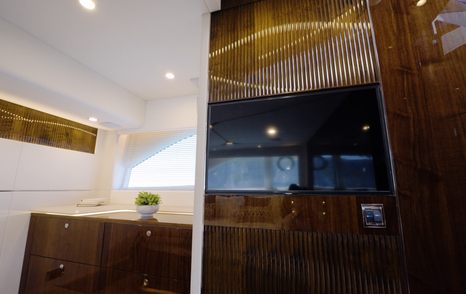
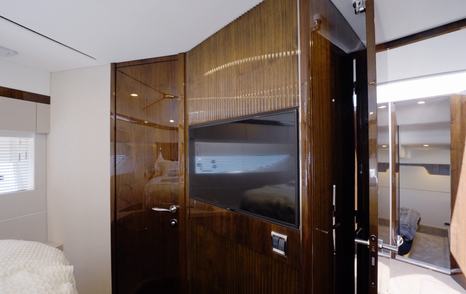
Headroom is better than you might expect as well because Fairline has lifted the deckhead slightly, and the quality carries through too. The fluted detailing around the TV matches the rest of the boat, there's useful storage at eye level, and the lighting has been thought about rather than simply bolted on afterwards.
Fairline has had a few ups and downs as a company over the last few years, so it's nice to see that the standard of the joinery still feels right up there. Guests also get direct access to the day head, while a second door means it doubles as the bathroom for everyone else during the day.
At my height (6ft), the seat works best with the folding footrest lowered and both helm seats slid fully forwards. That makes for an upright driving position with proper back support, while the wheel and throttles fall naturally to hand. It feels comfortable straight away and, more importantly, like somewhere designed for a full day's cruising.
Fairline has also avoided the temptation to bury every function inside a touchscreen. The Garmin multifunction display sits slightly further away than ideal, but a rotary controller mounted beside the throttles allows charts to be zoomed, screens changed, and menus navigated without leaning across the dashboard. That's particularly useful once the sea becomes less forgiving.
Better still, the systems used most frequently remain proper buttons. Engine controls, lighting and other everyday functions sit together on a separate switch panel, exactly where they should be.
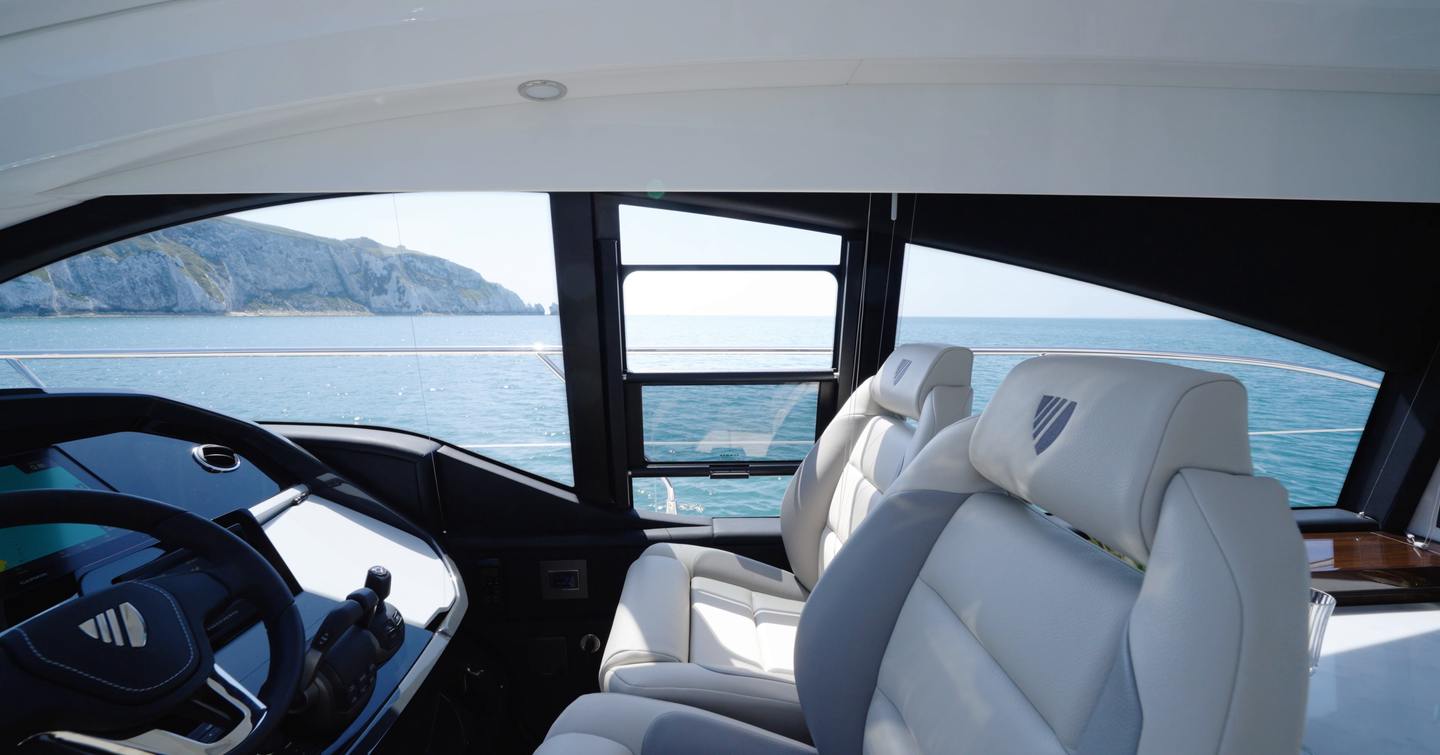
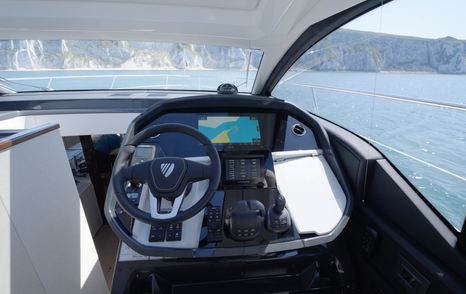
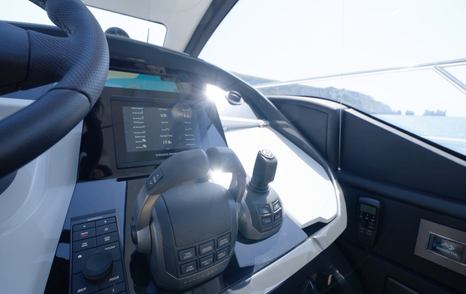
Forward visibility is excellent thanks to the single-piece windscreen and central helm position. Looking aft requires a little more effort. The roof supports are fairly chunky and the side windows are quite low, so checking the rear quarters during tighter manoeuvres usually means standing up. With the roof open that's no hardship, although in poor weather, when everything is closed, it becomes more noticeable.
There are one or two details that feel less resolved. Storage around the helm is limited, particularly for a phone or tablet, while the cup holders sit unusually low down. Some of the gloss black trim also feels slightly at odds with the otherwise high standard of finish.
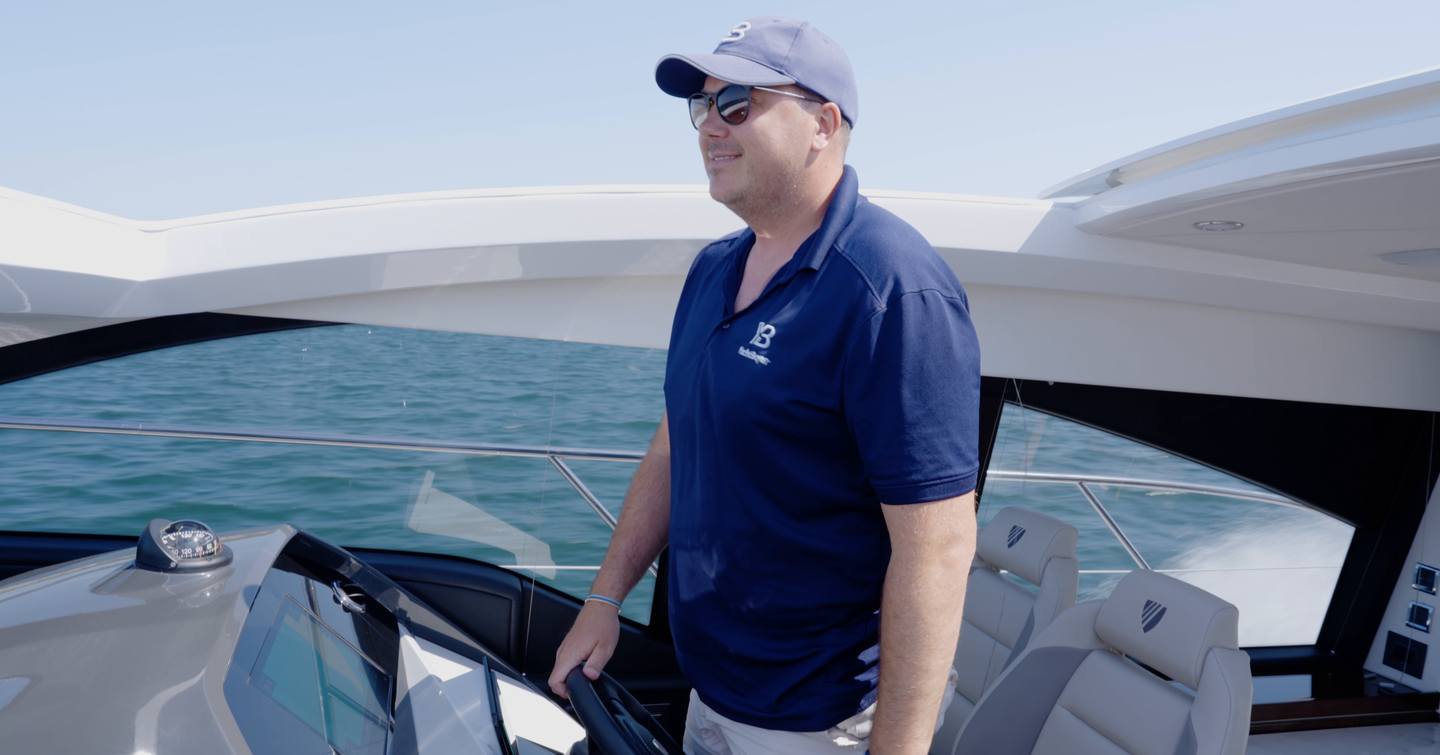
The overall driving environment suits the GT concept extremely well. Open the roof, slide back the cockpit doors and lower the side windows, and plenty of fresh air reaches the helm without the constant buffeting that comes with an open sports cruiser. The navigator remains close by, while the forward dinette extends far enough for another couple of passengers to stay part of the conversation while underway.
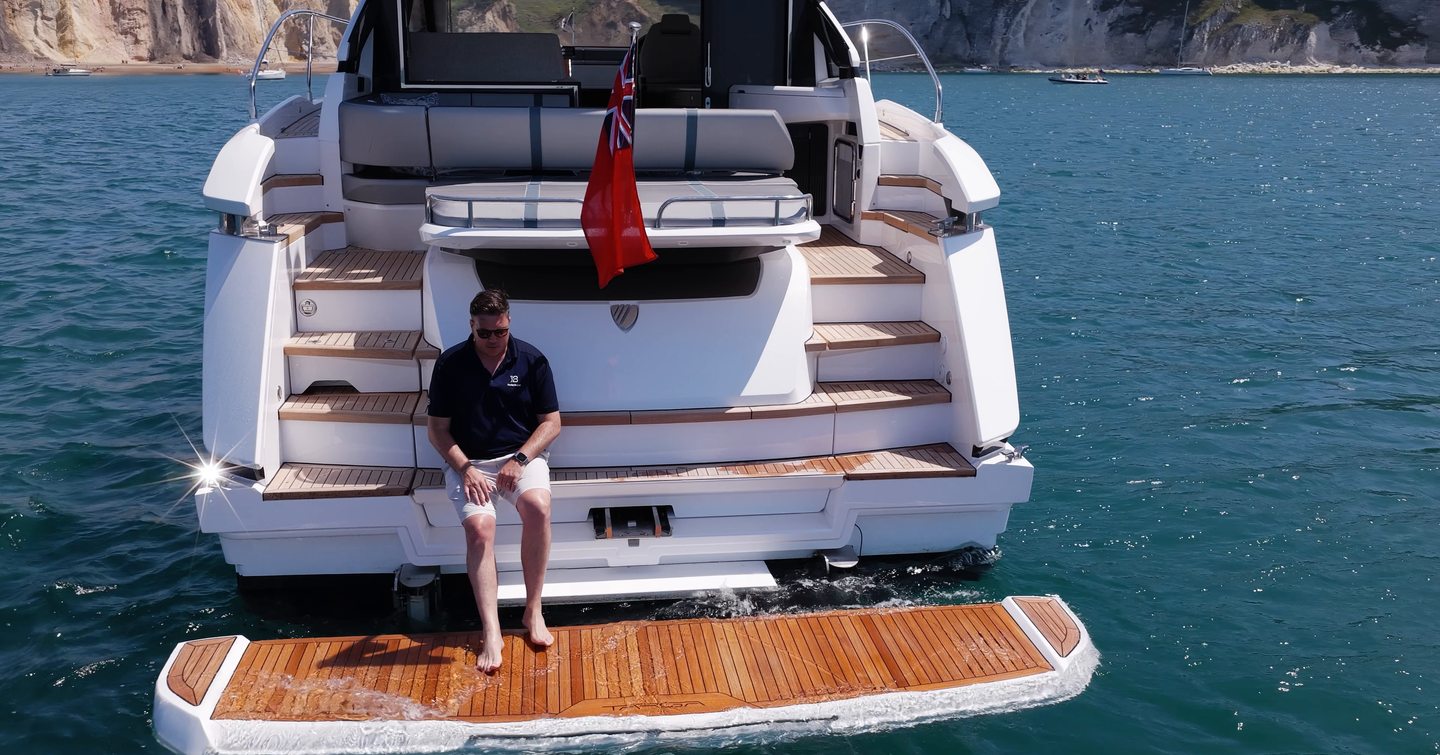
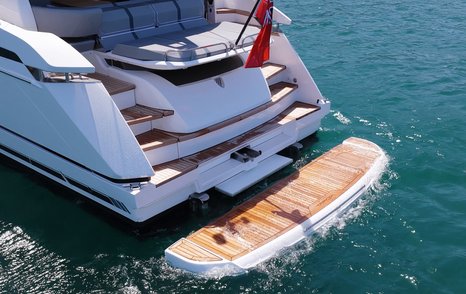
One of the changes over the Targa 45 GT is right at the stern. The bathing platform is a little longer than before. It's still not enormous and it isn't really designed to carry lots of toys, but that's no bad thing because Fairline has used the space well. Drop it just below the surface and it becomes a lovely place to sit with your feet in the water after a swim. Lower it a little further and getting in and out of the sea, or launching a paddleboard, becomes really straightforward. That's probably how most owners will use it.
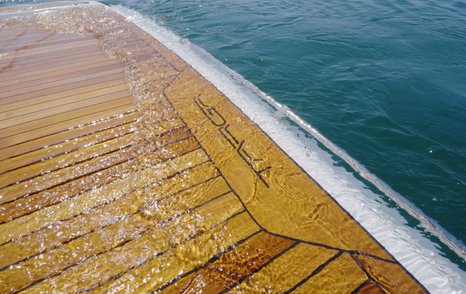
It's the little details that stand out here. The Targa logo is moulded into the platform, the drainage grilles are worked neatly into the teak and there's a proper handhold beside the boarding ladder. Then there's a clever little step built into the transom. It doesn't sound much, but it means you can still walk from one side deck to the other when the platform is lowered without having to climb down onto it first. It's one of those ideas that seems obvious once you've seen it, and it works really well.
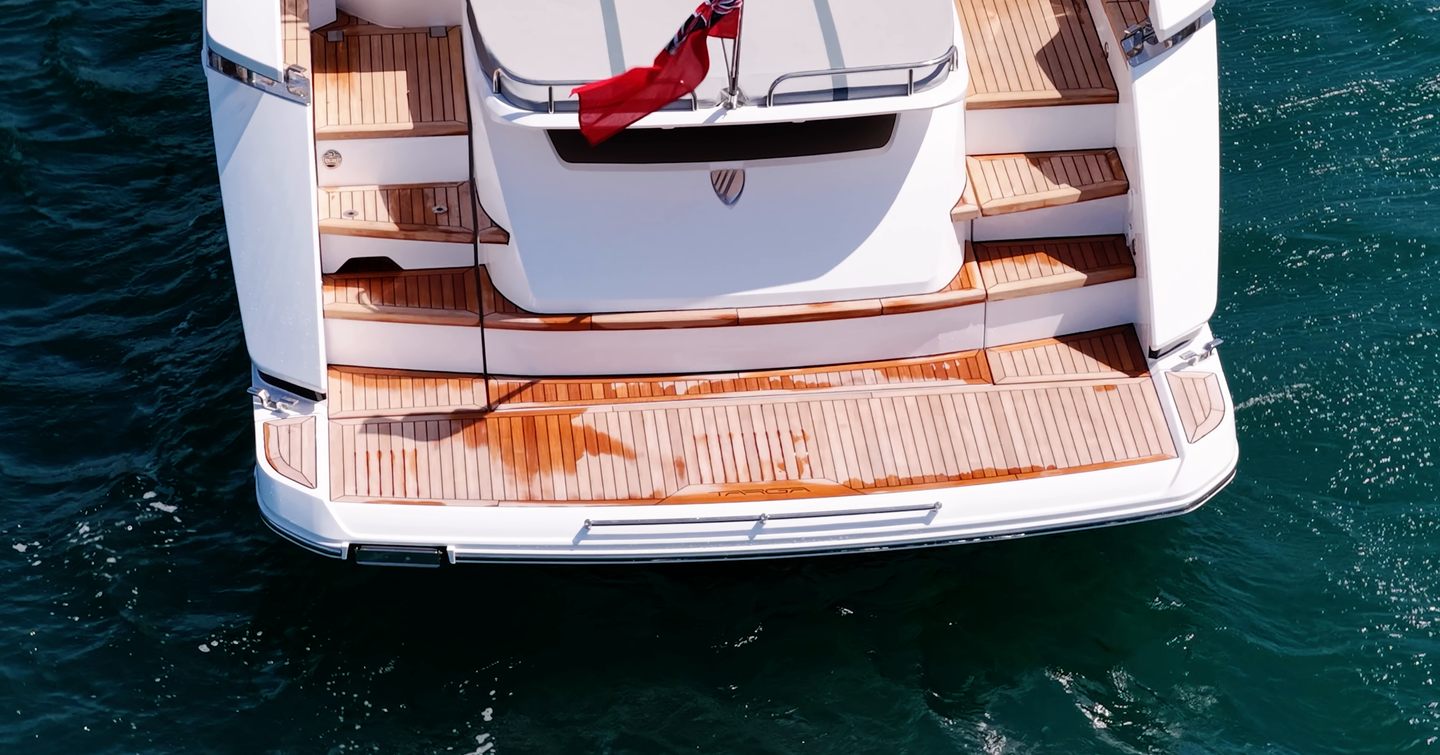
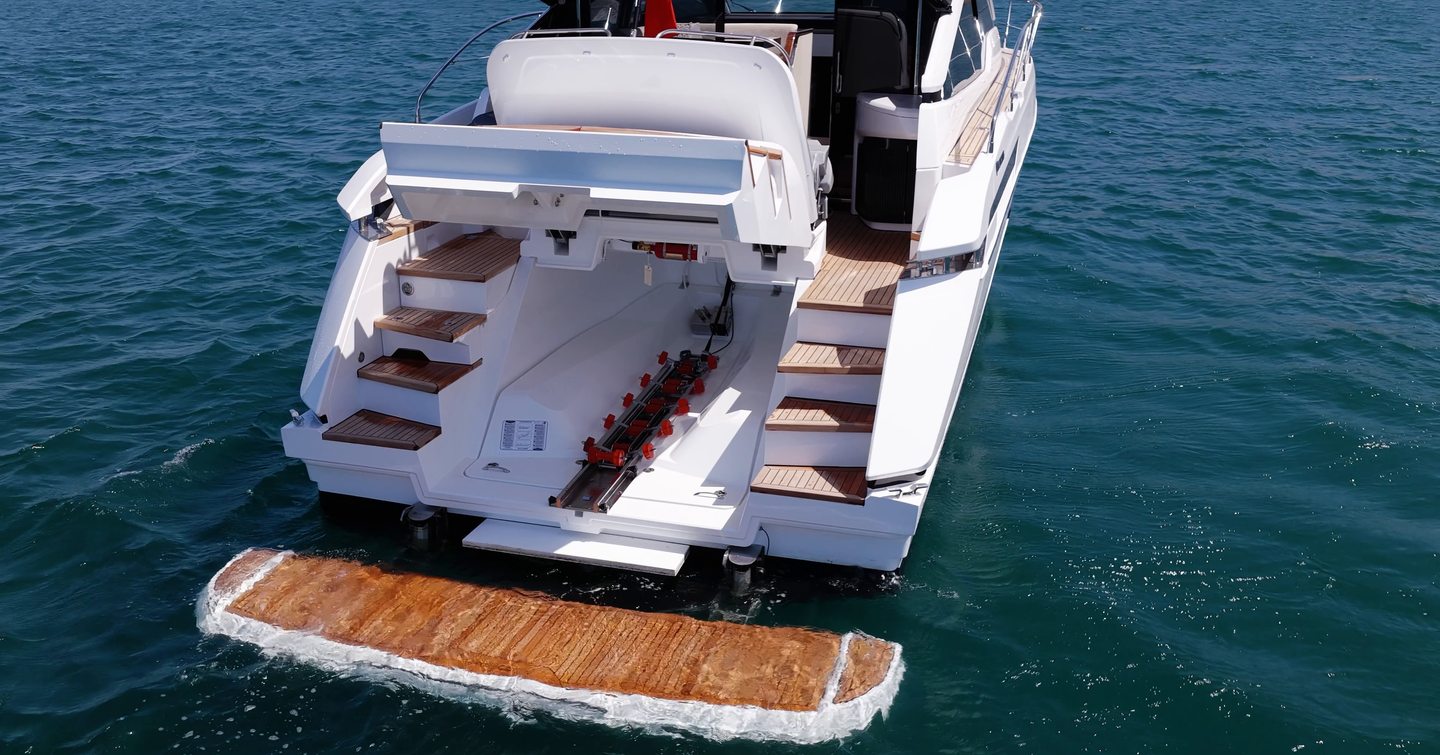
Underneath the cockpit is the tender garage. Fairline reckons it'll take a Williams of around 3m and there is still room left over for a few water toys. The only thing to remember is that the platform has to be lowered before the garage will open, so it's worth putting fenders and anything else you'll need underway back in there before leaving the berth. There's also a deck shower here, which is exactly where you'd want it after a swim.
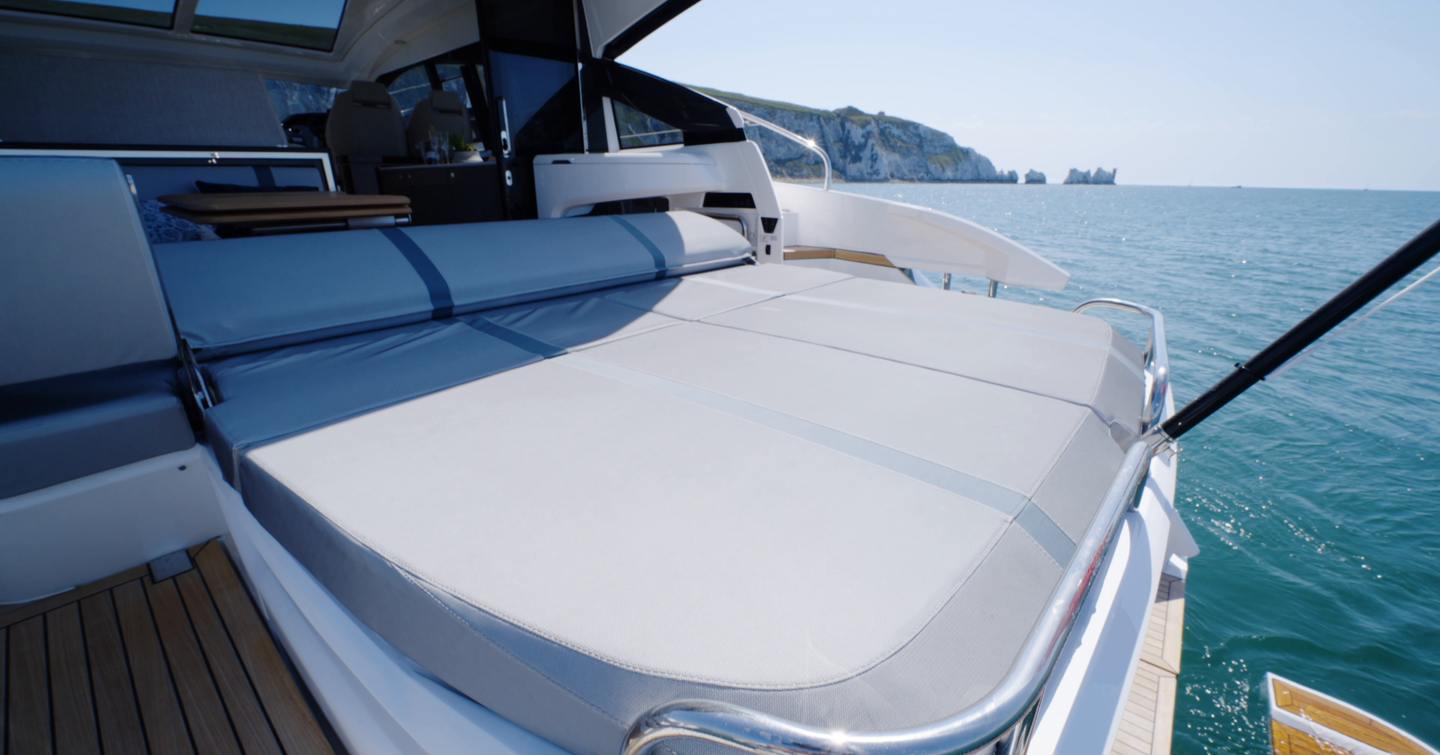
Of course, the biggest advantage of hiding the tender away is what it leaves on top. The whole aft section becomes one large sunpad, easily big enough for two or three adults, and an optional shade can be extended over it if you want some shelter. It's a nice contrast to the cockpit just forward. One space is very much about lying out in the sun, the other is somewhere to sit in the shade with lunch or a drink. It feels like a well-balanced aft end rather than one trying too hard to do everything.
Cockpit
Like the Targa 45 GT, you can have the 47 as either a GT or an Open. The difference is exactly what you'd expect. The Open does away with the doors and gives you a much bigger cockpit. This one splits the main deck between an enclosed saloon and an outside seating area, so inevitably you lose a bit of cockpit space. What you get back is a boat that works in a much wider range of weather, and after spending time on board it's easy to see why the GT has proved so popular.
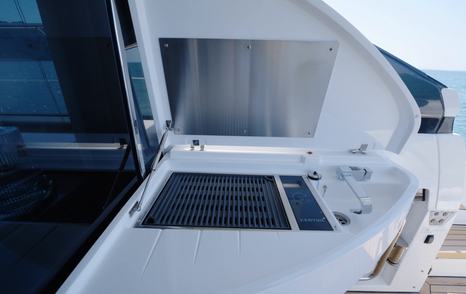
The first thing you come to is the wet bar. Fairline has managed to squeeze a decent-sized Kenyon grill into quite a compact space and it works well because the sink sits immediately alongside it. Once you've finished cooking you can simply wipe everything straight off the grill and into the sink. Underneath isn't another fridge because there's already one just inside. Instead, Fairline has fitted a bin which is just one of those features that's always useful and surprisingly rare on a boat this size.
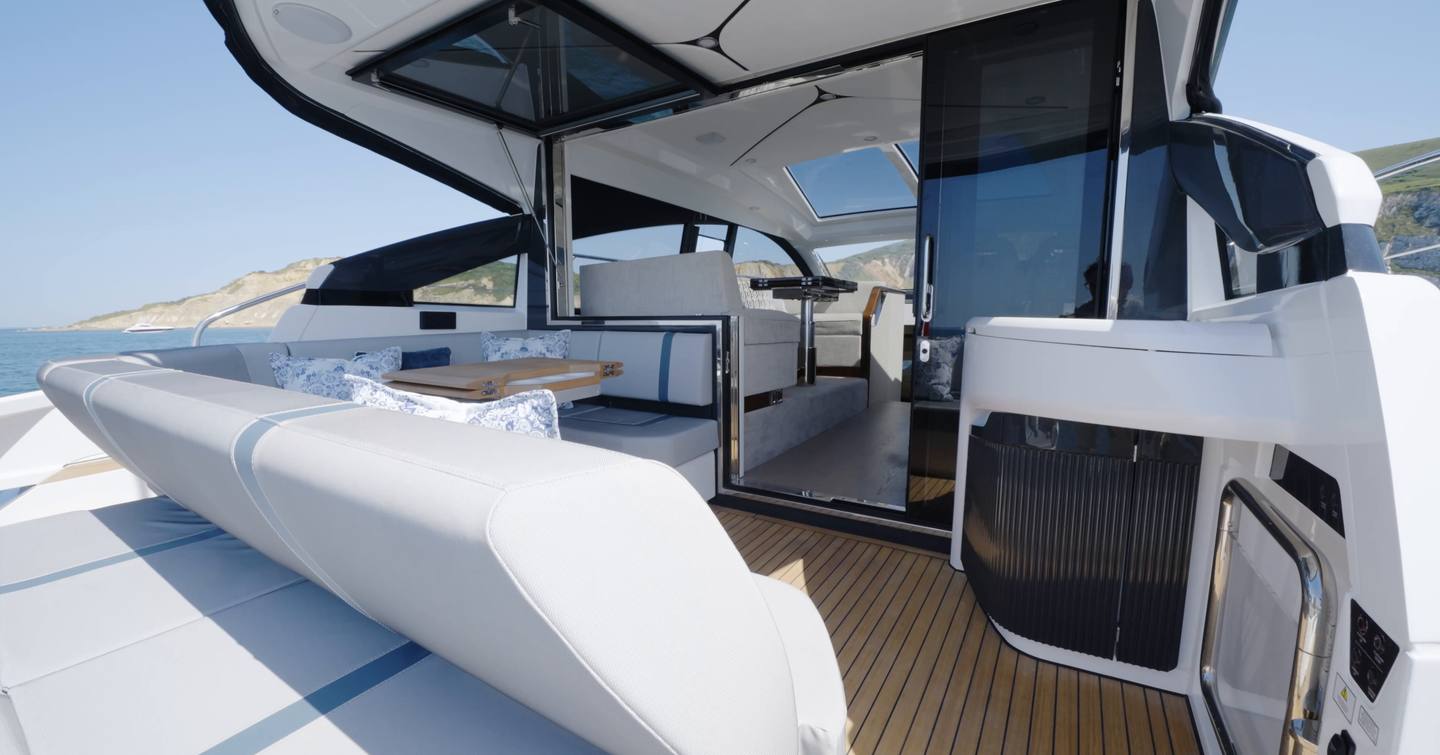
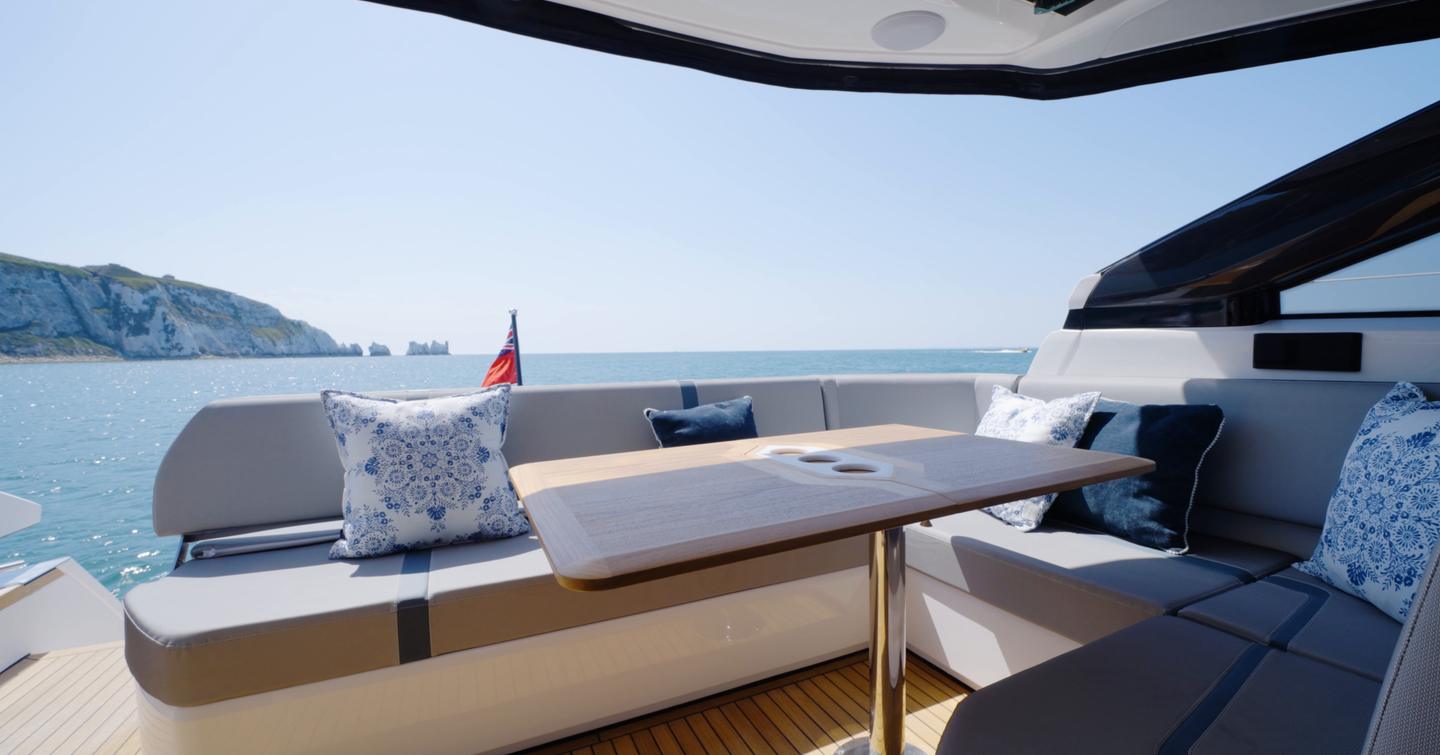
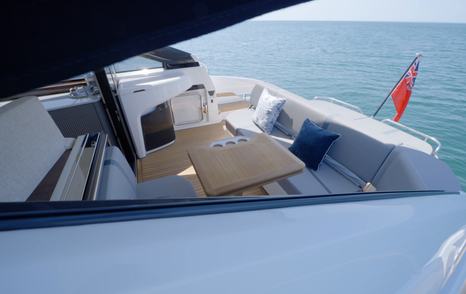
The seating is where most of the clever thinking has gone. The backrest has to move so the tender garage can open, but Fairline has made it do two jobs. Fold it one way, and it becomes a headrest for the sunpad. Put it back again, and you've got a really comfortable place to sit for lunch.
The seating itself extends a long way aft, making the most of the space available. The table only just covers it all, but with four permanent berths on board, it's about the right size for day-to-day use. If you regularly have six or eight people on board, you could always drop another occasional table in at the end.
Perhaps the nicest surprise is just how sheltered this cockpit feels. The wheelhouse does a very good job of taking the breeze away, so even with plenty of wind over the bow, there's very little reaching the seating area. Sit here and it feels completely different to the sunpad aft. One is somewhere to stretch out in the sun, the other is somewhere to escape it for a while with lunch or a drink. Is the cockpit as big as the Open? No. Does it actually matter day to day? Probably not.
Side Decks & Foredeck
Getting forward is pretty easy, although it's much better on the starboard side. The port side deck is interrupted by the cockpit seating, so if you're walking forward from the cockpit, you'll naturally head this way instead.
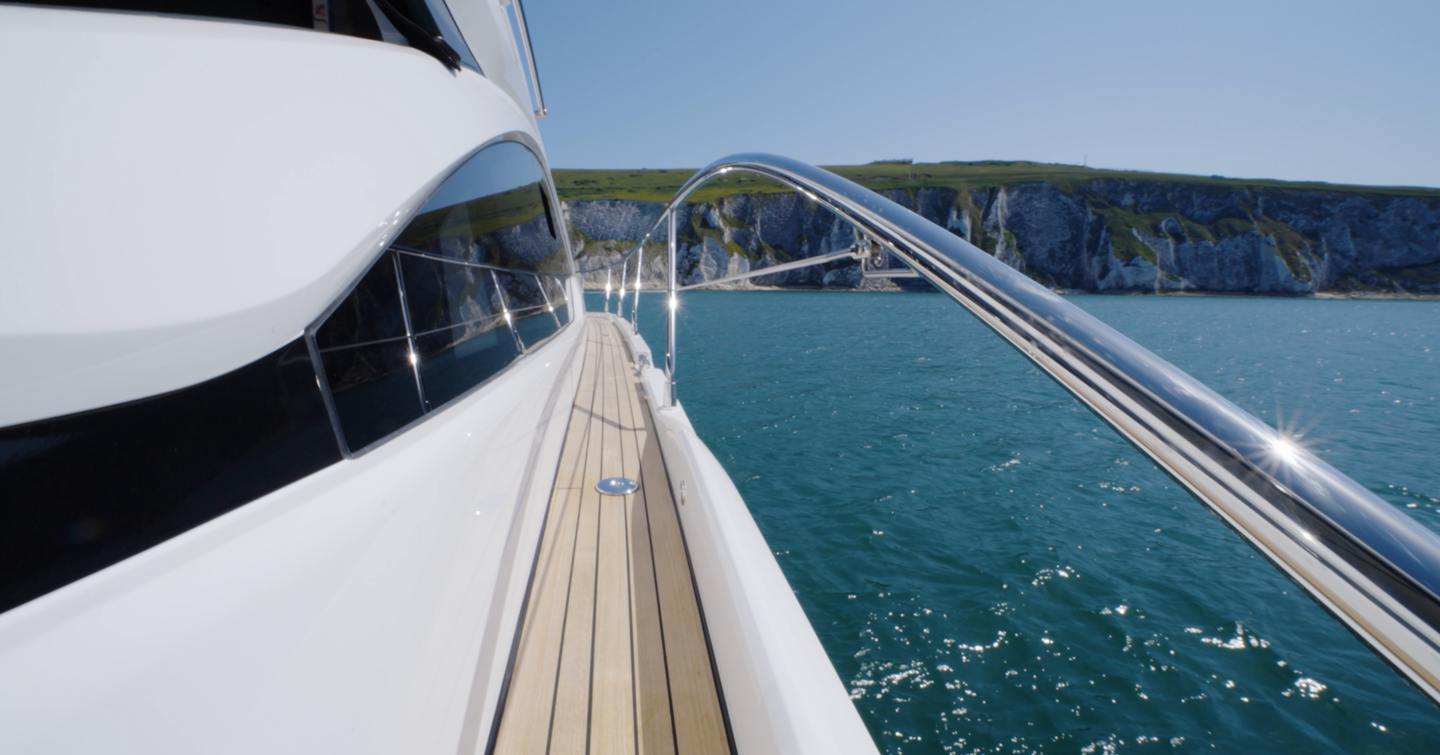
Access from the bathing platform is good on both sides, though, so it isn't really an issue. Once you're alongside the wheelhouse, the side deck feels secure enough. The guardrail could perhaps be a little higher, but there's another handhold exactly where you need it, and it's easy enough to make your way forward.
It's also from here that you really appreciate how much glazing Fairline has added to the hardtop. Unlike the earlier Targa 45 GT, the glass roof is now standard, so even when everything is closed up there's still plenty of natural light finding its way into the saloon. It makes the GT feel much more usable because shutting the roof no longer turns the interior into a darker space. That's a worthwhile improvement and one you'll probably notice every time the weather isn't playing ball.
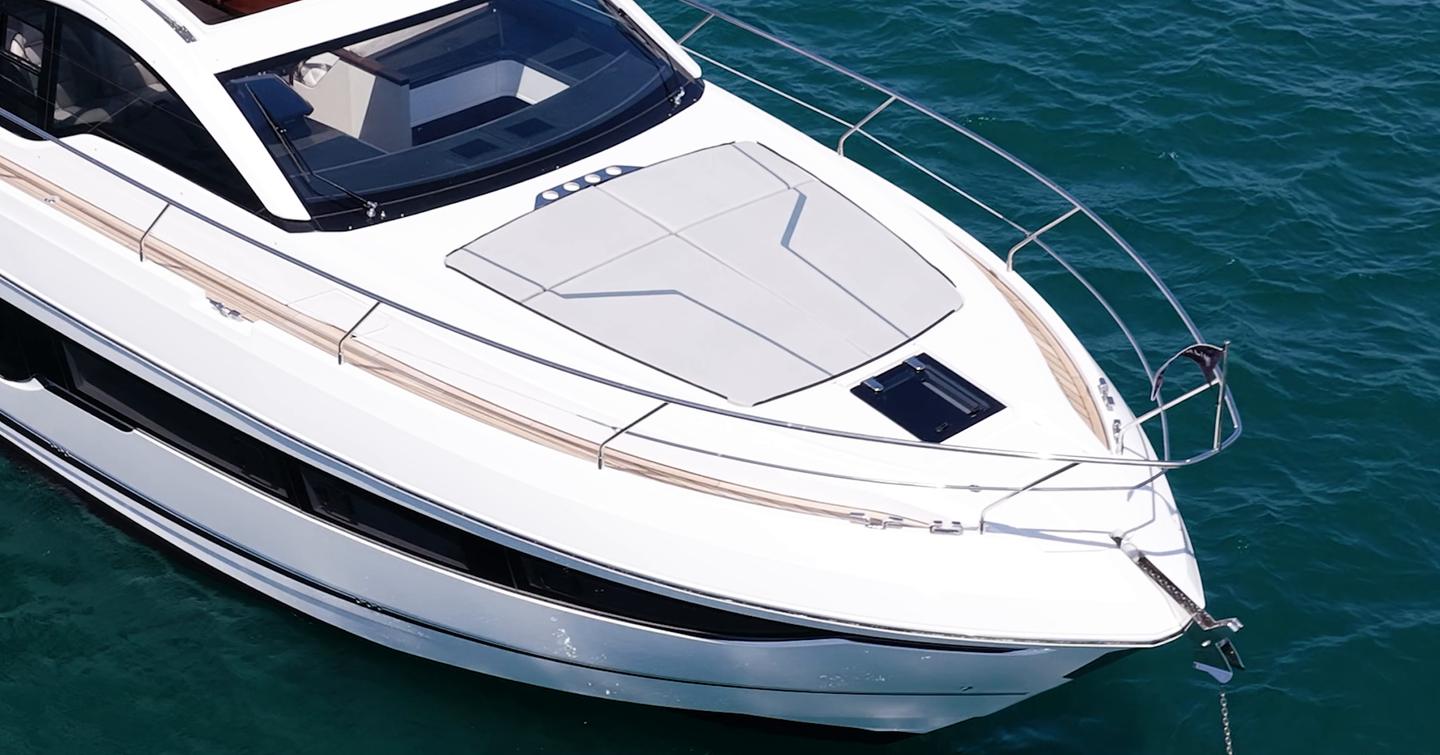
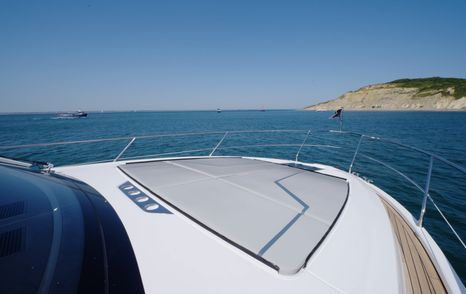
The foredeck tells a slightly different story. It works perfectly well if all you're after is somewhere to lie out in the sun because that's exactly what it gives you - a good-sized sunpad. The trouble is that's about where it stops. Boats in this sector have moved on quite quickly over the last few years.
Sunken seating, cocktail tables and proper bow lounges are becoming much more common, and Fairline hasn't really followed that trend. If spending the afternoon at anchor with friends is high on the list, some rivals simply make better use of this space.
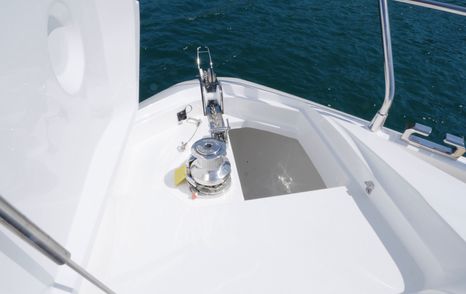
That said, there's nothing to complain about from a practical point of view. The cleats are substantial, the fairleads are well placed, and the anchor locker is deeper than it first appears, with plenty of room for the chain and a couple of fenders as well. So while the foredeck perhaps lacks a bit of imagination, it still does the job it's supposed to do. It's just one of the few places on the Targa 47 GT that feels a little behind the rest of the boat.
Engine Room
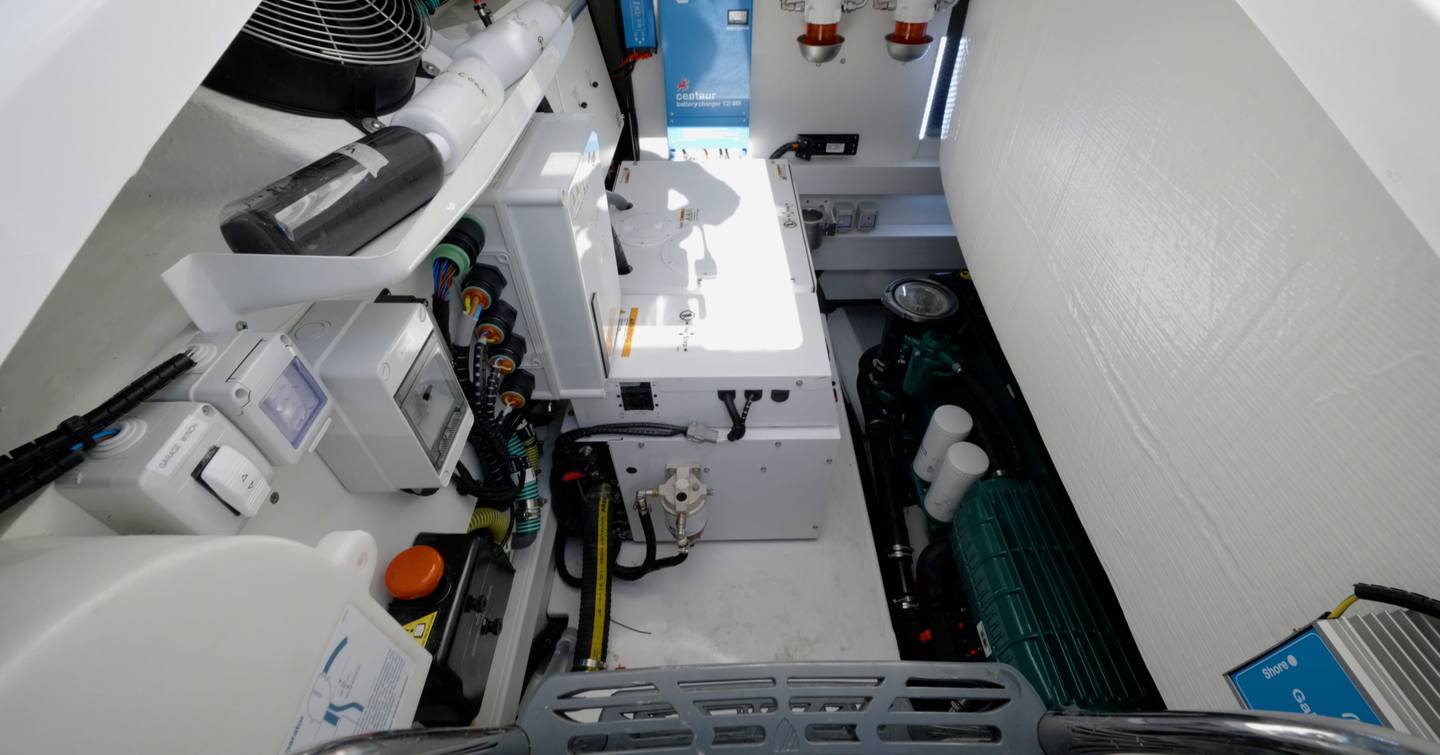
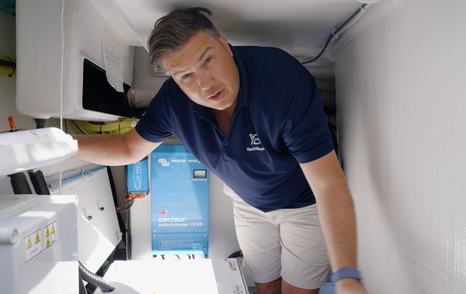
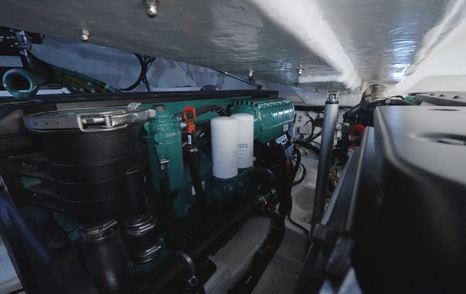
Engine room access is through a hatch on the port side and it's actually pretty good. The hatch opens nice and wide, there's a proper ladder down and, once you're at the bottom, you've got enough room to stand up comfortably. Sitting either side of the compartment are the twin 480hp Volvo Penta IPS650 diesel engines that power the Targa 47 GT, with the IPS pods tucked neatly beneath them. It's a tidy installation and, at first glance, access looks better than you might expect on a 47-footer.
The compromise comes a few steps later. This is the downside of having a tender garage on a boat this size because the moulding above takes up quite a bit of room. Getting to the port engine isn't too bad and access around the IPS pod is actually pretty good, but squeezing round to the starboard engine is definitely tighter. If you do your own servicing, or even just like poking around down here, that's something worth knowing.
The generator, on the other hand, is exactly where you'd want it, right by the ladder, so all the routine checks are nice and easy. Spend a couple of minutes looking around and the other thing that stands out is the finish. Fairline hasn't treated this as a space nobody will ever see. The quality down here is every bit as good as it is upstairs. Everything feels tidy, well installed and properly finished, even in the darker corners of the engine room.
So there is a compromise. The tender garage costs you a bit of access around the starboard engine. Beyond that though, there's very little to complain about. The machinery spaces feel exactly like the rest of the boat - well thought through, well built and finished to a really good standard.
The Targa 47 GT starts at just under £1 million excluding VAT, but, to be honest, that's only half the story. The boat tested here came in at £1,218,740 excluding VAT, and that feels much more like the figure most owners are likely to end up with.
The interesting thing is that this isn't a demonstrator loaded with every option Fairline could think of. Most of the difference comes from the Premium Pack (£175,000) and, although that's a big number, it includes many of the things you'd probably tick yourself. The Submersible Hi-Lo Bathing Platform (£30,200), Air Conditioning (£34,900), Bow Thruster (£8,900), Cockpit Wet Bar (£2,300), Garmin Glass Bridge with 12-inch Display (£7,000), Garmin AIS (£1,600), Garmin Radar (£3,800) and Folding Cockpit Table (£6,300) are all wrapped into that package, along with upgraded lighting, better interior finishes, reclining foredeck cushions, sprung mattresses and all the little bits that make the boat feel finished.
The Premium Pack covers most of what owners are likely to want, so the remaining options are really about tailoring the boat to your own wishlist. If you need more accommodation, you can swap the lower saloon for a third cabin (£13,700) or specify different berth arrangements in both cabins, including a sliding scissor berth forward (£3,300) and sliding twin beds in the mid-cabin (£2,200). Keen owner-operators can add Volvo's Assisted Docking System (£8,900), Humphree interceptors (£8,900) or the more advanced Dynamic Plus package (£16,300), while technology upgrades include Garmin's Surround View camera system (£25,900), Starlink (£3,800) and wireless phone charging in all cabins (£4,200). The main big ticket option that was notably missing from the testboat was the Seakeeper 4 gyroscopic stabiliser (£52,000). Expensive, but it's one of the few upgrades you'll miss every time the boat is rolling at anchor.
Does that push the price a long way beyond the headline figure? Yes, very much. But against rivals from Princess, Riviera and Galeon, it's about where you'd expect a British-built boat of this quality to sit.
For the latest new boat pricing, used values and live market data, visit our Fairline Targa 47 GT Prices section on our listings page, powered by YachtBuyer MarketWatch.
Our Verdict
There's no hiding the fact that this is a fairly light refresh of the boat it's based on and, in a couple of areas, you could argue Fairline has played it a little safe. The foredeck is probably the best example. It does the job perfectly well if all you want is somewhere to stretch out in the sun, but boats like the Riviera, Galeon and even Jeanneau are starting to do a bit more with these spaces. If you're looking for the latest clever features, the Targa doesn't always have the answer.
The thing is, none of that really changes what this boat is. Spend a day on board and it still feels like a really good all-round package. The GT layout works just as well now as it did on the Targa 45. The cabins are properly thought through, particularly in the two-cabin layout, the quality still feels right up there and, out on the water, it's exactly what you'd hope a Fairline sports cruiser would be. It's comfortable, it's easy to drive and it feels very happy sitting at its cruising speed all day long.
So yes, it's an evolution rather than a revolution. Some buyers will inevitably wish Fairline had been a bit braver, but it still feels very well built, it's enjoyable to drive, looks great on the water and, for many owners, that's probably more important than having the cleverest cockpit in the marina.
Reasons to Buy
- GT layout works in any weather
- Lovely quality throughout the interior
- Strong cruising performance at 25 knots
- Feels every bit a Fairline
Things to Consider
- Foredeck feels behind newer rivals
- Premium Pack lifts price considerably
- Spray issue on the test boat
Pricing
Price as reviewed: £999,000 (€1,180,371 approx)
Tested Specification: £1,218,740 ex VAT. Typical owner specification included the £175,000 Premium Pack, Humphree interceptors, Mid-Master layout, upgraded Garmin electronics and Walnut Gloss interior finish.
Looking to own a Fairline Targa 47 GT? Use YachtBuyer’s Market Watch to compare all new and used Fairline Targa 47 GT Yachts for sale worldwide. You can also order a new Fairline Targa 47 GT, customized to your exact specifications, with options for engine choice and layout configuration. Alternatively, explore our global listings of new and used yachts for sale and find your perfect yacht today!
Rivals to Consider
The Riviera 465 SUV is probably the boat that comes closest in spirit, but it arrives there by a completely different route. At 15.90m (52ft 2in) with a 4.76m (15ft 7in) beam, it's a slightly bigger boat than the Fairline and you feel that almost straight away. Rather than splitting the accommodation between inside and outside, Riviera creates one huge entertaining space by putting the enclosed saloon and cockpit on a single level beneath the hardtop. Down below, it squeezes in three cabins for up to six guests, while twin 600hp Volvo Penta D8 IPS800 engines give it a top speed of around 32 knots. Riviera is one of the boats that does a bit more with the cockpit. If long-range cruising and practical deck spaces sit at the top of your shopping list, it's a really compelling package. The Fairline feels more elegant, the interior has a richer feel and, perhaps most importantly, it's the one that still feels more like a traditional British sports cruiser when you're behind the wheel.
The Beneteau Gran Turismo 50 is slightly longer again at 15.95m (52ft 4in), although its 4.48m (14ft 8in) beam is a little narrower than the Riviera's. It uses the same twin 480hp Volvo Penta D6 IPS650 engines as the Fairline, so performance is broadly similar with a top speed of around 31 knots, but the whole layout has a different feel. Beneteau has moved the galley onto the main deck, creating one large social space beneath the hardtop, and the AirStep hull gives the boat an easy-going, efficient character. It feels bigger inside than the Fairline and it's very easy to imagine spending long afternoons aboard at anchor. The Fairline doesn't quite have that same sense of space, but the quality of the timber work, the finish and the driving experience all feel a step above. It comes down to what you value more - volume or craftsmanship.
The Galeon 485 HTS measures 14.98m (49ft 2in) with a 4.25m (13ft 11in) beam, making it one of the smaller boats here, but it's also probably the most inventive. Depending on engine choice, twin Volvo Penta IPS installations produce between 30 and 35 knots, but it's the layout that really sets it apart. Galeon's huge glazed roof, retractable glass bulkhead and clever use of moving glass create an interior that feels far more open than its dimensions suggest. It's exactly the sort of innovation that Fairline is missing in places, particularly around the cockpit and foredeck. The trade-off is that the Galeon is a much more complex boat. The Fairline feels simpler, more understated and beautifully put together. It isn't trying to impress you with party tricks. It's trying to be a boat you'll still enjoy owning ten years from now.
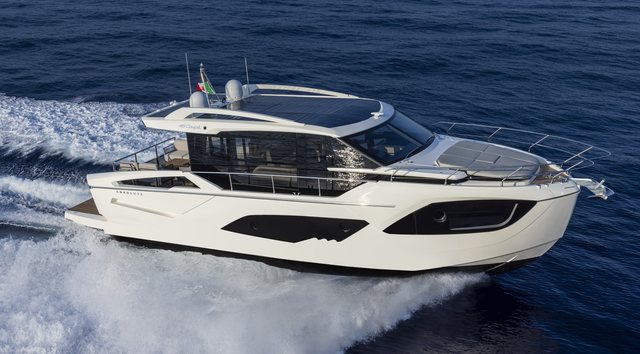
The Absolute 48 Coupé is actually the shortest boat here at 14.90m (48ft 11in), sharing the Galeon's 4.25m (13ft 11in) beam and the Fairline's twin 480hp Volvo Penta D6 IPS650 engines. Top speed is a more relaxed 28 knots, but Absolute has used every bit of the available space to create a remarkably spacious interior with three proper cabins for up to six guests. The high-volume superstructure, forward-raked windscreen and extensive glazing make it feel much larger than its dimensions suggest, while integrated solar panels help reduce generator use when you're sitting at anchor. If accommodation is your priority, the Absolute is very difficult to ignore. The Fairline doesn't offer the same amount of space, but it has a much lower, sleeker profile and a driving experience that feels considerably more engaging. One is designed around making the most of every cubic metre; the other still remembers it's supposed to be a sports cruiser.
Considering a new yacht? Explore Fairline's entire current range to find the model that best suits your needs, and compare it with alternatives from competitors to ensure you make the perfect choice.
Specifications
- Builder Fairline
- Range Targa
- Model Targa 47 GT
- Length Overall 14.73m
- Beam 4.83m
- Draft(full load) 1.15m
- Hull GRP
- Cabins 2
- Berths 6
- Yacht Type (Primary) Sportsboat
- Use Type (Primary) Cruising
- Cruising Speed
- Max Speed
- Fuel Capacity 1,300 Litres
- Fresh Water Capacity 400 Litres
- Engine Model 2x Volvo Penta D6-IPS650
- Engine max range (speed type) 250 (nm)
Fairline Targa 47 GT Layout
-
Main Deck
-
![Main Deck Fairline Targa 47 GT]()
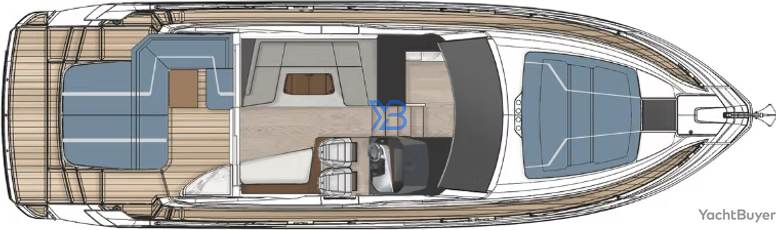
The GT main deck offers best of both worlds flexiblity
-
Lower Deck
-
2 cabin layout with forward double and starboard twin
![Lower Deck Fairline Targa 47 GT]()
The standard arrangement has twin berths aft
-
2 cabin layout with forward twin and starboard double
![Lower Deck Fairline Targa 47 GT]()
The layout of the boat we tested with two ensuite doubles
-
2 cabin layout with 2 doubles
![Lower Deck Fairline Targa 47 GT]()
You can have a fixed double forward instead of scissor berths
-
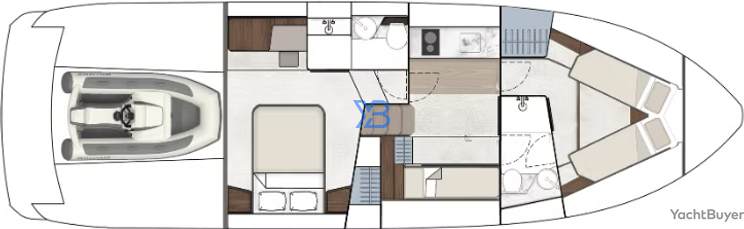
3 cabin layout
![Lower Deck Fairline Targa 47 GT]()
The three cabin layout adds bunk to starboard
Available Stock


Fairline
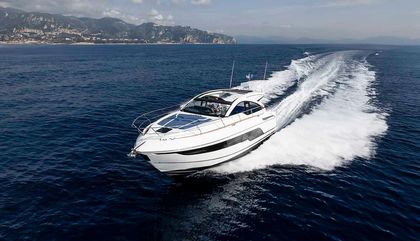
Fairline Targa 47 GT15m | Targa 47 GT (Mk2)
2026 M/Y noname
2 x Volvo Penta 480hp
Features: Joystick
Fairline
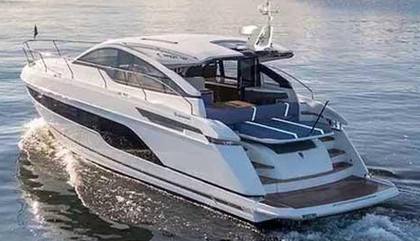
Fairline Targa 47 GT15m | Targa 47 GT (Mk2)
2026 M/Y noname
2 x Volvo Penta 480hp
Features: Aircon, Joystick, Bow Thruster
Fairline
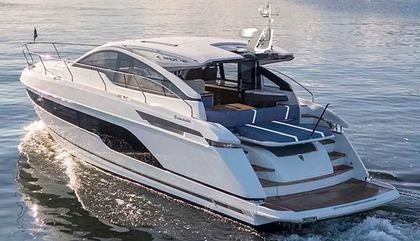
Fairline Targa 47 GT15m | Targa 47 GT (Mk2)
2026 M/Y noname
2 x Volvo Penta 480hp
Features: Joystick
Interested in a Targa 47 GT?
NEW Build
Find your local dealer for a personalised, no-cost consultation
or just request
Brochures & Pricing
Used & In Stock
Looking for a ready-to-go Targa 47 GT or pre-owned options? Explore all inventory of the Targa 47 GT available worldwide