Forte 47 Grand Turismo
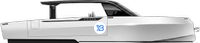
- LOA 14.35m
- Model Year 2026
- Cabins 2
- Max Speed 47 knots
- Status In Production
- Yacht Type Centre Console
- Use Type Weekending
Video Tour
Forte 47 Gran Turismo At A Glance
Why you'll love it
- Aluminium hull combines low weight with exceptional strength
- Choice of triple Mercury V12 outboards or Volvo Penta IPS propulsion
- Fold-down terraces and a beach-club style cockpit
Things to know
- Relatively new builder with a smaller dealer network
- Open-deck design prioritises day boating over extended cruising
- Aluminium construction requires a different maintenance routine to GRP
On Deck
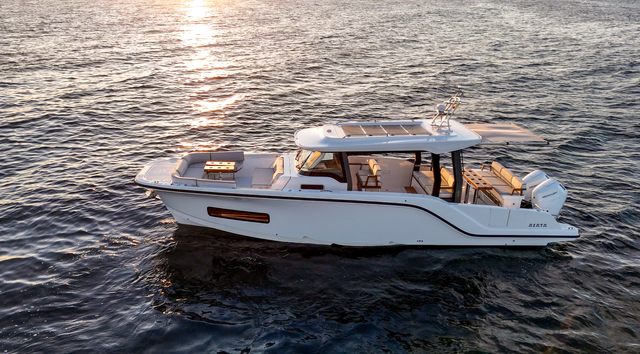
The Forte 47 GT has been designed around one thing above all else, and that's spending time outside. Yes, there are two cabins below and they're perfectly usable, but they're not the reason you'd buy this boat. This is very much one of the new generation of Mediterranean dayboats where the cockpit is the destination. Get to your anchorage, drop the hook and the boat becomes somewhere to spend the rest of the day rather than somewhere to sleep.
One of the more interesting things is the construction because this isn't a GRP boat. The hull and superstructure are aluminium, which is still quite unusual at this size. It keeps the weight down, it's incredibly tough and, because it's painted rather than finished in gelcoat, owners have much more freedom over colour if they want something other than the usual white hull. Interestingly, the only GRP on the boat is the helm console. Forte told us that's simply because it contains so many apertures for screens and switches that it made far more sense to mould that section than fabricate it in aluminium.
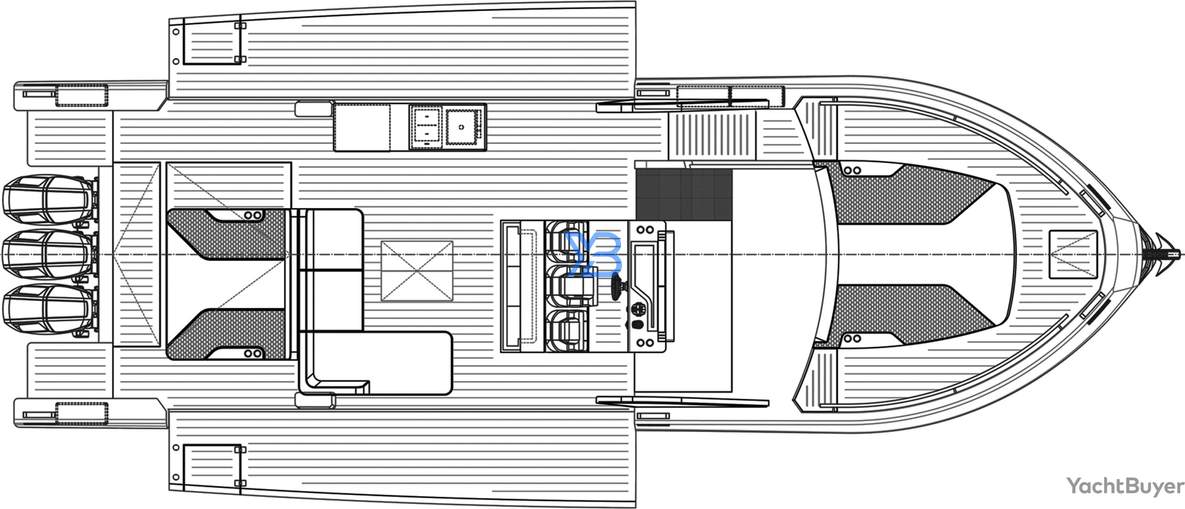
The cockpit tells you exactly what this boat is about. There's no attempt to fill every corner with seating or create half a dozen separate entertaining areas. Instead, Forte has left plenty of open deck and, in practice, that's probably the better solution. It makes moving around very easy and, when you've got a group aboard, people naturally find their own space rather than everyone ending up squeezed around the same table.
The terraces make the biggest difference. They're fitted to both sides and, once lowered, they increase the beam to around 6.5m (21ft), giving you roughly 40m² (430ft²) of usable deck. Those figures are impressive enough, but it's the feeling they create that's important. Suddenly the cockpit isn't just the middle of the boat anymore. It stretches right out to the water and the whole atmosphere changes. Some people end up sitting on the terraces with their feet over the side, others migrate to the bow sunpad, someone is making lunch in the galley, and it never feels crowded. That's actually quite difficult to achieve on a 47-footer, but Forte has managed it rather well.
The furniture has been kept deliberately simple. There's a dinette aft with a table that folds out when you've got more people aboard, while the galley stays outside where it belongs on a boat like this. Refrigeration, an ice maker, sink and hob all disappear beneath flush lids, so when you're not using them the worktop remains completely clear. It's a small detail, but it helps keep the cockpit looking uncluttered. There's even a television that rises from the aft unit, although I suspect most owners will spend more time looking out than looking at it.
The helm has twin Garmin displays ahead of the wheel, backed up by joystick control, a quick chain counter, gyro controls and bow thruster controls, all positioned where you'd expect to find them rather than hidden away for the sake of clean styling. The three helm seats are properly supportive and there's an opening section in the windscreen that feeds a welcome stream of air towards the helm on hotter days. Buyers wanting more protection can also specify an enclosed wheelhouse, which changes the character of the boat quite a bit and makes it a much more practical proposition outside the height of summer.
Another thing Forte has got right is the way you move around the boat. The side decks sit down within the hull, so you feel secure as you walk forward rather than perched on top of the gunwale. It sounds like a small point, but it's noticeable. There's also a door between the cockpit and foredeck that can be closed while you're running, helping keep the helm sheltered without affecting access once you've stopped.
The foredeck itself is given over almost entirely to one enormous sunpad. It's easy to reach and it feels connected to the rest of the cockpit.
Interior Accommodation
Boats like this live or die by their deck layout, so it's hardly surprising that the accommodation below is relatively pared back. After all, every extra inch of headroom or cabin volume has to come from somewhere, and on the Forte 47 GT that space has been left where it matters most - in the cockpit above.
That doesn't mean the interior is overly compromised, though. Quite the opposite. It's been designed to do exactly what a boat like this needs it to do, giving owners and guests somewhere comfortable to spend a weekend without pretending to be a miniature flybridge yacht.
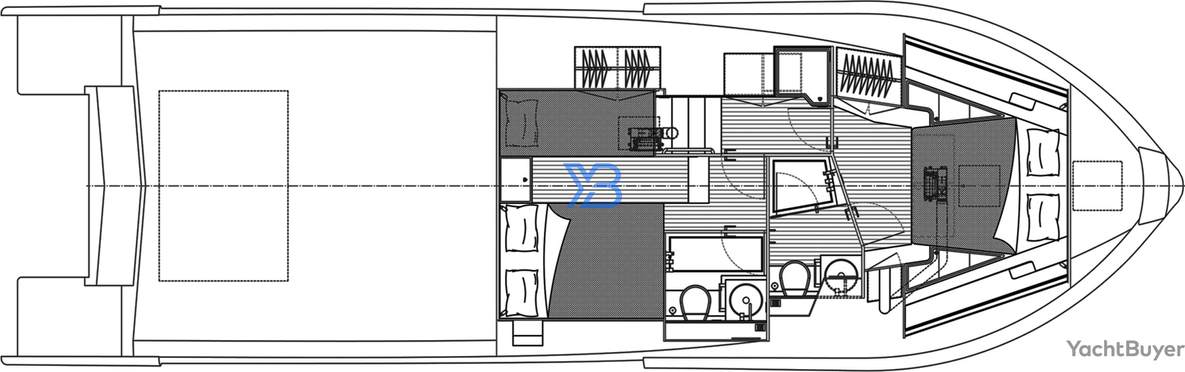
Sportsboats with low, purposeful profiles often ask you to stoop as soon as you step below, but that's not really the case for the headroom onboard the Forte 47. Through the companionway, around the saloon and into the owner's cabin there's close to two metres of standing headroom, so moving around feels surprisingly natural. That's helped by the volume beneath the foredeck, where the large sunpad above creates a generous amount of space without making the boat look heavy from outside.
The owner's cabin occupies the bow and makes sensible use of that volume. The island double berth is easy to get into from either side, there's useful storage worked into the surrounding cabinetry and enough floor space to get dressed without climbing over the bed. It isn't an owner's suite in the way you might expect from a flybridge yacht of a similar length, but it doesn't need to be. You're unlikely to spend hours down here, and as somewhere to retreat after a day on the water, it feels comfortable, airy and well proportioned.
For the ensuite, Forte has managed to fit a separate shower cubicle rather than relying on a wet room, and that's always worth having. It's one of those things you tend to appreciate more on the second or third morning aboard than the first because it makes everyday life that bit easier.
The guest cabin sits beneath the cockpit and, inevitably, that's where the compromises are. Rather than trying to disguise them, Forte has made sensible use of the space available. The berth arrangement combines a double with a separate single, so the cabin works just as well for another couple as it does for parents travelling with a young child. It's a practical layout and rather more flexible than the transverse doubles you'll often find on boats of this size. The guest ensuite is more compact and uses a wet-room arrangement rather than a separate shower, which feels entirely appropriate given the available space.
Headroom is naturally lower back here because you're underneath the cockpit sole, but that's simply the trade-off that comes with this type of boat. Raise the roof to create a taller cabin and you'd lose some of the outdoor space that defines the Forte in the first place. Instead, the standing room has been concentrated where it matters most, around the entrance and beside the berth, while the lower sections fall over the bed itself where they're far less noticeable in day-to-day use. It's a sensible compromise and one that most owners would probably make given the choice.
Performance & Engine Room
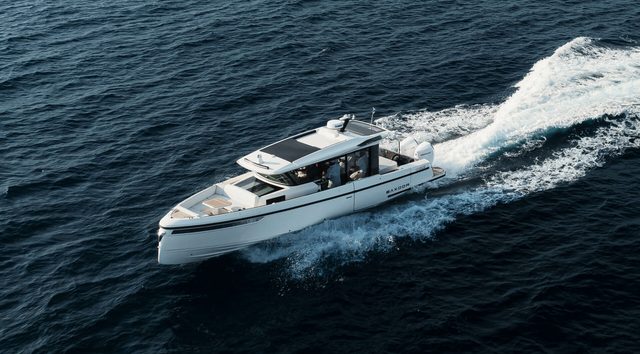
The boat toured was powered by triple Mercury 600hp V12 outboards, giving a total of 1,800hp and a quoted top speed of around 47 knots. That's plenty for a boat of this size and suits its intended role rather well. This isn't a boat designed to plod from harbour to harbour. It's built to cover a fair bit of water, anchor somewhere nice for the afternoon and then head home again without feeling you've spent the whole day travelling.
The Mercury V12s are interesting engines too. Unlike a conventional outboard, the powerhead stays fixed and only the lower gearcase turns when you steer. It means the engines can be mounted much closer together across the transom because they don't need such wide gaps between them to swing from side to side. Mercury also fits a two-speed automatic gearbox, something that's still unusual on an outboard, helping a boat of this size get onto the plane cleanly before changing into a higher ratio as the speed builds.
Having the engines mounted outside the hull brings a couple of practical benefits as well. It leaves the space beneath the cockpit free for equipment such as the Seakeeper gyro rather than filling it with engines, and servicing is about as straightforward as it gets. Outboards have become increasingly popular on larger dayboats over the last few years for exactly these reasons.
If outboards aren't your thing, Forte also offers the boat with Volvo Penta IPS. That gives you a completely different look across the stern because the engines disappear beneath the cockpit, leaving a much larger bathing platform and easier access to the water. Joystick docking comes as part of the package and, for owners spending as much time swimming and using the platform as they do running the boat, it will probably make a lot of sense.
Ownership Considerations
The Forte 47 GT comes from a relatively young builder, and that's something worth factoring into the buying decision. Established brands have spent decades building dealer networks, after-sales support and a sizeable fleet of boats on the water, so it's generally easier to find owner feedback and long-term ownership experience. Forte is still building that reputation. That's no reason to dismiss it, but before committing it's worth understanding who'll be looking after the boat once it's leaves the factory, what the dealer support looks like in your part of the world and how straightforward it is to source parts and technical assistance should you ever need them.
The aluminium hull is another area that deserves a little thought if you've only ever owned GRP boats. It's one of the reasons the Forte can combine a relatively modest displacement with this level of performance, and aluminium has a well-earned reputation for strength and durability. Unlike GRP, there's no risk of osmosis, but the maintenance priorities are slightly different. Sacrificial anodes become particularly important, any damage to the paint system wants dealing with promptly and it's worth keeping an eye on areas where salt and moisture can become trapped. None of that is difficult or unusual for an aluminium boat, but it is a different ownership routine and one that's worth understanding from the outset.
The CE Category B certification also tells you quite a lot about the sort of boat this is. Under the Recreational Craft Directive, Category B covers offshore operation in conditions of up to Force 8 winds and significant wave heights of 4 metres. That isn't an invitation to head out looking for heavy weather, but it does mean the hull, stability and structure have been engineered with open-water passages in mind. If your cruising regularly involves crossing between islands or making longer coastal passages, that's a reassuring thing to have. Good seamanship and careful weather planning still matter every bit as much as the certification itself.
Uncover details about the Forte 47 Grand Turismo or delve into the entire collection by exploring all Forte Yachts for sale. For more options, see all yachts for sale.
Pricing
Price as reviewed: €1,900,000
New Price from: Approximately €1.9 million. For the latest brokerage listings, eventual historical values and asking price trends, visit our Forte 47 GT Prices mointored by YachtBuyer MarketWatch.
Rivals to Consider
The Pardo GT52 is probably the closest rival in terms of size and intent, although it approaches the brief rather differently. At 16.58m (54.4ft), it's around two metres longer than the Forte and pairs a conventional GRP planing hull with twin Volvo Penta IPS drives rather than offering the choice of IPS or triple outboards. The extra length translates into a little more volume below decks, with a forward owner's cabin, twin guest cabin and accommodation for four, while the main deck centres around an enclosed wheelhouse with the galley positioned aft to keep whoever's preparing lunch connected to the cockpit. Performance tops out at around 32 knots, with a cruising range of approximately 300 nautical miles at 25 knots, so it places slightly more emphasis on comfortable cruising than outright pace. Buyers looking for a proven package from one of Italy's most established names will find plenty to like, while the Forte counters with its aluminium construction, lighter displacement and a more distinctive approach to propulsion.
The Fjord 53 XL shares much of the Forte's outdoor lifestyle philosophy, but interprets it in a slightly different way. Measuring 16.7m (54.8ft) overall with a 4.79m (15.7ft) beam, it makes full use of its footprint with an expansive open cockpit, central helm position and a substantial outdoor galley and bar that naturally becomes the social hub of the boat. Accommodation is more generous too, with three cabins sleeping up to five guests, making it the better option if overnighting is likely to feature more regularly in your plans. Like the Pardo, the hull is GRP and designed to plane efficiently, although Fjord's focus has always been less about chasing headline speeds and more about creating an exceptionally usable deck layout. If entertaining large groups is your priority, the Fjord remains one of the benchmarks in this sector. The Forte, on the other hand, feels a little more sporting, particularly when specified with the triple Mercury V12 installation, and its aluminium hull gives it a character all of its own.
The Wallywhy100 sits in a rather different category altogether, stretching to 21.46m (70.4ft) with a semi-displacement hull, twin Volvo Penta IPS installations producing up to 2,000hp and a cruising range of around 420 nautical miles. It's designed less as a high-performance dayboat and more as a compact lifestyle yacht, with three guest cabins, separate crew accommodation and enough interior volume to support extended cruising as comfortably as a day at anchor. Formal dining, a full-beam owner's suite and a hydraulic bathing platform all reinforce that superyacht-inspired feel, while the semi-displacement hull favours efficient cruising over outright speed, topping out at around 27 knots. It's a considerably larger and more expensive proposition than the Forte, but buyers drawn to contemporary styling and a seamless connection between indoor and outdoor living are likely to find themselves looking at both. The Forte delivers much of that same modern Mediterranean appeal in a package that's easier to berth, easier to manage and, for many owners, rather better suited to spontaneous days on the water.
Considering a new yacht? Explore Forte 's entire current range to find the model that best suits your needs, and compare it with alternatives from competitors to ensure you make the perfect choice.
Specifications
- Builder Forte Yachts
- Model Forte 47 Grand Turismo
- Length Overall 14.35m
- Beam 4.5m
- Draft(full load) 0.85m
- Hull Aluminium
- Cabins 2
- Berths 3
- Yacht Type (Primary) Centre Console
- Use Type (Primary) Weekending
- Max Speed 47 knots
- Fuel Capacity 2,000 Litres
- Fresh Water Capacity 335 Litres
- Engine Model 3x Mercury Verado V12 7.6L 600hp
- Engine HP 6400
Forte 47 Grand Turismo Layout
-
Main Deck
-
Lower Deck
Interested in a Forte 47 Grand Turismo?
NEW Build
Find your local dealer for a personalised, no-cost consultation
or just request
Brochures & Pricing
Used & In Stock
Looking for a ready-to-go Forte 47 Grand Turismo or pre-owned options? Explore all inventory of the Forte 47 Grand Turismo available worldwide