| Length | GT | Built (REFIT) |
|---|---|---|
|
223' 1"
|
1,376 GT | 1991 (2000) |
| Beam | ||
| 42' 8" |
Delivered in 1991, Destriero is a 68m motor yacht built by Italian shipyard Fincantieri. Donald Blount is responsible for her naval architecture.
Key Features
- 53.09-knot Atlantic average
- Three LM1600 turbines
- 66-knot top speed
- 3,106nm record crossing
Design & Construction
Designed around an aluminium hull and superstructure she features a 13m beam. The yacht has an internal volume of 1,376 GT (Gross Tonnes).
Exterior Design
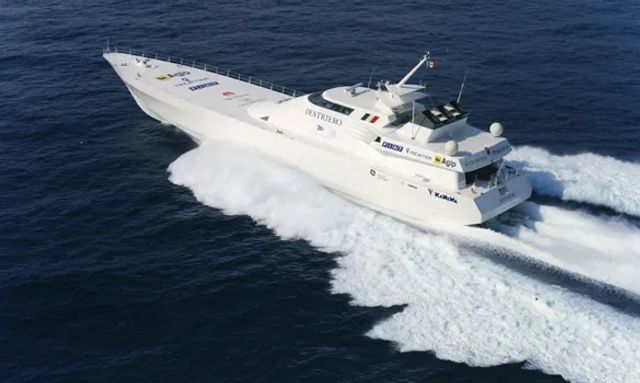
Destriero was drawn around one job: crossing the Atlantic as quickly as possible. Donald L. Blount and Associates developed the hull, while Pininfarina shaped the exterior and studied its aerodynamics in the wind tunnel. There was very little yacht convention left once those priorities had been worked through.
Almost all of the superstructure sat aft, leaving an extraordinary length of clean foredeck ahead of the bridge. The bow was long and fine, while the deckhouse remained compact and relatively low so there was less structure pushing through the air at speed. Photographs of Destriero under way showed how well that thinking worked, with the hull running high and throwing spray well aft rather than burying the foredeck.
Pininfarina did enough to give the yacht a recognisable profile, but engineering called the shots. The bridge glazing was concentrated into a small area, the exhausts and machinery openings were plainly visible, and there was virtually no outdoor guest furniture to speak of. Nothing was there for the sake of it.
The stern was just as functional. Propulsion, exhaust routing and waterjet installation dictated the shape, while the upper deck remained clear and simple. Destriero looked unlike almost every other large yacht of her period because she had been conceived much more like a record machine than a floating residence.
Performance & Capabilities
Three General Electric LM1600 gas turbines produced a combined 51,675hp and drove three KaMeWa waterjets.
The LM1600 itself came from aviation rather than conventional marine engineering. GE developed it from the F404 fighter engine used in the F/A-18 Hornet, carrying over the emphasis on low weight, compact construction and very high power density.
In standard marine form, each LM1600 was rated at around 20,000hp, with a complete turbine weighing only a few tonnes. That gives some idea of why it suited Destriero so well: enormous power without the mass of a comparable diesel installation.
The three waterjets were equally important. They allowed the yacht to absorb that turbine output without large propellers hanging beneath the hull and avoided the drag and cavitation problems that would have come with a more conventional shaft arrangement at these speeds.
Fuel was the price of admission. Destriero reportedly carried around 800 tonnes for the record attempt, and a large part of the hull was effectively built around storing it and feeding the machinery. Comfort came much further down the list.
The turbines also responded very quickly. GE's own LM1600 data recorded the ability to start and reach full power in under two minutes, which suited a vessel expected to accelerate hard and run near maximum output for long periods.
Atlantic Record
Destriero's defining run came in August 1992.
She left Ambrose Light off New York and covered 3,106 nautical miles to Bishop Rock in the Isles of Scilly in 58 hours, 34 minutes and 50 seconds, without refuelling.
Average speed was 53.09 knots.
That was the number that really mattered. A 66-knot top speed was astonishing enough, but maintaining more than 53 knots across an entire ocean was a different kettle of fish altogether.
During the crossing, Destriero covered 1,402 nautical miles in one 24-hour period at an average of 58.4 knots. She was therefore spending long stretches remarkably close to her outright performance ceiling rather than simply cruising quickly and saving a final burst for the record books.
Sixteen people made up the record crew, but there were only six bunks aboard. They slept in shifts, which tells you almost everything you need to know about the hierarchy on board.
Destriero received the Virgin Atlantic Challenge Trophy and the Columbus Atlantic Trophy. The Hales Trophy was not awarded because it was reserved for commercial passenger vessels, despite Destriero having made the faster passage.
Special Features
Whilst DESTRIERO succeeded in breaking the trans-Atlantic crossing record on August 09, 1992 with a 53,09 knots average speed, in 58 hours 34 minutes and 5 seconds. her right to the Blue Riband Hales Trophy was denied as she is classed as a private yacht and not as a commercial passenger ship. After a 2000 refit she was abandoned at a yard in Plymouth before being moved to Lürssen in Lemwerder in 2009. Today the yacht is in a very bad condition. According to Lürssen, Destriero's future is uncertain.
Destriero Yacht is not For Sale
Motor yacht Destriero is not currently for sale. Explore all new & used yachts for sale globally powered by YachtBuyer’s Market Watch.
If you're the yacht owner, broker, or captain, please use the "Update Sales Info" link to report any changes to the sales information. Update Sales Info