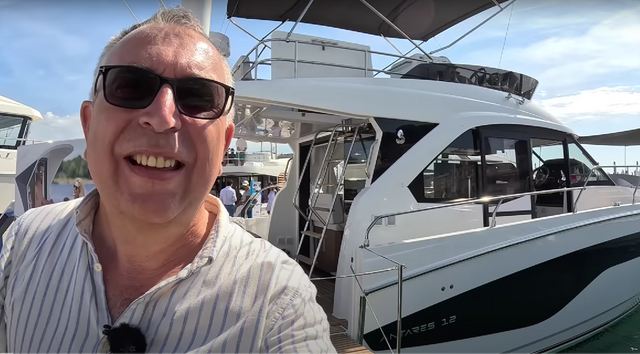
The 1290 Evolution takes the Rodman 1250 formula and makes it easier to live with, with a main-deck galley, better lower accommodation and the same big cockpit and walkaround decks. It is still a practical cruiser-fisher at heart, but one with broader appeal than that label suggests.
Rodman 1290 Evolution
- LOA 39' 1"
- Model Year 2026
- Cabins 2
- Max Speed 36 knots
- Status In Production
- Yacht Type Sportfisher
- Use Type Weekending
Video Tour
Rodman 1290 Evolution At A Glance
Why you'll love it
- Wide walkaround decks
- Big cockpit works for fishing or cruising
- IPS or shaft-drive engines
Things to know
- Two-cabin layout sleeps four
- High-spec boats cost well above base price
On Deck
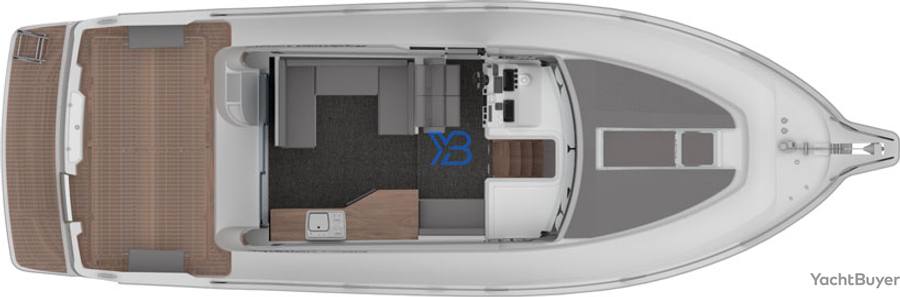
The aft cockpit tells you what sort of boat the Rodman 1290 Evolution is. It is a big, open space with rod holders around the edges, removable fish boxes and fold-away seats across the stern. Leave the seats out and there is somewhere comfortable to sit. Fold them away and you have a clear deck to fish from. There is a bathing platform behind it and a deck shower close by, so it works just as well when the rods stay at home.
There is quite a bit of thought beneath the surface too. The boxes either side of the engine hatch lift out, which gives access down the sides of the IPS engines. This particular boat has a larger storage box on one side, while the standard arrangement uses removable boxes on each side. A washdown point sits in a locker nearby and the cleats are big, sturdy things. It all feels suitably workmanlike.
A docking station at the stern is another useful touch, especially on a boat of this size that is likely to be run by its owner. The lower helm has a side door too, so the skipper can step straight out onto the deck rather than walk back through the saloon and cockpit. For lines and fenders, that is exactly where you want it.
The walkaround decks are excellent. They are wide, the bulwarks come well up around you and there is a chunky 38mm rail on top. It means you can just walk from the cockpit to the bow without that slightly awkward shuffle along a narrow side deck. You stay down inside the boat rather than perched on the edge of it, which is reassuring when the weather gets a bit lively.
Up at the bow there is a sunpad, with extra cushions that fill the centre when needed. The anchor winch and its controls are right forward and those substantial rails carry on around the bowsprit. It is a simple foredeck rather than another full seating area, but access to it is very good.
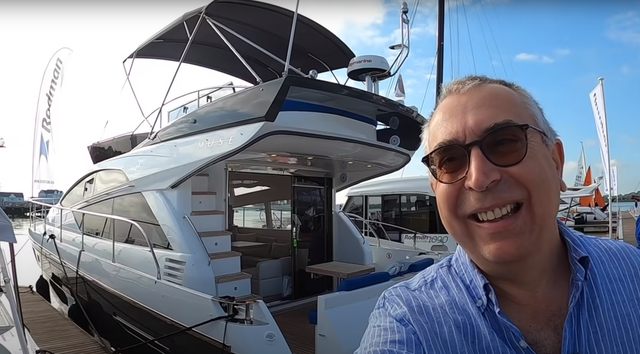
The flybridge is quite different from the lounge-led layouts found on many boats this size. Rodman has put the helm right aft, close to the cockpit below, so the skipper can keep in touch with whoever is fishing or working back there. There is a dinette farther forward and this boat has the optional hardtop, which adds useful shelter without closing the upper deck in. The liferaft is mounted up here too.
The upper helm has much the same kit as the main station, with twin Raymarine screens, Volvo engine instruments, autopilot, VHF, Zipwake controls, IPS joystick and the main throttles. The view out is good and, once again, the position makes sense for the way the boat is meant to work rather than simply because it looks neat on a plan.
There is also a small service area beneath the flybridge access with a sink, drawers and a draining box that could serve as an icebox or general storage. Nothing especially glamorous, but useful. That sums up much of the exterior rather well. Rodman has concentrated on space you can actually get at and use.
Interior Accommodation
The biggest change inside the Rodman 1290 Evolution is the galley. On the old 1250 it sat downstairs, tucked into the aft part of the lower deck. Rodman has moved it up into the saloon, which sounds simple enough, but it has made quite a difference to the accommodation below.
The galley now sits just inside the aft doors, opposite the dinette, with a two-burner electric hob, combination oven and microwave, plenty of drawers and cupboard space and a full-size fridge. There is another refrigerated compartment alongside that can work as either a fridge or freezer, while the television rises from the cabinetry behind. It is all fairly straightforward kit, but the position makes much more sense for day-to-day use than having the galley downstairs.
The saloon itself has changed too. The single sliding door of the 1250 has gone, replaced by a three-piece arrangement with two sliding panels that tuck behind a fixed section. The side windows are deeper and there are large opening sections, while the one-piece windscreen gives the lower helm a very good view ahead. Opposite the galley is a dinette with a folding table, so the main deck now has the cooking, eating and seating areas together.
Twin helm seats have fold-down armrests and a side door straight onto the deck. The dash carries twin multifunction displays, Volvo engine instruments, IPS joystick, Zipwake controls, autopilot and the main engine controls, with the Fusion stereo and heating controls tucked below. This boat also has a Seakeeper control fitted. Between the big windscreen, deeper side glass and opening windows, the lower helm is a useful place to drive from rather than somewhere to retreat to only when the weather turns foul.
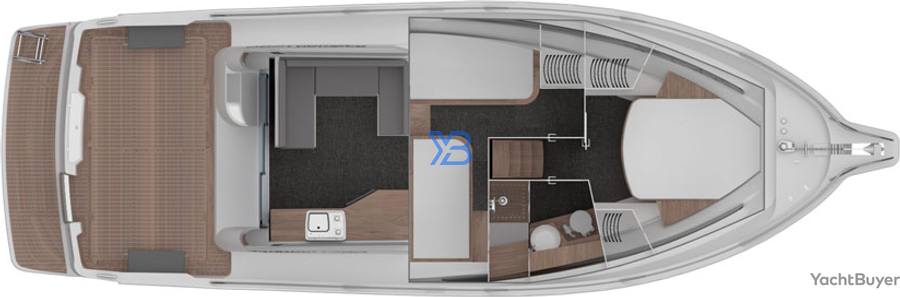
Downstairs, the gain from moving the galley becomes much clearer. On the 1250, the galley occupied the space aft on the lower deck, which meant a smaller heads farther forward and two fairly narrow single beds in the second cabin. The 1290 uses that space rather better.
Owner's Cabin
The owner's cabin is forward with a low centreline bed, drawers beneath and more storage under the mattress farther into the bow. Hull windows are another change from the 1250 and there is more glass above, along with a large overhead skylight and an opening section at the front. A blind covers the skylight when needed, and hanging lockers sit to either side. The extra glass makes a noticeable difference down here.
The heads has grown considerably now that the galley is out of the way. There is room for a proper separate shower with a rainfall head, plus the usual sink, toilet and mirror. On a 12.9m boat, having a shower compartment that does not ask everything else in the room to get wet is a worthwhile gain.
Guest Accommodation
The second cabin benefits just as much. Instead of the two narrow singles found on the 1250, there is now a much wider main berth with another bed that runs across underneath. Large hull windows on each side bring in plenty of daylight and there is a hanging rail for clothes. It is probably the clearest example of what the new layout has achieved, because the space once taken up by the galley is now doing something far more useful for anyone staying aboard.
Performance & Engine Room
Rodman gives buyers a choice between Volvo Penta IPS and conventional shafts on the 1290 Evolution, with the different setups covered in more detail in YachtBuyer's Rodman 1290 Evolution engine options comparison. The choice changes more than the way the boat drives. With IPS, as fitted to this boat, the engines sit beneath the aft cockpit, while the shaft-drive installation puts them farther forward beneath the saloon floor.
This boat has a pair of Volvo Penta D6 IPS650 diesels, each with 480hp. The whole aft section of cockpit lifts on a powered ram to expose them, and access through the middle is very good. The storage or fish boxes on either side can also be removed, so it is possible to get down the outside of each engine rather than having to work at everything from the centre. It is a decent engine space for a boat of this size.
The IPS installation also leaves a big storage area farther forward in the hull, in the space used by the engines on a shaft-drive boat. Go for shafts and the arrangement swaps around, with the engines beneath the saloon and the aft compartment used as the main lazarette. It gives buyers a genuine choice between two quite different machinery and storage layouts rather than simply a choice of drive system.
With the twin IPS650s, the 1290 Evolution will reach about 34 knots, which is pretty good going for a chunky 12.9m flybridge cruiser. A more natural cruise is around 22 knots, where range is just under 300 nautical miles. That is fairly typical for this sort of boat at that sort of pace, and dropping the speed back will stretch the range farther.
IPS also suits the way the Rodman is likely to be used. There is joystick control at the main helm and on the flybridge, plus the separate docking station aft, so the skipper has plenty of help around a marina. This particular boat also has a Seakeeper fitted, though the exact model was not confirmed during the tour.
Ownership Considerations
The Rodman 1290 Evolution makes sense as a fishing boat, but it doesn't depend on that role. The open cockpit and walkaround deck plan also suit an owner who simply wants a tough, easy-to-use cruiser with plenty of room outside. In fact, that is exactly why some buyers choose these boats without much interest in fishing at all.
There is quite a bit of choice when it comes to specification. IPS or conventional shafts is the big one, and each gives the boat a different machinery and storage layout. The boat toured sits towards the other end of the options list too, with extras such as the flybridge hardtop and a Seakeeper. Used examples are therefore worth looking at individually because two 1290 Evolutions need not be equipped in quite the same way.
For owners who spend proper time aboard, the Evolution changes over the old 1250 are probably more important than the extra kit. Moving the galley upstairs has left room below for a larger heads and a far better second cabin, while the new hull windows and extra glass make the accommodation nicer to spend time in. They are sensible changes to a boat that was already built around people who want to run it themselves.
To find out more about the Rodman 1290 Evolution, or indeed the rest of the fleet, take a look at all Rodman Yachts for sale. You might also want to browse all yachts for sale to uncover more options.
Pricing
Price as reviewed: £715,000 ($952,889 approx)
The Rodman 1290 Evolution has been advertised from around £347,000, but that figure represents a basic entry-level specification rather than the sort of boat seen here. Engine choice, electronics, stabilisation and other options can push the final cost much higher.
The 2024 Rodman 1290 Evolution toured for this review was for sale at £715,000. It has the larger 480hp Volvo Penta D6 IPS650 engines, a Seakeeper and the optional flybridge hardtop, so the price gives a better idea of what a highly specified example can cost.
For the latest asking prices, see Rodman 1290 Evolution Prices, moinitored by YachtBuyer MarketWatch.
Looking to own a Rodman 1290 Evolution? Use YachtBuyer’s Market Watch to compare all new and used Rodman 1290 Evolution Boats for sale worldwide. You can also order a new Rodman 1290 Evolution, customized to your exact specifications, with options for engine choice and layout configuration. Alternatively, explore our global listings of new and used boats for sale and find your perfect boat today!
Rivals to Consider
The Nord Star 42 takes much the same all-weather idea in a slightly different direction. At 13.4m (44ft), it is longer than the Rodman but narrower at 3.85m (12ft 8in), with a more enclosed pilothouse feel and two double cabins, each with its own en suite. That gives five guests better privacy than the Rodman's shared heads arrangement, and it makes a strong case for buyers who put overnight accommodation ahead of the 1290 Evolution's fishing space. Fuel capacity is smaller at 990 litres, though, and the 42 is now out of production, so this is primarily a used-boat alternative rather than a like-for-like new purchase. It is less sportfisher and more tough all-weather cruiser.
The Beneteau Antares 12 Fly is the obvious choice if beds and family space sit higher up the list. At 12.97m (42ft 7in), it has three cabins and can sleep seven, against two cabins and four guests on the Rodman. The 3.78m (12ft 5in) beam is considerably narrower and draft increases to 1.1m (3ft 7in), while propulsion comes from twin 400hp Mercury Verado outboards as standard rather than Volvo Penta IPS. Its flybridge is much more leisure-led too, with U-shaped seating and a wet bar. In other words, the Antares uses roughly the same length to squeeze in more accommodation and social space, while the Rodman devotes more of its footprint to beam, cockpit area and the cruiser-fisher brief. Prices for the Beneteau start at €415,000.
The Rodman Spirit 42 Coupe is perhaps the most interesting alternative because it comes from the same yard and costs much the same. At 12.35m (40ft 6in) with a 4.24m (13ft 11in) beam, it is close to the 1290 Evolution in size, and its twin-cabin layout also sleeps four. The difference is what Rodman does with that space. The Spirit has a lower-deck galley, an en-suite owner's cabin, a sunroof and a more conventional coupe layout, with twin 300hp Volvo Penta IPS400s as standard or IPS500s as an option. Its 0.71m (2ft 4in) draft is the shallowest here. For a buyer who likes the Rodman approach but has little use for the 1290's open fishing cockpit and flybridge set-up, the Spirit 42 Coupe is the more obvious cruising choice. Prices start at £355,000.
Considering a new boat? Explore Rodman's entire current range to find the model that best suits your needs, and compare it with alternatives from competitors to ensure you make the perfect choice.
Specifications
- Builder Rodman
- Range Evolution
- Model 1290 Evolution
- Length Overall 39' 1"
- Beam 14' 2"
- Draft 2' 8"
- Hull GRP
- Cabins 2
- Berths 3
- Yacht Type (Primary) Sportfisher
- Use Type (Primary) Weekending
- Cruising Speed
- Max Speed
- Fuel Capacity 322 Gallons
- Fresh Water Capacity 106 Gallons
- Engine Model 2x Volvo Penta D6-IPS500
- Engine max range (speed type) 282 (nm)
Interested in a 1290 Evolution?
NEW Build
Find your local dealer for a personalised, no-cost consultation
or just request
Brochures & Pricing
Used & In Stock
Looking for a ready-to-go 1290 Evolution or pre-owned options? Explore all inventory of the 1290 Evolution available worldwide